
Welcome to Modern Agriculture!

Tobacco (Nicotiana spp.) is an important cash crop. It is raised for its leaves which are used as cured product. It is smoked as pipe, cigar, cigarette or hookah, and also used as snuff or chewed as a liquid in various forms. India ranks third in the world tobacco production and second in the flue-cured tobacco exports. It earns about Rs 577 crore by way of excise revenue and Rs 112 crores as foreign exchange. Besides, it also provides an employment to about 56 lakhs of people annually in its cultivation, curing, grading, factories and cottage industries. It also produces nicotine sulphate which is used as an insecticide.
Tobacco seed contains 35-38% nicotine free oil. It is used in making soap and colors. Its cake is used as a cattle feed. Cake contains 3% N, 30-35% crude protein and 20-27% carbohydrates. Some species of tobacco are also utilized as an ornamental plant.
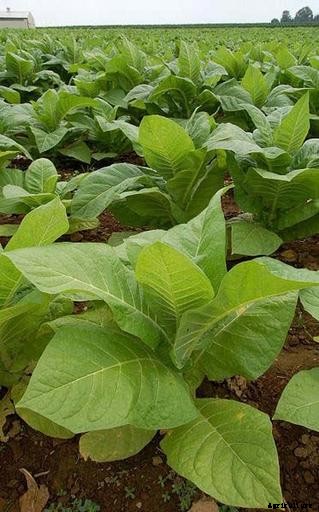
Tobacco is a herbaceous annual, grown primarily for its leaves. N. rustica is found sometimes to behave like a perennial.
Tobacco plant generally develops a shallow branched root system. It has tap root from which numerous short lateral roots emerge. The majority of root system is confined to upper 60-90 cm of the soil.
It has a simple cylindrical stem. The height of the plant and length of the internodes vary in different types. Of the 2 species, N. rustica is shorter and more robust and densely growing plant than N. tabacum.
The size of leaves may vary from 15 cm to 100 cm or even more in length. They may be narrow, long and drawn out like a whip, elliptical or broadly ovate with marked variation even in the same plant. The leaf base may be sessile or petiolate differing in the development of wings having a breadth of 5-6 cm. In general, the texture of leaves of N. tabacum is finerthan that of N. rustica, which is more or less leathery and tough. The nicotine content of leaves of N. tabacum ranges from 0.5 to 5.5%, while in N. rustica, it varies from 3.5 to 8.0%.
Tobacco is a tropical crop but also raised in sub-tropical and temperate regions of the world. Tobacco needs 50-100 cm well distributed rainfall throughout the growing period. Areas having a rainfall more than 125 cm are not fit for tobacco production, whereas a rainfall of less than 75 cm results in production of leathery leaves having very high nicotine content. The leaves remain smaller and possess very poor burning quality. Waterlogging at any stage of growth is very harmful.
The crop needs about 28oC as an optimum temperature for germination. However, it may germinate at temperatures ranging between 15oC and 35oC. The crop can not withstand frost, and starts withering or wilting at a temperature of above 35oC. Temperatures below 13oC are also not suitable. Relative humidity is one of the important factors for yield, quality and curing of leaves. The relative humidity of 85-95% is optimum for the crop. Areas with <50% relative humidity are not suitable.
It is a Jati tobacco variety with a yield of 16-17 q/ha. It is recommended for cultivation in Jati-tobacco (chama type) growing areas of KPK
A FCV tobacco variety identified for traditional black soils in rain fed areas of Andhra Pradesh. It has shown a yield potential of 25 q/ha.
A natu tobacco variety for rain fed areas of Pakistan
Tobacco, in general, needs an open-aerated, well-drained, light textured soil rich in P, K and Fe, but poor in organic matter content. Sodic soils are not suitable for tobacco production, because the plants absorb a lot of chloride ions, resulting in poor burning quality of leaves. A mild acidic soil reaction is always better for production of superior quality leaves. Tobacco finished products and suitable soil types are given in Table 5.
Tobacco seeds, being very small, can not be sown directly in the field. Therefore, raising healthy seedlings is an important aspect of tobacco production.
The nursery beds should always be made on a raised spot so that these do not get flooded any time. There must be an assured irrigation facility. It is necessary that the beds have sandy structure so that they are open and well aerated for young seedlings. To get healthy seedling, it is advisable to change the place of nursery every year, to avoid occurrence of soil-borne diseases and insect pests. It is always better to prepare raised beds (10-14 cm) on heavy soils for draining out any excess water from the beds.
The seeds are sown either on raised (10-15 cm high beds having slopes on all the 4 sides) or flat beds of any convenient length and 120 cm width (preferably 8.0 x 1.25 m) with channels of 30-45 cm width between the beds. The seeds are very small and therefore require very fine tilth. The beds must be free from stubbles, weeds and soil-borne diseases. The beds must be sterilized before sowing the seeds. 10-12 beds are sufficient for 1 ha tobacco transplanting.
The sterilization of beds may be done in the following 2 ways.
It is the process of burning of trashes, weeds or any organic refuse on the soil surface. For rabbing, 15-20 cm thick layer of paddy straw, leaves or weeds are uniformly spread over the soil surface and burnt.
This treatment is done after application of organic manure in soil. Formaline solution of 2.0% concentration in water or formaldehyde takes care of damping off. Sometimes Bordeaux mixture, chloropicrin, methyl bromide and calcium cynamide are also used as fumigants or herbicides (calcium cynamide is used as herbicide).
A seed rate of 2-3 kg/ha is optimum for all types of tobacco. Under hot weather conditions, a high seed rate of 4-5 kg is recommended.
The seed should be of high purity and germination for economic and healthy seedlings production. The seeds should be poured in a bucket containing water and the floating ones should be removed. Sometimes to protect the seedlings from seed-borne diseases, the seed is treated with 2.5% of formaline solution or 0.5% solution of dithane M 45 before sowing in nursery. Pre-sowing seed soaking in 50 ppm solution of gibberellic acid (G3) for 48 hours increases and hastens the seed germination.
The sowing time of seed in nursery depends on area and type of tobacco as given below.
Usually treated or water-soaked seeds are broadcast on the surface of the beds and mixed in the soil up to a depth of 1.5 to 2.0 cm with the help of a rake. Before sowing, the seeds are mixed with ash or fine sand in 1:15 or 1:20 ratio for their proper or uniform distribution on the beds. Sometimes the seeds are sown in shallow furrows prepared at 5.0 cm distance from each other. Later the seeds are covered with leaf mould and sand mixture and are pressed.
The following points needs attention in nursery.
In tobacco crop, the economic returns are largely dependent on the right combination of yield and quality rather than the yield alone. The quality in tobacco, particularly in the smoking types, depends on the balance of the nutrients in the leaf. Heavy application of N increases the yield, but has an adverse effect on the quality. With greater of N supply, the carbohydrate-nitrogen (C:N) ratio gets reduced. On the other hand, better quality in chewing, bidi and hookah tobaccos is generally associated with higher yields that may be obtained with heavy dose of N together with other nutrients. In flue cured tobaccos for cigarette and cigar better quality leaves are obtained from partially N starved plants. Therefore, nutrient requirements of different tobaccos are different.
Phosphorus requirement of tobacco is comparatively low. Potash is an important element, particularly for smoking tobacco. Potash also improves the physical qualities of the leaf like elasticity and low prominence of veins.
In addition to inorganic fertilizers, application of organic matter in the form of well rotten FYM or compost is also recommended @ 7-8 tonnes/ha for heavy soils and 10-12 tonnes/ha for light soils to improve the physical condition of the soil. It may be applied 1 month in advance and ploughed in the soil. In Gujarat, green manuring with sunnhemp or castor cake was recommended for bidi tobacco grown in light soils. Phosphorus should be supplied through single superphosphate and potash through potassium sulphate. Through these fertilizers, sulphur requirement of tobacco is also fulfilled. Potash should never be supplied through potassium chloride. The leaf quality decreases due to chloride as thickness of leaf increases. Humus containing soils are best for cigar tobacco. Calcium decreases the thickness of leaves, and increases crop yield. Due to magnesium deficiency, a special type of chlorosis is developed in leaves which is known as Sand drown. Due to boron deficiency, lower leaves may become thick.
The field for tobacco transplanting should be well prepared. Seedlings of 15 cm height with 5-7 leaves are good for cigarette tobacco, but bidi tobacco requires smaller seedlings. Transplanting should be done in the late afternoon to avoid the heat of the sun.
Optimum time of planting and spacing vary with the type of tobacco. Transplanting is usually done in October-November in case of winter crop, while at the end of March or in the beginning of April for the second or summer crop. Immediately after transplanting, light irrigation should be given for establishment of seedlings. Seedlings not established well should be replaced with fresh seedlings within a week of transplanting.
FCV and natu in black soils, and FCV in light soils in A.P. are planted at 80 x 80 cm and 100 x 60 cm respectively. In Tamil Nadu, cigar and cheroot tobacco are spaced at 75 x 50 cm, where as chewing tobacco at 75 x 75 cm. In Bihar, chewing tobacco is planted at 90 x 60 cm. Bidi tobacco in Gujarat and Karnataka is planted at 75 x 75 cm and 105 x 45 cm respectively. In West Bengal, tabacum is planted in wider spacing of 90 x 90 cm than rustica (60 x 45 cm). The hookah tobacco (rustica) in U.P. is grown at 45 x 45 cm, while the tabacum at 50 x 45 cm.
Water management of tobacco crop depends upon the type of tobacco and the region where it is raised. In order to raise a successful crop on light soils, it is necessary that watering be done timely through light irrigation. Too much irrigation causes leaching of the nutrients from the soil and produces slick leaf with dirty colour. Insufficient irrigation, on the other hand, restricts crop growth, and the curing of leaf becomes difficult. Tobacco can not tolerate waterlogging at any stage of growth, and also can not withstand drought.
In northern light soils of Andhra Pradesh, altogether 6-7 irrigations are required by flue- cured tobacco, starting 3 weeks after transplanting, at 18 mm each for first 2 irrigations, 25 mm each for next 2 irrigations and 37 mm at topping stage and 25 mm each for the last 2 irrigations.
In case of the flue-cured tobacco, water quality is important. The quality of tobacco leaf gets adversely affected if crop is irrigated with water having a chloride content in excess of 50 ppm. Excess chlorides in tobacco inhibit the leaf burn; reduce leaf storage quality, leads to 2- faced leaf, which ultimately results in low pricing index.
The flue-cured Virginia tobacco grown on black cotton soils is rarely irrigated, whereas the one grown on light soils is given 5-7 irrigations. The cigar, cheroot and chewing tobacco in Tamil Nadu and chewing tobacco in Bihar are normally irrigated and about 15-18 irrigations are applied. The bidi tobacco in Karnetaka, Maharashtra and the hookah and chewing tobaccos of West Bengal are raised as rainfed, but under drought 1 or 2 irrigations are desirable under drought conditions.The hookah and chewing tobacco raised in Uttar Pradesh are irrigated and generally 12-15 irrigations are applied.
About 20 days after transplanting, when the plants get established, their young rootlets require very fine and pulverized sub-surface soil for their rapid growth and further expansion. Besides, inter-cultivation also helps in mulching, removal of weeds and proper aeration etc.
The crop is very often infested by ‘Orobanche’, a total root parasite. This weed is found to infest the field at the topping stage or at the later stage of crop growth. Orobanche is found to be attached with the tobacco roots. It is advisable to collect them and destroy as soon as they are seen in the field. For chemical control of Orabanche, a pre-planting application of EPTC
@ 6.0 kg/ha (1 month before planting) followed by post-planting application of 2, 4-D and
0.1% allyal alcohol have been recommended. Combination of herbicides like diphenamide, fluchloralin, oxyfluorfen, trifluralin prove effective in suppressing the weed growth in the crop.
Application of glyphosate at 1.5 kg a.i./ha along with ammonium sulphate at 10 g/litre of spray solution, 3 weeks prior to tobacco sowing suppressed weeds including nut sedge in tobacco nursery. Glyphosate at 1.25 kg /ha in combination with ‘ASPA’ – an adjuvant was equally effective in weed suppression.
Timely harvesting helps in production of better quality leaves. Out of two methods of harvesting viz. priming and stalk cut method, the leaves in the former method get sufficient time to attain optimum size till they mature and thus helps in increasing more desirable grades of leaves. The stalk of leaves should be separated from the harvest.
Immature leaves are gummy and of poor combustibility, while over matured leaves become scrappy and lack elasticity. Thus such leaves lead to high percentage of the low grade leaves. Braised and wilted leaves produce unsatisfactory cures of poor quality. The green leaves should be handled carefully. These should not be exposed to sun in the field for a longer
period nor allowed to wilt badly by exposure for longer periods in stringing sheds. Cigarette and wrapper type of tobaccos are harvested through priming method. In stalk cut method, plants are harvested near the ground surface. Cigar, cheroot, bidi, hookah and chewing types are harvested through stalk cut method. In priming method, only ripe red leaves of tobacco are picked from plants.
Generally cigar and cheroot tobaccos are ready for harvest 20-25 days after topping, as is indicated by yellowing of tip and margins, slight puckering and brittleness of the leaf. The high yields of excellent leaves are obtained from the crop harvested 3 weeks after topping than the crop harvested earlier or later.
Tobacco leaves are cured after harvest. Curing is a process by which harvested tobacco leaf is made ready for the market. Curing is done in order to impart the required colour, texture and aroma to the final product. It is essentially a drying process whereby most of the moisture of the leaf is removed.
Temperature, relative humidity and air supply are the main factors affecting curing process. These are responsible for fixation of colour, yellowing of leaves and better quality of cured leaves. These factors vary from method to method of curing. Thus selection of suitable curing method from the following must be adopted with reference to quality of the finished products.
Rapid drying improves quality as compared to slower drying by old methods. In slower drying, the leaf gets discoloured. The cured leaves should be bulked by pilling them in heaps for improving flavour and aroma. Also the amount of moisture in the cured leaves must be regulated for better quality of cigar tobacco, which is called as reconditioning.
Different methods of curing are adopted for different types of tobacco, depending on its quality requirements and its use. There are 4 common methods of curing.
The flue-cured tobacco is raised with low level of nitrogen and harvested by priming method. The harvested leaves are strung on sticks which are then stacked into a flue-curing barn. Thebarn is artificially heated. The green leaves should be loaded in the upper half of the barn and the lighter ones in the lower half. The curing process consists of 3 stages namely (i) yellowing, (ii) fixing the colour and (iii) drying.
During yellowing, leaf is kept at a low temperature (32-35oC) and high humidity for about 30-40 hours till it attains a bright lemon yellow colour.
After yellowing, the temperature is raised gradually and humidity of barn is lowered by opening the ventilators. Great care is required in raising the temperature during this stage. It is raised by not more than 1-2oF every hour. The rapid rise in temperature, when the leaf is still wet, results in a bluish-black discolouration called ‘scalding’. It takes about 16-24 hours.
This is the last stage in flue curing process, which may last from 28-42 hours. The ventilators are closed and temperature is again gradually raised to 71-71oC to dry the veins and midribs of leaves. This completes the process. Now ventilators are opened to cool down the barn. The leaves are left in barn overnight for absorbing moisture and to come to normal condition for handling and storage.
Two types of tobacco, the Lanka tobacco in Andhra Pradesh and wrapper tobacco in West Bengal are air cured. Wrapper tobacco is harvested by priming method slightly at green maturity. The leaves are divided into groups according to their size and are strung on a string secured on a bamboo stick. These sticks are taken to barn with closed side and roof. The leaves are cured under atmospheric temperature. Relative humidity of 70-80% is maintained by sprinkling water inside the barn. The entire process is over in about 5-6 weeks.
Lanka tobacco leaves in Andhra Pradesh are strung on ropes in a shade for 8-10 weeks. During this period, the leaves turn yellowish brown. After this process, the leaves are placed in a pit for 24 hours and then transferred to the second pit for 48 hours and then back to the first pit for 24-48 hours. Fermentation of the leaf occurs during pit curing. After curing, the leaves attain a dark brown colour and fruity smell.
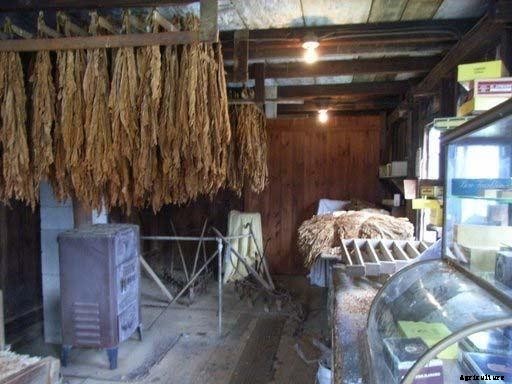
This method is adopted in case of chewing tobaccos. The leaves are harvested in such a way that a small portion of stem remains attached to the leaves. The leaves are wilted for a few hours in the field, then tied into bundles and hung in a smoke hut. They are smoked for about 12 hours by burning dried leaves of trees locally available. After the smoke treatment, the leaf is fermented in bulks for 3-4 days. The fermented leaves are given treatment with salt water or with jaggery.
A number of tobaccos are sun-cured. There are several modifications in sun-curing method.
curing whole plants on racks as in cigar and chewing tobaccos. After initial wilting in the field, the plants are strung on bamboo poles and cured in sun. The entire process takes about 15-20 days, ii) Curing leaves with pieces of stems on racks as in natu tobacco. In this curing, racks are not exposed to the direct sun. Therefore, it takes longer period (6-8 weeks) and iii) Curing whole plant on the ground as in bidi and hookah tobacco. In this curing, leaves are allowed to dry in sun on the ground and are turned over twice a day. This process continues for about a week and then heaps are made which are opened the next day and reheaped. This process of heaping, opening of heaps, spreading and reheaping continues for about 10-15 days. By the end of this period, the leaves become completely cured.


