Welcome to Modern Agriculture!

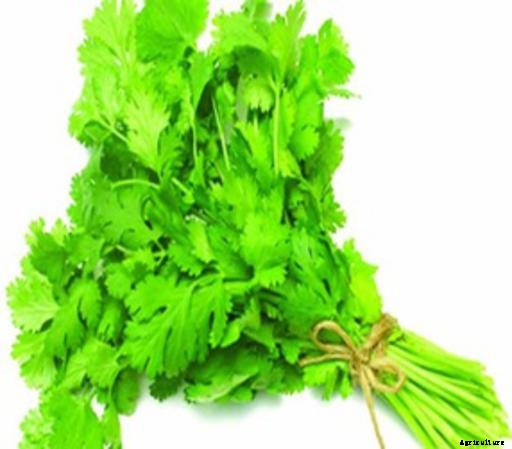
Coriander is indispensable spice in the kitchen. It gives good, flavour to dish. Thus coriander seed and fresh leaves are commonly used in every kitchen to prepare testy dishes. Coriander leaves constitute one of the richest sources of Vitamin ‘C’ and condiment in curries and in fresh chutneys.
It is a cool season crop. Cool weather is favourable for its cultivation. It is susceptible to mild frost.
It grows well on all type of soil. But sandy loam and clay loam soil are best suited for it The land should be prepared thoroughly.
Seeds of coriander are crashed and then sown. It is generally broadcast Seeds be soaked in water for overnight to remove inhibitor and thereby enhance germination. About 40 kg. seed is sufficient for sowing an area of one hectare if grown for its leaves. Sowing of crop at an fixed interval be carried out for regular marketing. It is an excellent intercrop in tomato, Brinjal, cabbage and cauliflower.
Besides 20 T FYM, apply 90 kg Nitrogen, 80 kg Phosphorus and 50 kg Potash per hectare.
Following are the improved varietis of coriander: Dilpazeer and Qandhari. Dilpazeer is more effective.
Small soft bodied insects on underside of leaves and/or stems of plant; usually green or yellow in color; if aphid infestation is heavy it may cause leaves to yellow and/or distorted, necrotic spots on leaves and/or stunted shoots; aphids secrete a sticky, sugary substance called honeydew which encourages the growth of sooty mold on the plants
If aphid population is limited to just a few leaves or shoots then the infestation can be pruned out to provide control; check transplants for aphids before planting; use tolerant varieties if available; reflective mulches such as silver colored plastic can deter aphids from feeding on plants; sturdy plants can be sprayed with a strong jet of water to knock aphids from leaves; insecticides are generally only required to treat aphids if the infestation is very high – plants generally tolerate low and medium level infestation; insecticidal soaps or oils such as neem or canola oil are usually the best method of control; always check the labels of the products for specific usage guidelines prior to use
Singular, or closely grouped circular to irregularly shaped holes in foliage; heavy feeding by young larvae leads to skeletonized leaves; shallow, dry wounds on fruit; egg clusters of 50-150 eggs may be present on the leaves; egg clusters are covered in a whitish scale which gives the cluster a cottony or fuzzy appearance; young larvae are pale green to yellow in color while older larvae are generally darker green with a dark and light line running along the side of their body and a pink or yellow underside
Organic methods of controlling armyworms include biological control by natural enemies which parasitize the larvae and the application of Bacillus thuringiensis; there are chemicals available for commercial control but many that are available for the home garden do not provide adequate control of the larvae
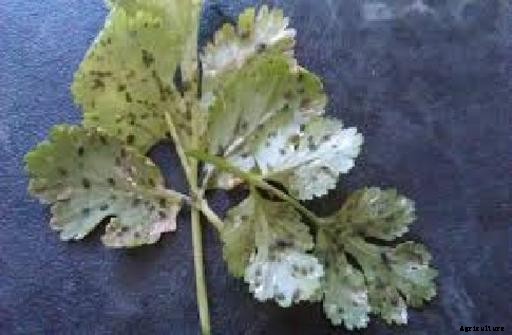
Very small water-soaked spots between leaf veins which enlarge and turn dark brown to black; stems may have elongated dark streaks; inflorescences yellowing and turning brown and blighted; water-soaked lesions on fruit
Bacterial leaf spot is difficult to control; plant pathogen-free seed; avoid overhead irrigation; do not work with plants when they are wet
Yellow and red leaves; stunted plant growth
Avoid planting coriander in close proximity to overwintered carrot fields
Peridroma saucia
Nephelodes minians and others
Stems of young transplants or seedlings may be severed at soil line; if infection occurs later, irregular holes are eaten into the surface of fruits; larvae causing the damage are usually active at night and hide during the day in the soil at the base of the plants or in plant debris of toppled plant; larvae are 2.5–5.0 cm (1–2 in) in length; larvae may exhibit a variety of patterns and coloration but will usually curl up into a C-shape when disturbed
Remove all plant residue from soil after harvest or at least two weeks before planting, this is especially important if the previous crop was another host such as alfalfa, beans or a leguminous cover crop; plastic or foil collars fitted around plant stems to cover the bottom 3 inches above the soil line and extending a couple of inches into the soil can prevent larvae severing plants; hand-pick larvae after dark; spread diatomaceous earth around the base of the plants (this creates a sharp barrier that will cut the insects if they try and crawl over it); apply appropriate insecticides to infested areas of garden or field if not growing organically
Soft, rotting seeds which fail to germinate; rapid death of seedling prior to emergence from soil; collpase of seedlings after they have emerged from the soil caused by water-soaked reddish lesions girdling the stem at the soil line
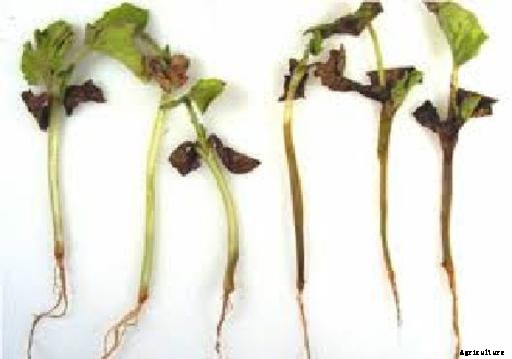
Avoid planting in poorly draining, cool, wet soil; planting in raised beds will help with soil drainage; plant high quality seed that germinates quickly; treat seeds with fungicide prior to planting to eliminate fungal pathogens
Powdery growth on leaves, petioles flowers stalks and bracts; leaves becoming chlorotic; severe infections can cause flowers to become distorted
Plant tolerant varieties; avoid excess fertilization; protective fungicide applications provide adequate protection; sulfur application can be used in infection occurs early in season
Galls on roots which can be up to 3.3 cm (1 in) in diameter but are usually smaller; reduction in plant vigor; yellowing plants which wilt in hot weather
Plant resistant varieties if nematodes are known to be present in the soil ;check roots of plants mid-season or sooner if symptoms indicate nematodes; solarizing soil can reduce nematode populations in the soil and levels of inoculum of many other pathogens
Small water-soaked lesions near base of petioles which become soft, sunken and brown
Control relies on the avoidance of conditions conducive to bacterial infection: plant coriander in well-draining soils; allow plants to dry before irrigating again; avoid wounding plants during harvest to prevent pst harvest development of disease; disinfect all equipment regularly
When grown for seed purpose, it is harvested. After full development of grain. If grown for its tender fresh leaves. It is harvested before flowering. Harvest, when it attains a height of about 20 cm. Uproot the plants and tie bundles of convenient size for marketing. One can harvest 10 tons of coriander from a hectare.