
Welcome to Modern Agriculture!

Water is the most important resource for agricultural activities and development. In terms of water usage, irrigation amounts to 70% of the global freshwater withdrawals.
Groundwater is being used extensively for irrigation. For instance, in the state of Maharashtra, 71% (28.75 lakh hectares) of agricultural land is irrigated by groundwater, while 29% (11.83 lakh hectares) of agricultural land is irrigated by canals or flow irrigation.
This article will try to give you a complete guide for setting up a borewell, right from getting permission to maintenance.
The NOC guidelines created by the government (CENTRAL GROUND WATER AUTHORITY) for borewell digging can be found here.
There is water under almost every part of the earth’s surface, but underground water is not always easy to find, and once found, it may not easily be accessed.
The amount of water in an area depends on factors such as rainfall, topography, hydrogeology, and recharge and discharge.
Hydrogeology is the study of the movement and distribution of ground water in the soils and rocks of the Earth’s crust. This is a branch of geology, and one who investigates these phenomena is known as a hydrogeologist.
It is always advisable to hire a hydrogeologist for identification of borewell digging location in your land who will be able to provide you with a reliable estimate of water level and the depth. Hydrogeologist will survey the land and locate the appropriate borewell digging points. Average fees of a hydrogeologist is about 1000 rupees/acre. So, as an example, survey of 5 acres of land for determining borewell digging locations can cost you 1000×5= 5000 INR.
Local well diviners are also capable of identifying borewell sites to some extent using sticks or magnetic blocks. However, this method may not always be reliable, especially in areas where the geological formation and location is crucial.
The bore well site should be accessible for cleaning, testing, monitoring, maintenance and repair.
There is no prescribed season for drilling a borewell if the location of the site possesses adequate ground water resources.
Experts often consider summer months to be the best time for locating a new borewell site and drilling the borewell, as it will give the exact idea of minimum waterlevel available.
Furthermore, most agricultural sites can only be accessed by drilling rigs during the summer.
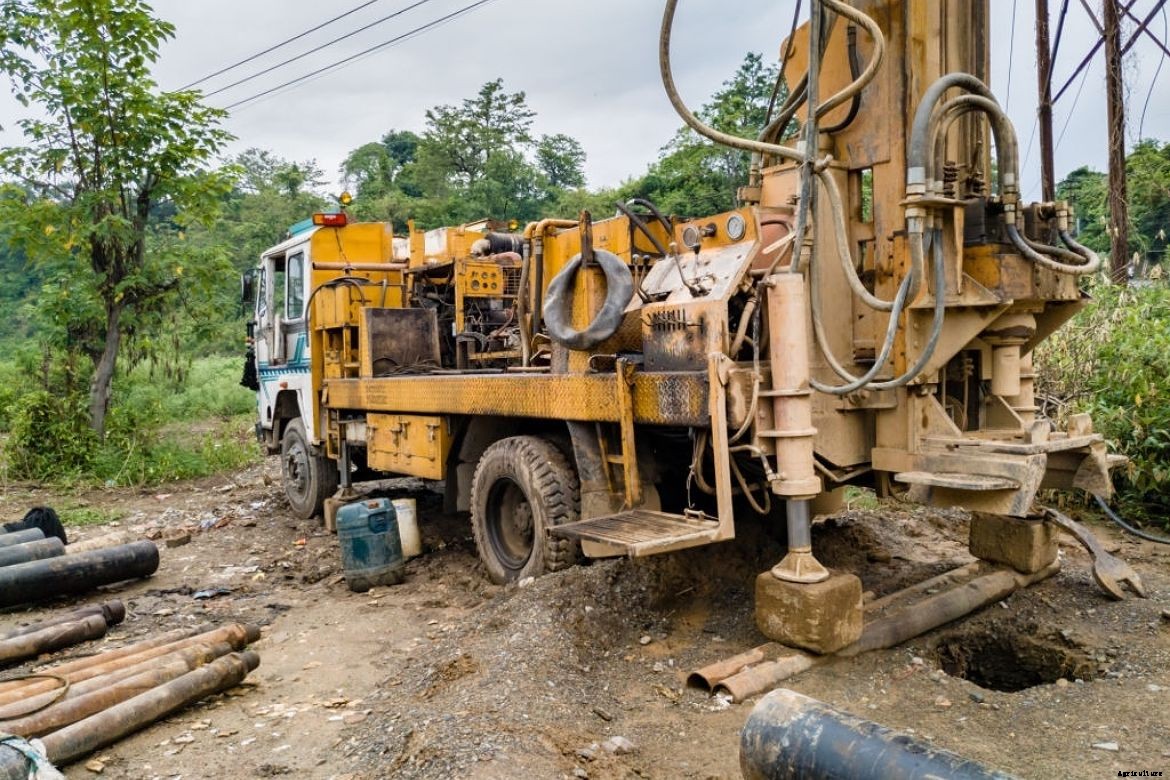
The method of drilling borewell, depends on a number of factors, such as its suitability for a particular type of geological location and soil (e.g. bouldery soil, hard rock soil, alluvial soil), cost, borewell diameter and depth, and the purpose of the borewell intended.
4.5 and 6 inches are the most commonly used standard diameters of borewells. 4.5 inches is used for smaller apartments and homes, where as 6 inches diameter borewell is usually drilled for bigger houses or agricultural purposes.
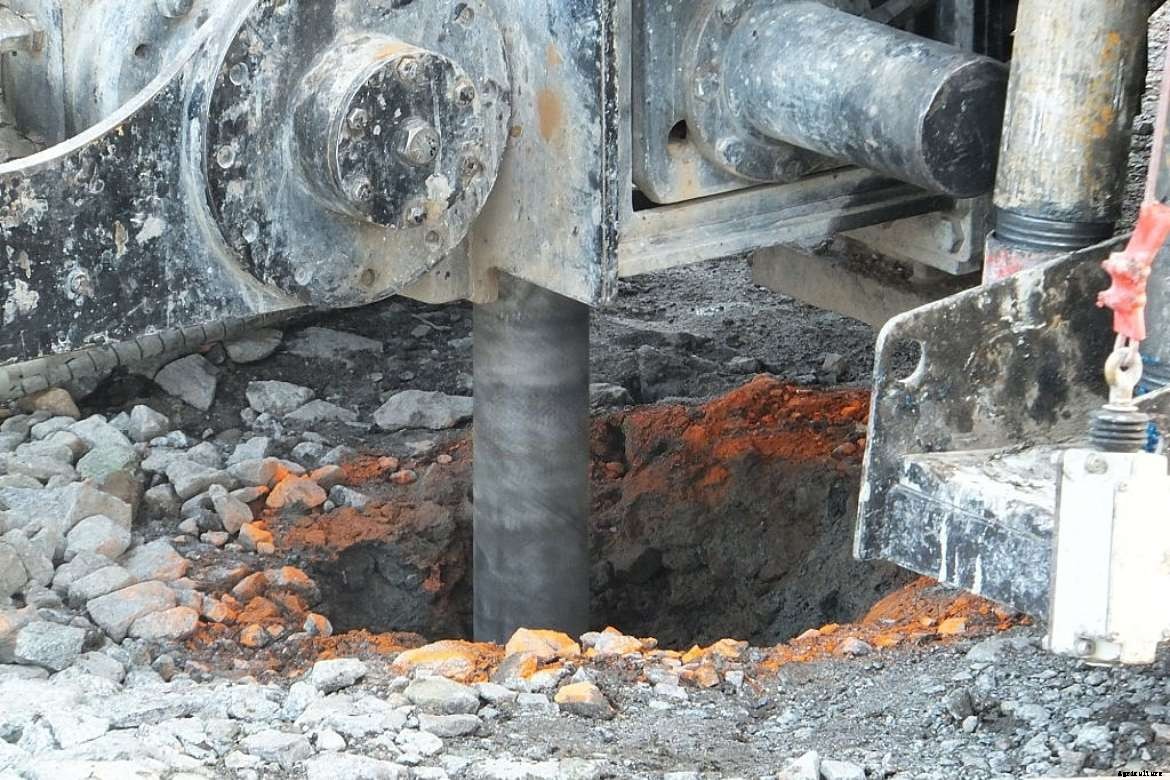
The borewell drilling cost calculated in this section is subjected to change depending on the your location and fuel prices. For ease of calculation and getting an estimate close to the actual cost lets assume the following average borewell drilling rates:
| Borewell drill depth (Feets) | Borewell Drilling rate / Cost |
|---|---|
| <100 (Less than 100 feet) | 70-80 INR / Feet |
| >100 (More than 100 feet but less than 200 feet) | 90-100 INR / Feet |
| >200 (More than 200 feet) | 110 - 120 INR / Feet |
As the borewell is being drilled, the inner wall of borewell is encased by casing pipes. The use of PVC pipes as casing pipes is widespread as opposed to GI/Mild steel casing pipes ( because metal casing pipes are infamus for corrosion problems).
PVC casing pipes used in borewells must comply with IS 12818: 1992 of the Bureau of Indian Standards regarding the specification for unplasticized PVC screen and casing pipes
Average borewell casing pipe price per feet is 200 rupees/feet. Traditionally, casing depth of 40 feet is preferred.
Cost of borewell casing for 40 feet = 40 x 200 = 8000 INR.
Following is the total average borewell drilling cost estimate of 200 feet along with casing cost / charges:
| Activity | Unit rate | Total rate (INR) |
|---|---|---|
| Drilling first 100 feet | 80 rupees / feet | 8000 |
| Drilling 100-200 feet | 100 rupees / feet | 10000 |
| PVC casing cost | 200 rupees / feet | 8000 |
| Labor charges (PVC casing installation, machinery handling etc) | 2000 | |
| Table (1) | Total borewell cost | 28000 |
All the above cost incurred is just the borewell cost of drilling.
Setting up of a new borewell required the following equipments:
For the purpose of calculating the total cost of drilling borewell and setting up borewell, we have made the following assumptions:
| Equipment and Services | Unit Price / Cost (INR) | Total Price / Cost (INR) |
|---|---|---|
| Submersible water motor / pump cost | 33000 | 33000 |
| Pump starter box price | 5000 | 5000 |
| Cable wire cost from submersible motor to starter box (200 Feet) | 10000 | 10000 |
| Bore pipe cost (20 feet x 8 = 160 feet) | 650 INR x 8 = 5200 | 5200 |
| Service wire cost from electric pole to starterbox | 2500 | 2500 |
| Pipe gate valve | 2500 | 2500 |
| Electrician and labor charges | 3000 | 3000 |
| Table (2) | Total cost of Equipment and assembling | 61200 |
Total borewell cost of drilling, machines and assembly = Table (1) + Table (2) = 28000 + 61200 = 89200 Rupees.
* Remember that we have NOT included material transportation charges and flushing charges (charged per hour after drilling of borewell) in this calculation and hence the total cost calculated for borewell drilling and setup might increase a little.
* Slotted PVC casing pipes are used when borewell is drilled in sandy soil. This prevents the borewell from sinking and collapsing, and also prevents fine sand from getting into the borewell. Sandy soil also requires gravel packing around the casing. All this additionl steps will increase the total cost of borewell drilling and setup.


