In this article, we will provide you with the details of Sagwan/Teak wood tree Farming, economics and cost associated with Sagwan farming, planting methods, its uses and much more. Unlike Safeda/Eucalyptus tree farming, Sagwan tree aka Segum tree cultivation takes a little bit more time but is very profitable. I will share the ways to plant the trees and maintain the trees to yield maximum wood and profit. Let’s begin.
What is a Sagwan Tree/ Teak wood tree
Sagwan tree is a tropical tree. The scientific name of Sagwan tree is “Tecona Grandis”. It’s a hard wood. It is locally also known as “sagon” or “saak”. It has got following properties:
Mild, leathery odour during cutting, lasts for long,
Termite Hazzard
Medium
Workability
Easy, easy to polish, Good carving and carving nature, for nailing and screwing predrilling is advisable.
Texture
Coarse and uneven texture with low to moderate natural lustre level.
Grain
Straight grain, with occasional occurrence of interlocked or waved grain.
Sustainability
Not listed on the IUCN Red List of Threatened Species
Required growth density
No particular requirements
Drying
Easy
Durability
Excellent. Almost unmatched in the ability to endure age, outdoor elements, insects, and rot. Very little flex after changes in moisture levels. long lasting. Good acid resistance
Furniture, Panelling, Plywood, Chemical tanks, Ship building, Flooring, carving, turnery
What are the types of Sagwan Trees / Segum tree
Based on teak scientific names
Tectona grandis – Common teak, originally growing in South and Southeast Asia.
Tectona philippinensis – Known as Philippine teak. Currently marked as endangered due to excessive commercial harvesting.
Tectona hamiltoniana – Known as Dahat teak. Grows in Burma, and is also marked as endangered.
Based on geographic region
South and Central American Teak
Konni Teak
Nilambur (Malabar) Teak
West African Teak
Godhavari Teak
Burma Teak
Indian Teak
Indonesian Teak
What is the use of Sagwan wood / Teak wood
Teak is an incredibly versatile type of wood, which makes it possible to see it everywhere around us from large construction elements to small household items. Here is where you can most commonly find it:
Ships and boatbuilding
Exterior construction
Exterior and interior flooring
Exterior and interior panelling
Turnings
Carving
Various small wooden objects
Durable outdoor furniture
Cutting boards
Countertops
Veneer
Indoor furnishings
Door and window frames
Indoor structural beams and columns
How much money/profit can be earned by farming Sagwan wood
Farming and agribusiness of Sagwan wood / teak wood can be very profitable, provided you are ready to give it some time and be patient. For a Sagwan tree to mature, it takes 12-15 years.
The plants of Sagwan are made by tissue culture technology, which ensures high quality and disease-free nature of the plant.
how many teak trees per acre ?
Planting the tissue cultured Sagwan plants in 1 Acre agricultural land may yield 520 to 540 sagwan trees / teak wood trees. To achieve this yield, the distance between the plants should be 8 feet x 10 feet. On an average you can get a yield of 500 trees from 1 Acre of land.
The average cost of tissue cultured Sagwan plant price / teak sapling price ranges from 150 to 200 Indian rupees. And a fully grown Sagwan tree, after 15 – 20 years sells for an average of 30,000 INR. Taking the number of trees that can be planted in 1 acre (500 – 540), a total revenue between 1.5 to 2 crores Indian rupees can be made. The profit may vary slightly depending on the maintenance and care, as proper watering and maintenance is very important.
What is the best climate for Sagwan farming
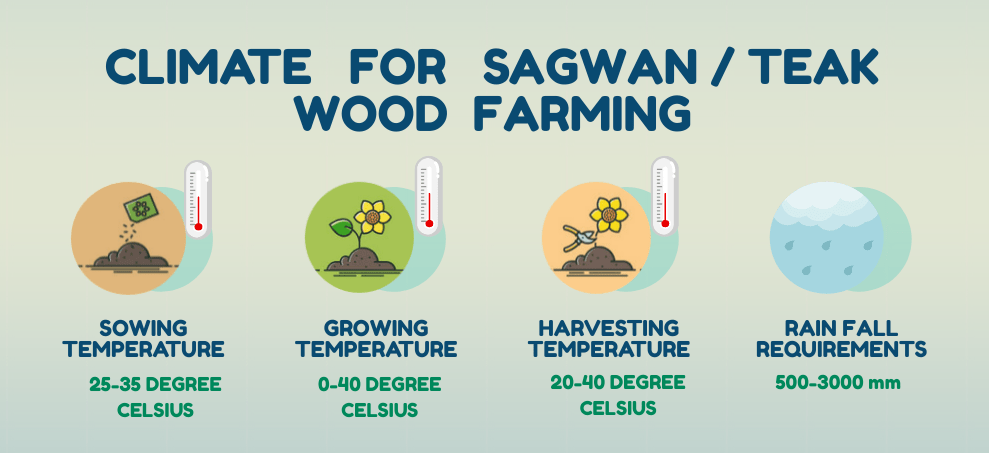
You can plant Sagwan tree in any climate, but timely irrigation and care are very important to ensure good health and maximum profit.
Sagwan tree is very good in sustaining high temperatures. It can be grown in any climate with a temperature ranging from 10 – 45 degree Celsius
Rain falls requirement plays a major part in farming of any crop or tree. The rainfall requirement of farming Sagwan tree is 1200 – 2500 mm.
All these parameters are supposed to be kept in mind before deciding to start agriculture of Sagwan.
What kind of soil is best for Sagwan Farming?
Alluvial soil (soil deposited by surface water) is considered the best soil for Sagwan farming. Some of the features of suitable soils for farming of Sagwan are listed below:
Acidic soil, marshy soil or sandy soil is not a choice for Sagwan tree framing
Soil ph of 6.5 or above is considered the best for teak cultivation
Deep and well-drained soil
High in calcium soil
Soil with presence of lime stone or volcanic rocks is good for Teak
Lack of any minerals like calcium, nitrogen, potassium or phosphorus can be mitigated by using fertilizers
A Must Read: What is bio fertilizer and its types
What is the best time to sow Sagwan plants / teak plant
As I mentioned before, you can start the planting the Sagwan plant at any time of the year. Few things to keep in mind before starting the sowing the Sagwan plant are listed below:
Preferable sowing temperature is 30-35 degree Celsius
Time from March to October is good for sowing
Extreme cold can affect the grown of the Sagwan plant
Beginning of the monsoon season is also considered good
Keep good arrangement of irrigation in case you are going to plant the Sagwan trees in the month of May
A Must read : Types of soils and their nutrient content
How to plant / sow Sagwan Tree / Segum tree / teak wood tree
The land should be leveled. You can also use a land having a slop. It’s very important to level all the area to avoid any water stagnation
The land should be tilled at least two times
Before start of sowing, plan accordingly depending on whether you would like to do any multicroping
If you plan to multi-crop, then keep the distance between the teak plants 8 feet x 10 feet, 8 feet x 8 feet, or 9 feet x 9 feet
A distance of 6 feet x 6 feet can be maintained if you don’t intend to multi-crop on the same land.
For every Sagwan plant or teak plant sowing, dig a pit of 45 cm x 45 cm x 45 cm
Broadcasting, transplanting or line sowing can be used
How to do irrigation of Sagwan Farm / Segum tree
Monthly irrigation for the first 3 years is very important for the growth of the plant
50 Grams (15:15:15) of Potash, DAP and ammonium sulphate should be applied to plants for the first 3 years
Irrigate the small plants every 5 days. Bigger plants can be irrigated every 20-25 days in a month
After 3 years, irrigation can be done only in hot weather
A few months of dry weather is good for good quality of Sagwan tree
Do not over irrigate as it might lead to Fungus growth or Water blister in teak
A must read : Types of fertilizers and their uses
How to maintain and take care of Sagwan plantation / Segum tree
Weed control is very important at least in the early years of Sagwan plantation.
For the first year, weed control should be done thrice, for the second yeas, twice and for the consequent thirst year, once.
A land with good sunlight is very good for Sagwan cultivation
Make sure the levels of calcium, nitrogen, potassium or phosphorus are optimum in the plantation
As discussed earlier, role of calcium is very important for Sagwan. Make sure to supplement the soil with calcium on regular basis
Plants can be applied with fresh extracts of leaf of Need tree or Devil trumpet tree to avoid any kind of diseases
Timely pruning of the tree is very important as it is very important for a good quality yield
Pruning is done when the tree is between the age of 5 to 10 years
What diseases occur in Sagwan tree / Segum tree
Butt rot or Root rot: Occurs due to a fungus called Polyporus Zonalis. It rots the tree from roots and the core. The colour of the fungus is reddish brown and its lower part is white
Rust: This disease on Sagwan tree is caused by a microcyclic rust known as Olivea tectonae. It makes spots on the leaf of dull green colour because of the orange yellow uredinia under the leaf. The spots then turn brown in colour
Powdery mildew: This disease is caused by Uncinula tectonae fungus. This disease leads to defoliation
Leaf blight: This is a fungal disease found on Sagwan tree caused by the fungus Alternaria alternat. A brown water-soaked lesion develops on the leaf and spreads fast to occupy major portion of the leaf leading to complete drying of the lamina
Ganoderma Root disease: Ganoderma lucidum fungus cases this disease and this can be identified by yellowing or dropping of leaves. It can be seen growing from the base of the tree
Can inter-cropping / multi-cropping be done with Sagwan plantation
Sagwan plantation can also be used for multicropping or intercropping
In the first two years of the plantation, multicropping can be done
Make sure to plant a crop which does not require much water
High water demanding crops like banana, sugarcane, cotton etc can not be cultivated with Sagwan farming
Paddy, wheat, soyabean and vegetables are a good option for intercropping with Sagwan / Teak farming
Avoid crop which leads to stagnation of water
How to harvest Sagwan tree / Segum tree
15-year aged Sagwan tree / Teak wood tree is considered to be good for harvesting. By this time the tree is 30-45 feet tall, and the diameter is 35-45 inches. This gives a yield of 10-25 cubic feet of hardwood
The bill of purchase of Sagwan plant has to be registered in the nearest Chief Regional Forestry Office or tehsil office. This also serves as a proof showing your intent to conduct a business of Sagwan / Teak wood tree
The forest department then marks your plant
In the time of harvesting, again a report is filed at Chief Regional Forestry Office
After approval, you can cut the tree and sell the hardwood to make profit
A Must read : Indian measurement units for agriculture land
Final words
There is a great demand of Sawgan in the world. India used to import the wood but now India is in a position to export it all across the world. Sagwan also servers a very good purpose of making a good habitat for wild life. Apart from its great features for wood working, it’s also being used in many countries as a source of food e.g., leaves and bark of Sagwan are used in foods. “Pellakai gatti”, a south Indian dish is made by using Sagwan’s leaves. Sagwan tree leaves / teak wood tree leaves are also used as a seasoning in some parts of the world.
It’s also used in home remedies for stone treatment, Hair health, Week digestion, sneak bite, head ache, swelling and treatment of bad skin.
Though cultivation of Sagwan tree / teak wood tree is a profitable business, one has to keep one thing in mind i.e., it’s a long-term business and patience is the key. The market for Sagwan hardwood is huge and finding a buyer is not hard.
I hope this article was able to answer many of your questions. Please feel free to comment your thoughts. Any suggestion or advise will be highly appreciated. Also, kindly do post any questions which are still unanswered. I would be happy to assist.