High Density Guava Plantation and Cultivation:
The following is all about High Density Guava Plantation and Cultivation.
INTRODUCTION To HIGH DENSITY GUAVA CULTIVATION
Guava is a subtropical crop. It is one of the most common and major fruits of India and is considered the fourth most important fruit in area and production after mango, banana, and citrus. It is a hardy and prolific bearer and highly remunerative fruit. It involves an adoption of modern, innovative and hi-tech methods. One such strategy is the high-density plantation (HDP). This includes the adoption of appropriate plant density, crop management, quality planting material, support, and management system with appropriate inputs. high-density plantation generally refers to planting at a closer spacing than the normally recommended spacing. It has been attempted in different crops such as guava, apple, banana, mango, pineapple, peach, etc. Many guava farmers have been adopting this technology successfully. high-density plantation technology results in maximization of unit area yield and availability of the fruits in the market early which fetch the better price.
- Botanical Name: Psidium guajava, Linn.
- Family: Myrtaceae.
- Origin: Tropical America (from Mexico to Peru).
INDIAN NAMES OF GUAVA FRUIT
- English: Guava.
- Tamil: Koyyapazham.
- Malayalam: Perakka.
- Telugu: Jaamapandu.
- Kannada: Pyarilhannu / Sibe Hannu.
- Hindi: Amrud.
- Bengali: Payara.
- Gujarati: Jamrukh / Jam Phal.
- Konkani: Paer / Peron.
- Marathi: Peroo.
- Oriya: Pijuli.
- Punjabi: Amrud.
- Tulu: Perangai.
MAJOR GUAVA PRODUCTION STATES IN INDIA
- Bihar.
- Maharashtra.
- Karnataka.
- Uttar Pradesh.
- West Bengal.
- Andhra Pradesh / Telangana.
- Chhattisgarh.
- Gujarat.
- Punjab.
CLIMATE FOR CULTIVATION OF HIGH DENSITY GUAVA
Guava cultivation can be extended to varying agro-climatic regions owing to wider adaptability. Guava can be successfully cultivated both under tropical and subtropical conditions. It does well up to an altitude of 1,080-1,600 meters.
- It grows best with an annual rainfall below 150cm restricted between June-September. Places having more than 300cm rainfall are not suitable for guava. Under heavy rains and high relative humidity brings down the quality of fruits. Optimum temperature requirement is 23°C to28°C.
- The areas having a distinct winter season is considered best for increasing yield and improving quality. The humid conditions lead to a luxuriant growth of the trees and yield fruits of poor quality.
- It can be grown as rainfed as well as irrigated crop depending upon agro-climatic conditions. At the time of flowering and fruiting, it requires dry climate. High temperature and high-velocity winds during fruit development period lead to heavy fruit drop.
SOIL FOR CULTIVATION OF HIGH DENSITY GUAVA
Guava adapts well to a wide range of soils. Well-drained, light sandy loam to clay soils is good. Since it is a hardy fruit crop, it can be grown on alkaline soils wastelands etc. It is sensitive to waterlogged conditions. It tolerates a wide range of pH from 4.5 to 8.5.If the soils are having a pH of 7.5 and above there are more chances of getting guava wilt. Some varieties like Lucknow- 49 can be grown in saline soils.
VARIETIES FOR CULTIVATION OF HIGH DENSITY GUAVA
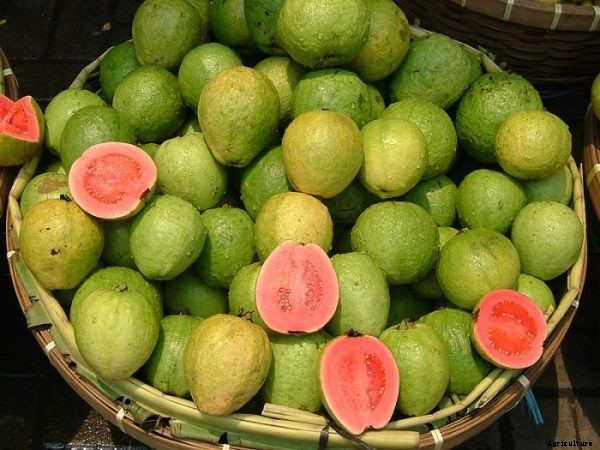 Red Variety Guava Fruits.
- Basically based on seed content in guava there are two types Seedless and seeded varieties. Seedless guavas are triploids with irregular shape and low productivity and plants are very vigorous in growth. Hence, unfit for commercial cultivation. Seeded guavas are more commercial, high yielder‘s with excellent quality.
- The seeded guavas are diploids. Seeds range from 250-500 / fruit. Basing on the color of the flesh again there are two types White fleshed and red fleshed. Among these two, white-fleshed are more common and red-fleshed are less common.
- Beaumont & Ka Hua Kula are famous for growing in Hawaii, Red Indian cultivar is popular for growing in Florida, Ruby X is hybrid from two Florida cultivars named, Supreme and Ruby, Uma cultivar is a vigorous variety with heavy fruit yields and is famous for cultivating in California.
- Sweet White Indonesian bear large size fruits with soft & thick delicious flesh. Giant Bangkok & Donrom variety of guavas are known for bearing fruits with firm green and white flesh. The Mexican Cream cultivar produces small to med size and yellow skin having yummy, sweet & creamy flesh.
- The Detwiler cultivar of guava produces green to yellow fruits with a medium, sweet yellow to salmon flesh. It Includes White Malaysian (San Francisco), Ruby Supreme, Vietnamese, Purple Malaysian, Turnbull White, etc (Southern California), Benjamin, Giant Bangkok & Mexican Cream (Florida), etc.
- These are Asian continent, with the different growing conditions, the popular varieties are Allahabad Safeda, Chittidar, Lucknow 46, Lucknow 49, Hafshi, Harijha, Nagpur seedless, Saharanpur Seedless, Arka Amulya, Arka Mridula, Banaras, Baptla, Apple guava, Arka Kiran, Lalit, TRY (G) – 1 etc.
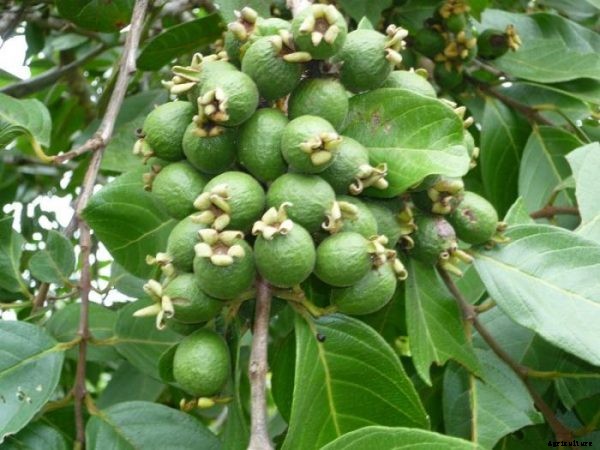 Cherry Guava Variety.
PROPAGATION FOR CULTIVATION OF HIGH DENSITY GUAVA
High Density Guava can be propagated both by seed and vegetatively.
Seed Propagation: It is still common to raise commercial orchards by propagation from seeds. This practice is not advisable because this would lead to the lot of variation among trees in fruit size, yield, and quality. Hence, it is very important to plant an orchard only with vegetatively propagated plants of a known variety.
Vegetative propagation: Air layering or ground layering can be practiced for multiplication of guava plants and the best time for doing this is the rainy season. It is more commonly practiced in S.India. It is very convenient, cheap and easy method. The layered plant being on its own roots grows more vigorously and establishes quickly even in difficult soil conditions.
Propagation of Guava by cuttings under ordinary conditions is not successful. It is only successful under intermittent mist conditions with the aid of rooting hormones like IBA and NAA. Hence, propagation through cuttings is not generally followed.
The commercial method of propagation for guava is air layering/pot layering or inarching.
PLANTING FOR CULTIVATION OF HIGH DENSITY GUAVA
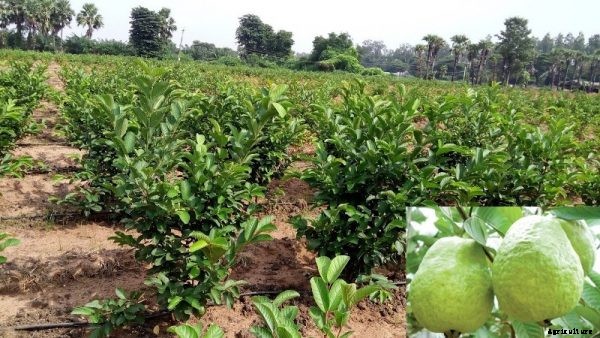 High Density Guava Farming with Drip System.
High Density and Meadow Orcharding: There is a trend to plant fruit trees at closer spacing leading to high density or meadow orchard. Higher and quality production is achieved from densely planted orchards through judicious canopy management and adoption of suitable tree training systems.
Meadow Orchard:
- The Meadow Orchard is a modem method of fruit cultivation by using the dwarf tree with modified cropping pattern. High light distribution within tree cropping patter increases the 1lumberof well-illuminated leaves. It also promotes the rate of photosynthesis that leads to high yield per unit area.
- The system of guava planting is going to revolutionize the guava industry by enhancing productivity coupled with the reduction in production costs. By the meadow orchard system of guava accommodates 5185 plants per ha, planted at 2.5 x 1.5m spacing and managed with regular topping and hedging, especially during initial stages.
- The topping and hedging in guava are helpful in controlling tree size and extending fruit availability. A comparison between meadow orchard system and the traditional system of fruit growing is necessary to evaluate the potentiality of this technique.
High Density:
- High-Density orchard establishment is a long-term investment. Ploughing the area once or twice is suggested followed by two to three harrowings to pulverize and expose the soil completely. It can be best done during the dry season.
- The rectangular system of planting/layout is preferred as it facilitates orchard operations. Planting can be done anytime during the year provided irrigation facilities are available. If planting in December-January there is a chance of frost it causes severe damage. The pits of about 80 x 80 x 80 cm or 55 x 55 x 55 cm or 45 x 45 x 45 cm are dug as per layout plan.
- Then after 8 to 11days, each pit is filled with soil mixed with 15to 20kg organic manure and 550g of single superphosphate. Standard spacing for guava is 8x 8m, which accommodates 300 plants ha-1.It is important to shape the tree after planting. The spacing of the plants in the system depends on the fertility of the soil, availability of water, intensity of sunlight and wind exposure. As guava responds very well to pruning, the following plant densities have been recommended by Central Institute for Subtropical Horticulture, Lucknow for early, higher and quality guava production:
- 5 meter (row to row) x 1.5m (plant to plant) accommodating 2238 plants / ha.
- 5 meter (row to row) x 3.0m (plant to plant) accommodating 1120 plants / ha.
- 5 meter (row to row) x 3.0m(plant to plant) accommodating 561plants / ha.
FLOWERING AND FRUITING OF HIGH DENSITY GUAVA
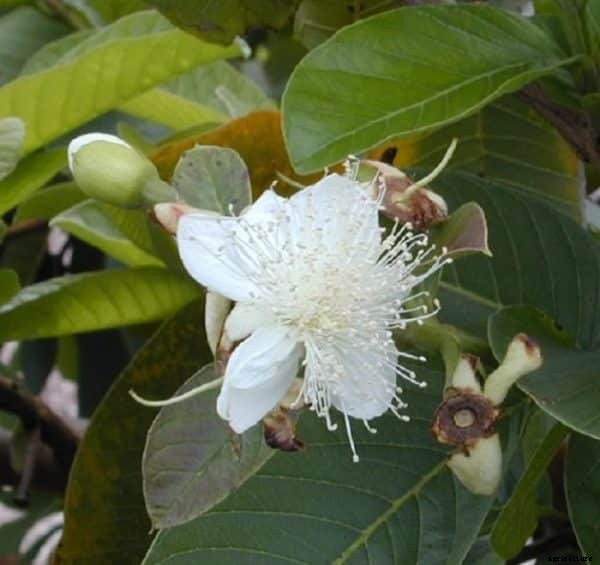 Lucknow Guava Flowering.
The guava bears flowers solitary or in cymes of two or three flowers, on the current season’s growth in the axils of leaves. The bearing twigs grow a few centimeters long, putting forth 4-5 pairs of leaves. The blooming period varies from 25-45 days depending on the cultivar, season and region. The initial fruit set is quite high and approximately 85% of flowers set fruits. Afterwards, due to severe fruit drop, only 34 – 56 percent of fruits reach maturity. In cultivars like seedless, the final retention is as low as 6 percent.
IRRIGATION FOR CULTIVATION OF HIGH DENSITY GUAVA
Guava is a hardy plant and generally, it doesn‘t require much irrigation. But the yield and quality improve markedly by irrigation in summer. The young guava plants need irrigation at the weekly interval during summer months and 2-3 irrigations during winter months. Just after transplanting, watering is necessary for the absence of rains. For bearing trees irrigations are needed for flowering and better fruit setting. Fruit size is reduced if sufficient soil moisture is not maintained. Irrigation is also required to check excessive fruit drop during summer months. Drip irrigation in high density is feasible and recommended to effectively use the water at plant roots. You can contact horticulture department for drip irrigation subsidies.
MANURES AND FERTILIZERS FOR CULTIVATION OF HIGH DENSITY GUAVA
The requirement for manures and fertilizers to give high density guava crop varies with the varieties, age of the crop, fertility status of the soil-climatic conditions and management practices. The fruit of guava are borne on current seasons growth, therefore, manures and fertilizers encourage vegetative growth and fruiting.
Manures (Kg)
One year after planting (Kg
Add every year (kg)
Fruit bearing trees
Compost
20
20
100
Ammonium sulphate
1.5
1.0
3.5
Superphosphate
1.6
0.5
2.5
Muriate of Potash
1.7
0.5
2.5
In case of zinc deficiency, spraying trees with 480g of zinc sulphate and 350g of slaked lime in 83 liters of water twice in a year, once in June-July and second in September-October corrects the deficiency. Zinc deficiency is serious in waterlogged areas.
INTERCROPPING FOR CULTIVATION OF HIGH DENSITY GUAVA
In the early stages of the establishment of high density guava orchard till the commercial bearing, the interspaces can be utilized by growing suitable intercrops. Vegetable crops like bhendi (Lady’s finger), brinjal (eggplant), beetroot and fruit crop like papaya can be grown as intercrops. However, intercropping is not desirable in orchards with full-grown plants.
TRAINING AND PRUNING FOR CULTIVATION OF HIGH DENSITY GUAVA
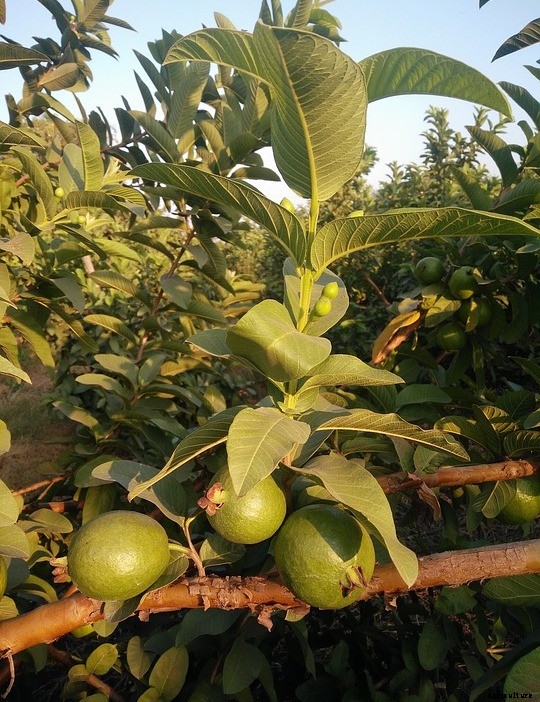 Pruning in High Density Guava.
- The main objective of training a high density guava plant is to provide a strong framework and scaffold branches suitable for bearing a heavy crop without damaging the branches. Training guava trees to open center system is good.
- Care must be taken to prevent crisscrossing of the primary branches in the initial years of planting. In case of varieties having spreading habit, primary branches are allowed at least 75cm above ground level.
- It is better to shape the tree canopy to a limited height into a rectangular shape, allowing more spread in East-West direction. Dead, diseased, intercrossing branches and suckers coming up from the base and sides of the framework should be pruned back annually.
- In guava, the flowers and fruits are borne on current season‘s growth in the axils of leaves arising from the old ones, hence, a light annual pruning is considered necessary to encourage new shoots after the harvest.
- Seedling trees grow vertically high up producing fruit bearing new growths at their top ends. They don‘t produce many fruits lower down. On the other hand grafts or layers remain dwarf and their branches grow horizontally and drooping producing an enormous number of fruit-bearing shoots.
- Pruning in guava results in large fruits of higher value, early flowering, protection of fruits from birds, rats etc. due to cover by vigorous foliage. Severe pruning reduces yield largely, the light pruning is always desirable.
POLLARDING OR DEHORNING FOR CULTIVATION OF HIGH DENSITY GUAVA
When the trees are aged and don‘t give good yields, their branches may be pollarded or dehorned. In this method, the branches are cut leaving 30 cm in length at their origin. The cut branches produce enormous shoots and flowers and ultimately give high yields.
BENDING:
It is a common feature that in high density guava trees branches growing upright and tall don‘t bear at all. In such cases, straight-growing branches may be bent and tied on the pegs driven on the ground. In bent branches, dormant buds are activated and induced to bear flowers and fruits heavily. This method is successful especially in varieties, which grow erect and bear little fruits.
HARVESTING FOR CULTIVATION OF HIGH DENSITY GUAVA
Seedling guava trees require 4-5 years to bear, while vegetatively propagated plants start bearing from the third year after planting. The fruits turn greenish yellow with the approach of maturity are considered ready for harvesting.
- Guava fruits mature for harvesting after 4-5 months of anthesis. However, it depends upon the climatic conditions and variety. Fruits on ripening give excellent taste and flavor characteristic of a particular variety.
- The fruits should be harvested immediately when it is mature because it cannot be retained on the tree in ripe stage. Mature or half-ripe fruits are preferred for consumption. Hand picking at regular intervals is suggested to avoid possible damage to fruits instead of shaking the tree.
- The fruits should not be allowed to over-ripen on the trees as they deteriorate in quality and are more liable to be damaged by birds. Individual fruits are picked when they are still hard and firm at regular intervals.
YIELD IN HIGH DENSITY GUAVA CULTIVATION
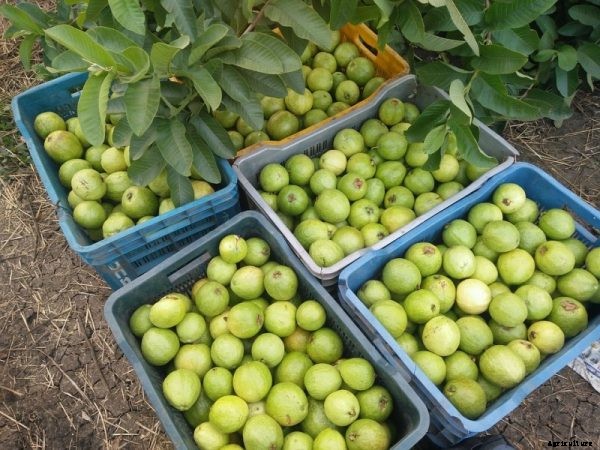 Yield in High Density Guava Cultivation.
The yield of high density guava varies due to different varieties, the age of the plants, fruiting season and orchard management practices etc. Seedling tree of guava of 10 years old yields about 400-500 fruits. Grafted tree yields 1000-2000 fruits where as good orchard yields about 25-30 tonnes per hectare.
Read here about Dairy Cow Farming Project.
Read here about Fish Farming Business Plan.
Read more about Growing Guava In Pots.


