
Welcome to Modern Agriculture!

High Density Papaya Plantation (PawPaw) in India
Papaya is one of the easiest crops to grow in India. It requires minimal maintenance and less water. It is very easy to grow and with the right nutrients, the profits are high. Papaya is also called papaw or papita. Due to its fast growth, high yield, long fruiting period, and high nutrient values it has become a popular fruit.
The Papaya tree is one of the commercially important crops that are cultivated in India. It holds importance due to its high medicinal properties and nutritional value. India is the largest Papaya producing country and it accounts for 46% of the total Papaya production in the world. The states of Karnataka, Andhra Pradesh, Maharashtra, Gujarat, Madhya Pradesh, and West Bengal are the major Papaya producing states in India.
Papaya is most popular because;
(1) Short duration
(2) High yield
(3) More income
(4) High palatability
(5) Continuous bearing
Papaya is a perennial fruit tree widely cultivated in tropical and subtropical climates for its nutritive properties and medicinal values. Papaya is grown for local and export markets. Total annual world production is approximately 6 million tonnes of fruits. India leads the world in Papaya production and other leading Papaya producing countries are Brazil, Mexico, Nigeria, Indonesia, China, Peru, Thailand, and the Philippines. High-density planting is efficient since it is precocious, easily manageable, has higher crop yield potential with better quality fruits and higher returns/unit area. It requires more capital to establish and is productive and profitable. Then, the adoption of high-density planting systems is revolutionizing fruit growing over much of the world and promises to have a significant effect on the horticulture industry.
High density planting is simply a term used for planting fruit-producing trees close to allow for more varieties in a small space.
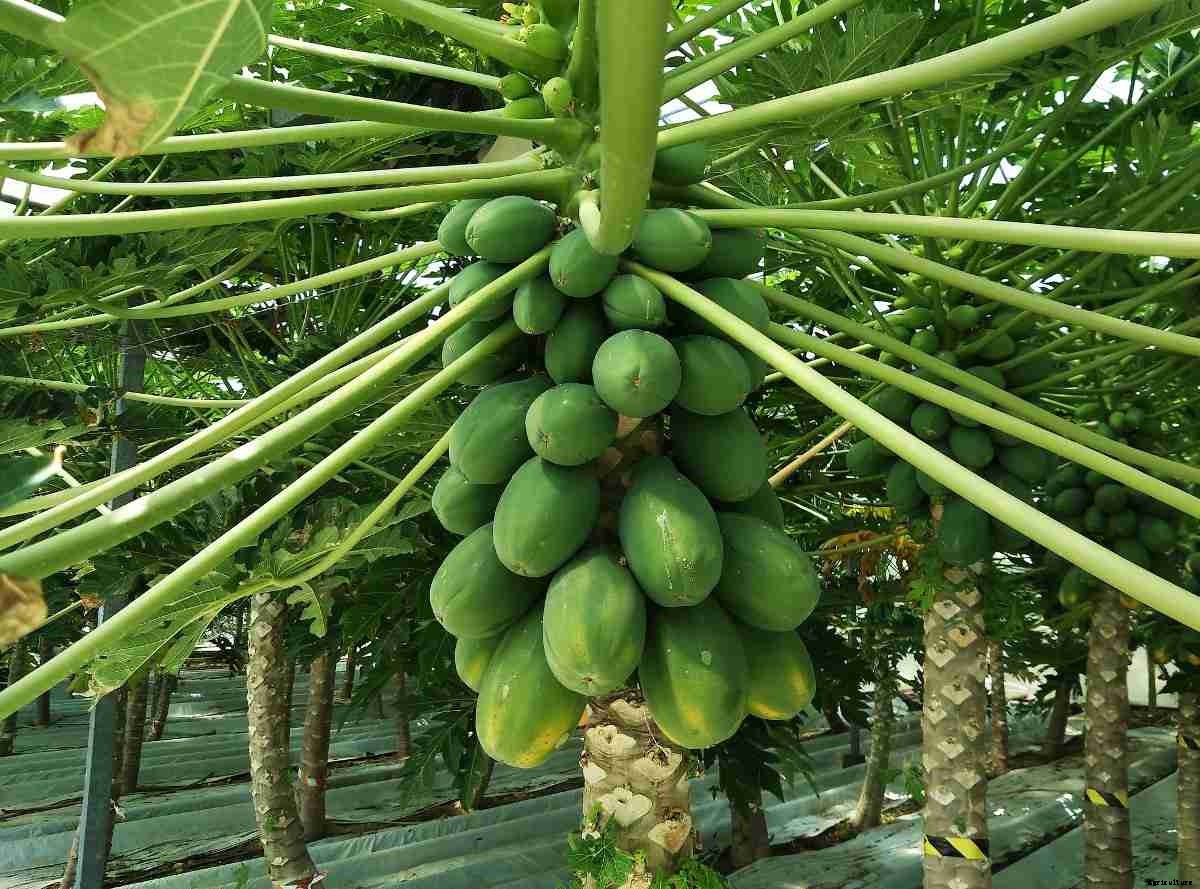
HDP is one of the recent novel ways of increasing productivity of both short duration and perennial fruit crops. Planting density is the most important factor which determines the yield of an orchard.
The basic components of HDP are the use of dwarf scion varieties, planting system, Canopy management, dwarfing rootstocks and inter-stocks, efficient training and pruning, use of plant growth regulators, and suitable crop management practices. HDP comprise the planting of small tree densely, restricting their vegetative growth by using dwarfing rootstocks, or other horticultural methods like pruning.
The major components of high density planting system are;
1. Planting Density – Even though a small canopy with a high number of well-illuminated leaves is efficient in photosynthesis but it is poor in light interception, which leads to low potential yield per hectare. Light interception can be improved by increasing tree density. Though, optimum tree density is the level of density and which is required to facilitate optimum light distribution and interception leading to high photosynthesis. As a result, crop yield per hectare is maximized. An optimum light interception is a factor of plant form, planting density, tree arrangement, and leaf response to light for the photosynthesis process. Optimum light interception can be defined as a level of light intercepted by an orchard system above or below which, the economic crop yield will be reduced.
2. Planting Geometry – The planting system is a combination of both tree arrangement and plant form. Tree arrangement in HDP has sufficient alleyways for the movement of farm machinery. The way trees are arranged determines the light distribution pattern and light interception level.
3. Pruning System – The training begins when the tree is first planted and continues throughout its productive life. Proper tree forms, branch angle and limb spacing in it aids in growth control. The main objective of pruning in high-density planting is to develop plant form which is good in light distribution, small in size, and easy to manage especially in terms of mechanization.
4. Irrigation – Irrigation and fertigation have been identified as a factor for the success of high-density planting.
Dwarf varieties of Papaya like Pusa Dwarf, PusaNanha, Red Lady 786, and Ranchi make it possible to grow Papaya under the HDP plantation.
Pusa Nanha – It is an extremely dwarf Papaya variety. Pusa Nanha Papaya is suitable for kitchen gardens, pot, and rooftop cultivation. This is ideal for high-density plantation.
Pusa Dwarf – It is a dwarf-statured dioecious variety with good crop yield. Pusa Dwarf Papaya fruits are medium-sized with an oval shape. It is a dioecious variety with dwarf Papaya plants and medium-sized (1 to 2 kg) oval fruits. Pusa Dwarf plant variety is suitable for high-density planting.
Papaya varieties are planted at a distance of about 2.5 m X 3 m or 2.5m X 2.5 m (1,333 to 1,600 plants/ha), while PusaNanha may be planted at a distance of 1.25 x 1.25m (6,400 plants/ha). Other Papaya varieties like CO-1, CO-2, Pusa Dwarf, and Honey Dew-1 are also suitable for high density planting.
Generally, high density planting gives higher yield as well as returns/unit area due to increasing the no. of trees/unit area. It is mainly possible by regular pruning and the use of bioregulators for maintaining the size and shape of the tree. The main characteristics of HDP are;
(a) Trees of HDP have a maximum number of fruiting branches and a minimum number of structural branches.
(b) Trees are trained with a central leader surrounded by nearly horizontal fruiting branches.
(c) Pruned occurs with canopy adjustment.
(d) The height must be according to the harvesting efficiency.
The merit of HDP over Normal Planting;
The high density planting has certain definite benefits as well as limitations compared to conventional low-density planting. It is worth mentioning that under high density planting system the yield per plant is low as compared to low-density planting. Though, the total yield per unit area of land is several times higher than low-density planting. It appears to be the most appropriate method and to overcome low productivity and the long gestation period for early returns and export quality fruits.
Clay soil is not recommended for Papaya farming. Sandy loam soil with no water retention is recommended and it does grow well in alluvial soil as long as there is no water retention. Papaya root must remain dry throughout its life to prevent root rot and fungal diseases. The pH level of the soil is to be between 5.5 and 6.5 and should be free from Lime. Light soil with proper manuring is found to be beneficial too. The usual practice in most commercial farms with high density Papaya farming is to make a raised bed with loose soil for up to 2-3 inches in height. The area is covered with mulching sheets and dotted with drip pipelines for watering the Papaya plants. After a while, the root will spread out and you will not need to worry if the raised bed flattens out. With the mulching sheets, you can be worry-free about weeds. There are practices where mulching sheets are not used. You could need to week 2-3 times till the plant grows to the desired height, usually around 2 feet tall after which you can stop weeding. If the plants are spaced out for more than 6 to 7 feet, small tillers can be used to till the land between the rows of plants. With higher density plantations this may be a concern, but weeds do not occur after the plant has reached a good height.

