
Welcome to Modern Agriculture!

Growing Poplar trees for profit is a wise decision. Before getting into commercial hybrid poplar tree cultivation, you must have enough knowledge on the plantation of the Poplar tree and other cultural practices. Why wait..here we go!.
The Poplar tree is a deciduous tree and belongs to a family of Salicaceae. These trees are the fastest growing tree under ideal climatic conditions. Poplars wood and bark are mainly used for making plywood, boards, matchsticks, also for making sports good and pencil. Poplar trees are rapid-growing but relatively short-lived trees. In India, Poplar plant growing up to the height of 85 feet or above within life span of 5 to 7 years. Major poplar producing states in India in Haryana, Punjab, Uttarakhand, Uttar Pradesh, Himachal Pradesh, Jammu & Kashmir, Arunachal Pradesh, and West Bengal.
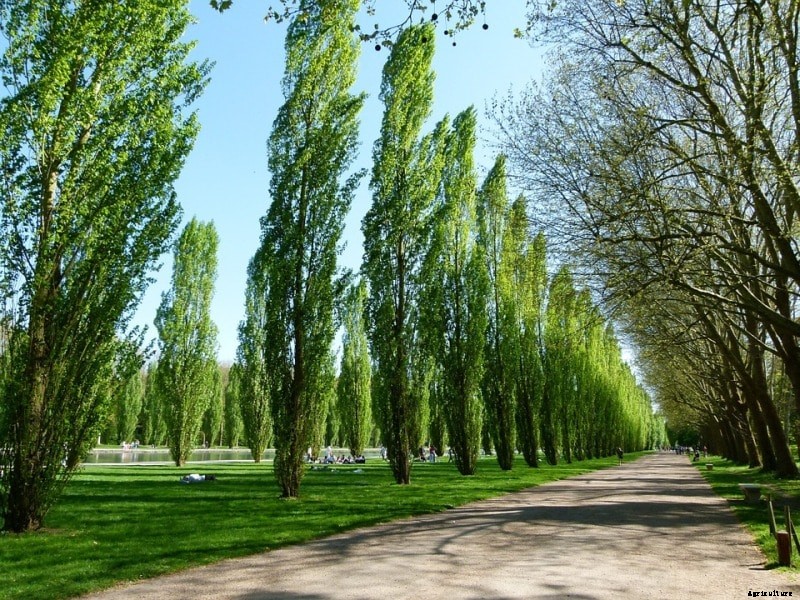
Poplar trees are developed as ornamental, landscaping trees, with numerous cultivars produced and used. These trees have the advantage of growing very large and quickly. Commercial propagation is very easy as most Poplars take root readily from cuttings.
Leaves aside, tree bark may provide some clues to identity Poplar trees. For example, the white Poplar tree has grayish-white color diamond-shaped marks on its bark as a young tree. These turn black color as the tree ages. The black Poplar tree has a dark grayish-brown color bark and clusters of upright branches. A young balsam poplar tree has a greenish to reddish-brown bark, which turns gray color as it ages. Moreover, if you notice a sweet fragrance from a poplar tree’s opening buds, it is likely to be a balsam poplar.
Some of the common names of Poplar trees can be given below;
Common names of Poplar trees are Balsam Poplars, Bigleaf Poplars, Black Poplars, White Poplars, Mexican Poplars, Necklace Poplars, and Subtropical Poplars. The Botanical name for Poplar is Populus, and all species of Poplar belong to the Populus genus group.
Here we will discuss some of the uses of Poplar tree;
You may be interested to read Teak Wood Farming, Planting, Care, Harvesting.
Now let us see different types of Poplar trees;
Different types of Poplar trees consist of the white poplar, the cottonwood, and the black poplar. Another Poplar is the Lombardy poplar, which is a male clone of a tree developed in the Lombardy region of Italy. Aspens are other kinds of Poplars.
Before the plantation of Poplar tree, you must know the suitable agro-climatic conditions. This Poplar tree can grow generally in temperate climatic conditions. Poplar tree can thrive optimum in between temperature range of 5°C to 45°C areas in India. Poplar tree requires straight sunlight and sufficient moisture substance in the soil. The Frost conditions are not well for the improved growth of the Poplar tree.
Avoid alkaline and saline soils for Poplar growth cultivation. It gives the best effect when grown on fertile loamy soils rich in organic matter. For Poplar cultivation, the ideal pH level of soil should be between 5.8 to 8.5.
The Poplar trees are developed from Kalam or softwood and hardwood cuttings method. But in this process Poplar tree cannot thrive well. So, you must take the young plants from nursery and plantation them in the land.
Time of sowing: January and February month is the best time for transplanting of Poplar seedling. And, also planting can be done from 15th Feb to 10th March.
The spacing of Poplar plants: Use spacing of 5 x 5 m (Plant population182 plant per acre) or 5 m x 4 m or 6 m x 2 m (396 plants per acre) or 5 m x 2 m (476 plants per acre).
Sowing Depth: For planting, dug 1-meter pit and then plant a seedling in the pit. Topsoil must be mixed with well-decomposed cow dung@ 2 kg, MOP@25gm, and SSP@50gm.
Method of sowing: Poplar is sown by direct sowing or by transplanting method.
Seed
Seed Treatment: To protect seedling from pest and disease attack, before planting young plant should be treated with a fungicide. Pruned thick and damaged roots of seedling before treatment. Treat seedling with Chlorpyriphos@250ml/100Ltrs of water for 10 to 15 min. After this, place the seedling in Emisan 6@200gm/100Ltr for 20 minutes. Some information about seed treatment for growing Poplar trees;
You may also check Brinjal Farming Profit, Cost.
For the first two years of planting, intercrops can be done. It will help the farmer to earn income through the initial years of Poplar cultivation. You can be planting the poplar tree in the farm or field and cultivate on the boundary of the farm. In Poplar tree farming farmer can utilize the inner free space for intercrops cultivation and obtain the extra income. Crops like sugarcane, turmeric, potato, tomato, coriander, and ginger can be taken as Poplar tree intercrops.
In the plantation of Poplar tree, planting time is important. If plants are not planted in the right time then planted could be 10% mortality. When you transfer seedlings from the nursery to major filed then directly placed in the storage pits which are filled with fresh water (2 to 3 days). Usually, you can start planting in January.
Poplar trees grow very big, very fast. Poplar root systems can extend more than 100 feet in search of water. Planting one close to houses or ceramic water pipes may effect in damaged foundations and cracked walls and pipes.
During the first year, apply light and frequent irrigation with an interval of seven days till the onset of monsoon. In October-December apply two irrigation per month. In the second year, in winter season apply irrigation at an interval of 15 to 20 days and in summer apply irrigation at an interval of 7 days. In the third year and onwards, in summer season apply two irrigation per month.
Removes weed during the initial years of Poplar crop. Once a Poplar tree is developed, minimum weeds developed under shade.
If you do not control the extra weed from the field then they influence the Poplar tree growth. You can apply the Herbicides on the land for control the extra weed around the whole Poplar tree. You should control the weed during the 1 to 2 years after planting. After the Poplar tree well grown you not require to control the weed because it is automatically controlled by the shade of the trees.
Pest and their control:
The following are some of the pests that are found in Poplar trees;
Termites: If infestation is observed, to control apply Chlorpyriphos@1.5 Liter per acre.
Stem Borer: If infestation is observed, to control apply Phorate 10G@5kg/acre up to the second year of plantation or inject Kerosene@2 to 5ml per hole.
Mites: If infestation is observed, to control this pest to take spray of Metasystox@2ml/Ltr of water. Repeat the spray with an interval of 15 days.
Leaf Defoliators: Its infestation is observed in July. To control take spray of Chlorpyriphos 200 ml + Cypermethrin@80 ml per acre.
Leaf-feeding Caterpillars: All species of poplars are affected by sort of leaf-feeding caterpillar. Larva feed on the buds or the leaves causing a lacy form. Infestations generally aren’t fatal, but several successive years of attack can weaken a tree enough to kill it. Insecticides can be helpful to treat infestations.
You may check A Step by Step Guide for Goat Farming in India.
Diseases of Poplar trees
The following are some of the diseases that are found in Poplar trees;
Wet wood or Slime Flux: A bacterium takes hold in the heartwood and causes abnormally very high sap pressure. Fermented sap (or flux) is forced out of wounds in the tree. The sap is sour-smelling and oozes down the side of the tree, causing unsightly gray streaks when dried. The wounds generally will not heal accurately and the condition can persist for many years. While there is no treatment for the disease, the streaking can sometimes be prevented by placing a small tube in the infected area thus, the flux drips away from the tree.
Canker and Dieback: Canker and dieback on poplars are caused by some different fungi. Lombardy poplars are particularly vulnerable. Dark sunken cankers form where the fungus enters a tree during wounds or cracks. These cankers can disrupt water and nutrient flow also, if it spreads to more than half of the diameter of the trunk, will probably kill the tree. Pruning off infected and removing severely infected trees can slow or even prevent spread. The best measure is to help the general health of the tree through regular fertilization and watering.
Clearcutting creates the conditions Poplars require to regenerate naturally. Depending on the site, you might harvest with patch cuts or strip cuts, though taking measures to protect wildlife dens, shorelines, and slopes. The whole-tree process, which removes the entire tree, is recommended because it leaves little debris on the site. Fine branches and other debris are often put during a roadside chipper and used for pulp.
The Poplar trees are developed from kalam or cuttings, harvested annually in January and February, and commercially available up to 15 November.
Poplars are very easy and inexpensive to reproduce. When mature Poplars are harvested through clear-cutting, a dense carpet of new shoots known as coppice growth or suckers sprouts from the roots near the soil surface. The Poplar suckers develop rapidly into a new forest. In fact, they can make a pulpwood size in 20 to 30 years.
In India, the Poplar is grown commercially by farmers, mostly in the Punjab region. Common Poplar varieties in India are;
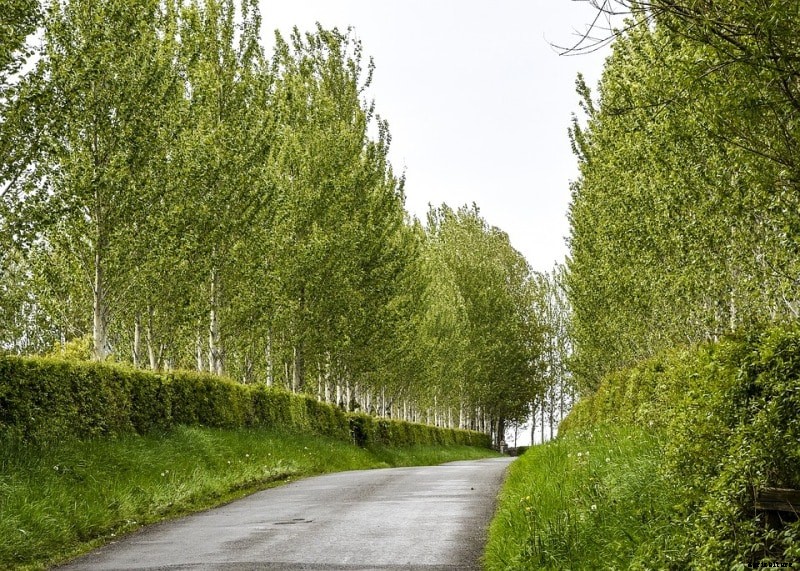
Poplar yield depends on climate conditions, site quality, clone, age, spacing, and silvicultural conditions and treatments. Poplar yield estimates range from 1.25 to 8.61 dry tons per acre per year.
You may also be interested in Kadaknath Egg Production.
You can get the profit approximately 3600 to 4000 rupees per tree when poplar tree has 34 to 36 inches in girth or diameter; the height of a tree is 5 feet or 1.6 meters from ground level and 80 feet in height. The market value of the poplar tree mostly depends on the girth (diameter) of the tree.
If poplar tree cultivation is done on one-acre land so there are 225 plants and you will get about 1000 to 1250 quintals which give approximately about 5.25 to 6 lacs. In the local market, these poplar trees are much demanded. So, you can get the good returns from Poplar tree cultivation.
Here we can discuss some facts about growing Poplar trees;
That’s all folks about poplar tree plantation methods, profit details.
You may be interested to read the Growing Organic Tomatoes on the Terrace.


