Welcome to Modern Agriculture!

What is fermented chicken feed? According to Linda of Garden Betty,
Linda provides a plethora of wonderful information in her post on fermented feed. She has a smaller set-up (3 chickens) and I’ve found that all methods slightly vary, but the end game is the same. Yummy, nutritional feed for your happy hens and roos.
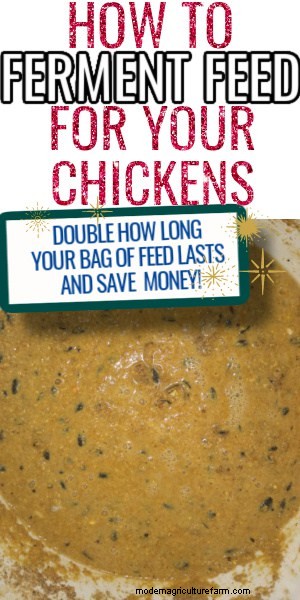
Table of contents
You likely already know what fermented foods are but don’t yet identify those foods as fermented. Most commonly, sourdough bread, yogurt, apple cider vinegar, kombucha and sauerkraut are all fermented foods. More specifically, these products utilize the process of lacto-fermentation just as fermenting chicken feed does.
Fermentation is an anaerobic process where yeast and bacterias (microorganisms) break down (or ‘feed on’) sugars into other products such as organic acids, gases or alcohol such as wine, beer and cider.
An average sized chicken is supposed to receive roughly 1/4lb of feed per day (or about 3/4 cup). A larger sized chicken is supposed to receive around 1/3 lbs or 1 cup of feed. If you buy a 50 lb bag of feed that means your feed bag has around 150-200 servings of feed going by the measurements above.
By fermenting chicken feed, you could likely double those digits and cut feed costs in half?
What if I told you that you could almost double those digits?
I have around 25 chooks who eat a cup of feed per chicken per day. That means, at 25 cups of feed per day, I was buying chicken feed every 6-8 days. I wanted to buy nicer feed but just could not afford to.
Generic feed where I am at the time of writing this in 2018 is $12.99/50 lb bag and Organic, Non-GMO feed is $25.99 for a 40lb bag. $0.26 per lb compared to $0.65 per lb? It just wasn’t in my budget. My flock does roam all day with access to a field to forage and freshly dropped muscadines in the summer, but the nutritional value of their chicken feed could always be better.
I found The 104 Homestead‘s post on “Fermenting Chicken Feed: Less Money, More Nutrition“. I’m familiar with the fermenting process because I brew my own kombucha and I know the health benefits it can provide.
The math seemed great and I loved that my chickens would get more nutrients from the generic feed I could afford to give them. Also, if it really did double the quantity of the feed, I could afford to start buying organic, Non-GMO feed!
My last bag of generic feed (50 lbs) lasted me 20 days when I fermented the batches. That is over DOUBLE the lifespan of when I’m feeding dry pellets to the flock.
Before ever starting a project that potentially alters the nutrition given to your animal, it’s smart to understand what your animal needs so you can adjust appropriately. Make sure your flock is offered a balance ration of fats, carbohydrates and proteins paired with sufficient vitamins and minerals.
According to the University of Georgia Extension, “A starter diet is about 24% protein, grower diet 20% protein, and finisher diet 18% protein (1). Layer diets generally have about 16% protein. Special diets are available for broilers, pullets, layers, and breeders. Whole grains can also be provided as scratch grains.Jan 10, 2003“.
There’s a great chart on the Nutrition for the Backyard Flock resource showing the required nutrients for birds at every stage of life. Take a look at this chart and a breakdown of the nutrients your flock needs before trying our fermented chicken feed.
***Note: These measurements are for 25 adult chickens. Adjust accordingly, of course, for your own numbers. Also note that with my method, each chicken will receive slightly less than 1 full cup of fermented feed per chicken***
Well, besides saving a fair amount of money, my chickens’ poo smelled less stinky. Egg production became a bit more steady and it felt like the egg weight increased along with the quality of the yolk. There was a significant drop in wasted food, which also contributes to saving the moolah.
Keep in mind that I had a great experience with fermenting chicken feed, but you might not. If you have a large flock, consider starting with a smaller quantity to see how your backyard chickens react. I am not, nor have I ever claimed to be, a licensed veterinarian and can not scientifically speak to the well-being of your animal. For years I, along with many other homesteaders, have fed their backyard chickens layer pellets with no negative effect. Each farm animal requires a different thing, so keep an eye on your flock as a whole and adjust accordingly.
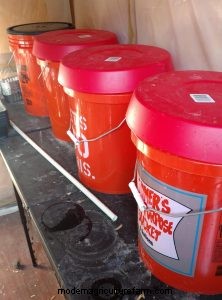
With the four bucket method, you should have a perfectly fermented bucket of feed and fermented grains every four days. Lacto-fermentation takes around 3-5 days. I’ve read you can serve the feed on the third day. For me, it works best serving it on the fourth day so my bucket gets a solid 3 days of fermentation. In certain warm climates, it is possible that fermentation can become rapid within 24 hours. Keep an eye on your feed and look for bubbling and a yeast-like smell.
You can add various additives when fermenting chicken feed such as beans, seasonal grain, etc. I’ll experiment with this once winter rolls around and the Florida vegetation/jungle dies down a bit. I do add vitamins and electrolytes to my fermented feed in the winter since my flock is foraging less and their immune system might not be as strong.
By the fourth day of fermenting, the 12 Cups of feed I added to the bucket has turned into 24 cups of fermented feed. That means my 50lb bag of feed acts as the equivalent of a 100lb bag!
Some days my chickens eat every bit of the feed, other days they decide to forage more. Adjust accordingly. I can’t stress how important water levels and stirring/aerating your batches are.