
Welcome to Modern Agriculture!

Today, we are talking about sericulture training in India.
Sericulture is an agro-based industry. It involves the cultivation of host plants and rearing of silkworms to produce cocoon to produce raw silk. The sericulture involves the tasks like silkworm feed cultivation, spin silk cocoons, reeling the cocoons and unwinding the silk filament for processing and weaving. Silk for its best qualities like luxury, elegance, class, and comfort it called as the “Queen of Textiles”.As per the Chinese literature, the Chinese Empress ShilingTi discovered it in her teacup. It has defeated all the natural and artificial fibers and remained the undisputed “Queen of Textiles” for centuries. Silk has been part of the life and culture of the Indians. Though India is producing all varieties of silk products such as dress materials, scarves/stoles, readymade garments, etc., the silk sarees are truly unique.
Sericulture has a great role in rural employment, poverty alleviation and earning foreign exchange. A lot of entrepreneurial opportunities are available in various fields of sericulture. It is practiced in various states viz., Karnataka, Andhra Pradesh, Jammu & Kashmir, West Bengal and states like Madhya Pradesh and Maharashtra have also started practicing Sericulture. The non-mulberry (also called Vanya silk) sericulture is practiced in Assam, Jharkhand, Orissa, and Madhya Pradesh. More than 7 million people are involved in sericulture activities. So, there is a necessity to upgrade the skills of the Seri culturists to use the full potentialities of sericulture to produce qualitatively superior cocoons and to earn profitable income.
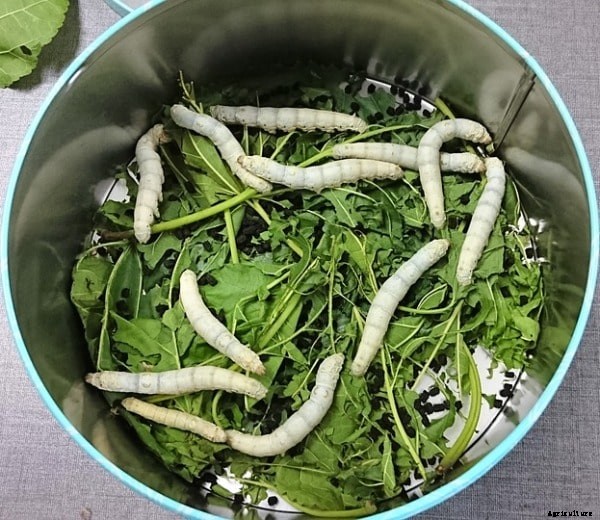
The practice of sericulture has many benefits to rural people. Some of the major advantages are listed below.
High Rate of Employment: Sericulture is the best source of employment. It is astonishing to know that sericulture industry is providing gainful employment to more than 60 lakh persons every year in our country. This sector employs one man throughout the year for producing every 3.07 kg of silk produced and used in handlooms. This potential is very high, and no other industry generates this kind of employment, especially in rural areas. It is because of this reason that sericulture is practiced as a tool for rural reconstruction. ”
Sericulture is the BestAgro-based Enterprise in Rural Areas: More than 57 % of the gross value of the final product in the industry (silk fabrics) flows back to the cocoon growers.
Sericulture needs Low Investment and High Returns: Mulberry takes only six months to grow for the commencement of silkworm rearing. For this unit, you need a minimum investment of only Rs.13,000 to 16,000 (excluding the cost of land and silkworm rearing house) is enough to undertake mulberry cultivation and silkworm rearing in one acre of irrigated land. Mulberry that place once can support silkworm rearing for 15-20 years depending on the management. You can easily take five crops in one year under tropical conditions. By adopting the recommended package of practices, a farmer can attain net income levels up to Rs.30,000 per acre per annum.
Read: Beekeeping Training Centers.
Sericulture as a Women Friendly Occupation: All the Sericulture activities from mulberry garden management, leaf harvesting, and silkworm rearing are easily taken up by women. And post-cocoon activities like silk reeling, twisting and weaving are also easily handled by women. SO, in the sericulture industry, women constitute over 60% of employees.
The best source of income for weaker sections of the society: Sericulture can be practiced even with very low land holding (0.75 acres of mulberry garden and silkworm rearing can support a family of three without hiring labor). Sericulture for its low gestation and high returns features, it is considered as an ideal programme for weaker sections of the society.
Eco-friendly Activity: As a perennial crop with good foliage and root-spread, mulberry provides green cover and contributes to soil conservation. Waste from silkworm rearing can be recycled as inputs to the mulberry garden. Being a labor-intensive and predominantly agro-based activity, smoke-emitting machinery is not involved. Developmental programmes initiated for mulberry plantation are mainly in upland areas, vacant lands, hill slopes where un-used cultivable land is made productive and also in watershed areas due to its deep-rooted perennial nature.
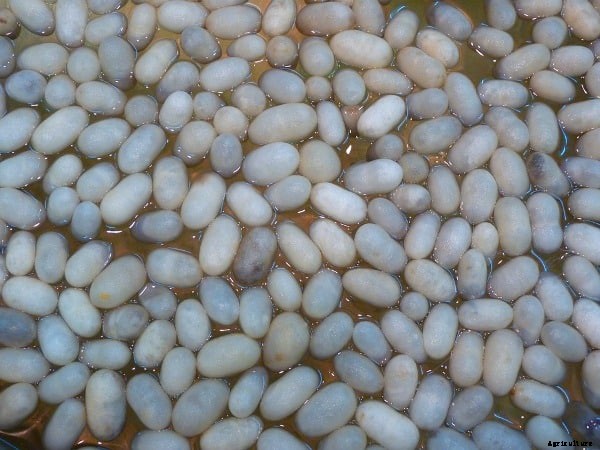
Central Silk Board (CSB) is an authorized department established in 1948 by an Act of Parliament. Silk Board comes under the administrative control of Ministry of Textiles, Government of India.
The Capacity Building & Training at CSB includes regular structured courses – Post-Graduate Diploma in Sericulture (PGDS) and Intensive Training in Sericulture (ITS), Entrepreneurship Development Programmes and other short-term (1-2 weeks) skill & competence enhancement training programmes. These training programmes are conducted: i) by various R&D institutes of CSB and their nested field units located in different parts of the country focusing on specific silk sub-sectors viz., Mulberry, tasar, Eri & Muga and also directly by ii) the Capacity Building & Training (CBT) division, CSB, Bangalore.
Address:
Central Silk Board
Address: CSB Complex, B.T.M. Layout, Madivala
Bangalore 560 068, Karnataka, INDIA.
Email Id: ms.csb@nic.in
Contact No : +91 80 26282699, 26282100
The Government Sericulture Training School was established at Hosur in 1973 for the purpose of giving training to the staff and Seri culturists. In the year 2006, Sericulture Training School was registered under TamilNadu Societies Registration with name as, “ TamilNadu Sericulture Training Institute”.
Tamil Nadu Sericulture Training Institute offers both on-campus and Off-campus training courses based on the requirement of trainees to department staff and farmers.
Courses offered at TamilNadu Sericulture Training Institute
Courses at Central Sericultural Research and Training Institute, Mysore
Courses at Silkworm Seed Technological Laboratory, Kodathi – Bangalore
The Central Sericultural Research and Training Institute, at Mysore, is offering courses for women Seri culturists – under SERI TECHNOLOGY COMPLEX FOR WOMEN – in collaboration with Department of Science & Technology and Department of Biotechnology, Govt. of India. The following Training Programmes are offered along with accommodation.
Read: Women Role In Agriculture.
Training Courses Offers:
Central Seri Cultural Research and Training Institute offers many courses in Sericulture.
Course Details:
Contact Address:
The Director,
Central Sericultural Research & Training Institute,
Manandawadi Road,
Srirampura,
MYSORE – 570 008.
Tel: +91 821 2362406 / 2362440 /2362368
Email:csrtimys.csb@nic.in; csrtimys@gmail.com
International Sericulture Commission:
ISC offers different training programs on Sericulture. ISC offering special training on sericulture and silk industry for the candidates selected from ISC Member Countries at Central Sericultural Research & Training Institute, Mysore. This sericulture training is sponsored by the Ministry of External Affairs, Govt. of India.
Selected sponsored candidates will get the facilities like return air journey in economy/excursion class, living allowance, accommodation in the place of training in Hotel/Hostel, project allowance, study tour, etc.
The training includes:
Contact address:
International Sericultural Commission
Ground Floor, Central Silk Board Complex, BTM Layout,
Madiwala, Bangalore – 560 068. INDIA.
+91 80 26680162/26681663
iscbangalore@gmail.com
Website: www.inserco.org.
Read: Home Gardening Tips.


