Hybrid Napier Grass Cultivation for Livestock
Today, we are going through Hybrid Napier Grass Cultivation procedure for livestock.
Introduction to Cultivation of Napier Drass:
Napier grass which is scientifically called as “Pennisetum purpureum” is the one which has its origin in grasslands of Africa. It is one of the species of tropical grass which is perennial. Napier grass is well-known for its less requirement of water and nutrition. Because of this characteristic, Napier grass can also make good use of lands which are not cultivated too. The Napier grass which is wild has been used for grazing in earlier days. In the present trend, Napier grass is also being used in the management strategies of pests. This particular management technique involves planting the crop which is desired along a “Push” plant, which attacks the pests along with a “Pull” plant surrounding the plot or area which attracts the insects or pests to come out of the plant. Napier grass has the capability to attract the stem borer moths which are considered to be the primary cause for the loss of yield, to come out of the plants such as maize. This is a management strategy which is sustainable and serves many purposes. This grass is also affordable by the farmers than to use pesticides. Moreover, Napier grass plays a major role in improving the fertility of the soil and also protects the land which is arid from the erosion of soil. It is also used for windbreaks, production of paper pulp, production of bio-oil, charcoal and biogas.
Description of Napier Grass:
- Napier grass belongs to the family of Poaceae.
- This grass is tall and its formation will be rousted and the clumps will look like bamboo.
- This grass plant is heterozygous and the seeds of this plant do not form completely.
- The reproduction of Napier grass is done in a vegetative way through shoots which are horizontal called stolons which locate above the soil extending from the parent to the offspring.
- The Napier grass has a very high production of biomass. It produces about 45 tonnes per hectare in a year and the harvesting can be done at least four times a year.
- Moreover, for the production of Napier grass, less water and nutrients are required. The propagation of Napier grass is done by seeds. Though the production of seeds is not that consistent, the collection part is very tough.
- As an alternative, the plantation of the grass can be done by using stem cuttings of stolons. The plantation of the stem cuttings can be done by insertion of these with the furrows with a distance of 80 cms, between and along the rows.
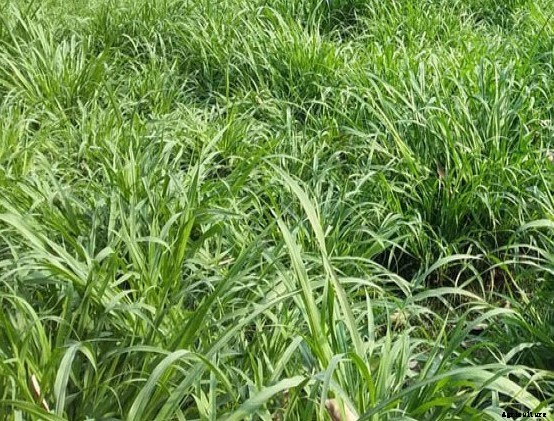 Hybrid Napier Grass Plantation.
Uses of Napier grass:
- Napier grass is mainly used as a fodder crop. It is used as feed to the cattle directly or it can also be made as hay or even silage.
- In African countries, it is used as a forage for elephants and hence, it is also termed as elephant grass.
- Napier plant plays a major role in the production of biomass.
- It can also be harvested up to 6 times in a single year. This makes it a very good raw material for the production of biofuel.
- The plantation of Napier grass is done in the marginal slopes and lands in order to improve the fertility of the soil and to decrease the erosion of soil.
- Napier grass is the primary source for the production of paper in many regions across the country.
- Napier grass is used in the pest management strategy as a pull crop which attracts the pests to come out of the plant. This mainly plays a vital role in the pest management strategy of plants like maize.
- The Napier grass leaves and shoots which are young are considered edible and they are also used to make stews and even soups.
Nutritive value of Napier Grass:
Taking an example, if the harvest of Napier grass is done at a height of 3 meters approximately, then the yield will be more. But here, though the yield is good, the nutritional value would be less as it does not contain any quantity of maintenance. Due to this, the primary purpose of the production of green fodder gets overcome with adversity. To get the results which lead to satisfaction, the Napier grass should be fed to the cattle along with the legumes, oil cakes. This will contain 10% to 12% of crude protein in it along with 25% to 30% of crude fibre. The number of total nutrients which are digestible will range between 56% to 59%.
Suitable climatic conditions for Napier Grass Cultivation:
Though Napier grass is tolerant to drought and can grow well even in the areas which are dry, it is considered to be suitable to grow in the areas where there is high rainfall. Napier grass does not grow properly in the areas where there is waterlogging. It can also be grown in combination with fodder trees along with the boundaries of the field or contour lines to help to prevent the soil erosion. Napier plant grass can also undergo intercropping with the crops like fodder trees, legumes etc. Napier grass also grows very well at an altitude of 1800 m to 2000m above the sea level. Napier grass also performs well in the temperatures varying between 26°C to 42°C.
Suitable soil for Napier Grass Cultivation:
Napier grass can grow in a large variety of soils. The soils which are light loamy and sandy are most preferred and heavy soils are not much encouraged for the growth of Napier grass. Wet soil is preferred at the roots but you need to make sure that it is not stagnated. Napier grass cannot survive in the lands which are waterlogged and prone to floods. Very good yields are obtained from the soils which are fertile with rich content of organic matter and nutrients. For the cultivation of Napier grass, make sure that the soil pH is between 5 and 8.
Preparation of land for the Napier Grass Cultivation:
Before starting the cultivation of Napier grass, plough the field and harrow it very well. It should be in such a way that the seedbed should be very good for the plantation.
Sowing of Napier Grass:
The crop of Napier grass will be sown mostly in the last week of February to the last week of August in India. That is when the climate is warm. But, to get a very good yield which results in maximum returns, the sowing should be done by the end of February. This is because, late sowing gives only one cut by the last week of November and after that, it stays in a dormant stage.
Plantation of Napier Grass:
For the plantation of Napier grass, there are two methods used.
- Conventional method
- Tumbukiza method
The conventional method of Napier Grass plantation:
- In this method, you need to first dig the field up to 20 cms wide and 20 cms deep by maintaining a distance of up to 90 cms in between the rows and a distance of 60 cms between the plants.
- Make sure that you are applying at least 10 to 12 tonnes of farmyard manure in each and every hole.
- Then place a cane which has 3 nodes at a slanted position in the soil by making sure that the two of the nodes are covered with soil.
- Now, place the splits of the root in the holes of planting and cover the soil.
Tumbukiza method of Napier Grass plantation:
- This is the method which gives very high yields of herbage even in the seasons which are dry.
- This method gives good results than the conventional one.
- In Tumbizika method of the plantation, again there are two types.
- One is Round pit and the other is a rectangular pit.
- For the pits which are round, digging should be done at a depth of up to 60 cms and a width of 90 cms. The distance between the rows of the pits should be 60 cms.
- For the pits which are rectangular, the pits should be dug at a depth of 60 cms and a width of 90 cms. The pitS length can change and it is completely dependent on the land which is available. The distance between the pits should be at least 90 cms.
Plantation in both round and rectangle type pits:
- First, you need to separate the soil at the top from the subsoil. Now mix 1 debye of topsoil with two debyes of farmyard manure and place it in the pits.
- There should be a gap of at least 15 cm at the top of every pit. Now in the round pits, plantation of about 10 cane cuttings should be done.
- In rectangular pits, plantation of 10 cuttings should be done for every length 90 cms.
- Plantation of Napier grass is done at an angle of 30° from the ground. Two of the nodes of the grass are being buried in the soil and one node will be above the ground level.
- Plantation of many numbers of rows maintaining a space of at least 3 feet should be done in between the rows. If you are trying to plant slips, there is no need to wait for more time for the grass to grow.
- The establishment of seedlings will be done very rapidly from the slips rather than the ones which are grown from stem cuttings.
- Then remove the stems of Napier grass which are at the ground level in order to remove the green material.
- Now start digging the roots and shoots which have been growing beneath the ground level.
- Each and every seedling has to be separated from the clump. Every seedling should have root and shoot.
- Now, start trimming the roots to a length of about 2.5 inches.
- Plantation of seedlings should be done in holes which are small or it can also be done in furrows.
- Now, use soil in order to cover the roots. Make sure that the shoots are left open to air. The entire stem should be planted at the time of heavy rainfall and in the areas which are hilly.
- This is done so that the sprouting of grass will be done rapidly in order to cover the ground. Now, the plantation has to be done along the contour line in order to control soil erosion.
- Cut the young stems of the grass completely to a length of about 5 feet. Now, put the stems in a furrow in an end-to-end manner and start covering them with soil. After this, watering should be done immediately.
Harvesting the Napier Grass:
- The Napier grass will be ready for the harvesting to be done in about 180 to 240 days from the day of the plantation and the continuation of harvest can be done at for every 42 to 60 days and this can be done up to 5 years. Stem length of up to 12 cms should be left from the ground at the time of harvesting.
- If used as fresh grass, the best harvest time is completely dependent on the climatic conditions, practices of management, the fertility of the soil and the needs of livestock. It is highly recommended to harvest the Napier grass for the first time when it comes to a height of 120 cms and this should be done after 180 or 240 days of planting.
- After that, the Napier grass should be harvested at regular intervals of 6 weeks and at a similar height.
- The Napier grass which has been managed well can be harvested monthly in both sunny and rainy climatic conditions or the harvest can be done on a two-month basis where the climate is dry.
- If the harvesting takes in long intervals, it produces the yields which have high dry matter, but with very low quality of forage because, there would be a decrease in the protein content, the capability of digestion, the ratio of leaf to stem and also the content of ash.
- You need to leave about 15 cms of high stubble so that it would provide enough reserves of carbohydrates which would result in a growth which is subsequent.
- Napier grass is the one which is fed in a fresh way in the systems of cut and carry. It can be cut manually or by using machinery before it is sent as a feed so that there would be a reduction in the leaves and stem selection by the cattle.
- If the grass is cut and wilt in the sun for a few hours, then it would decrease the content of moisture and helps in the stimulation of appetite. This would also help in the rumination process of the cattle thereby improving the utilization of forage.
- When using it as pasture, the grazing of the Napier grass should be done heavily so that many of the leaves and shoots which are young and have a very good value of nutrition will be made available to the ruminants. If the grazing is done at intervals of 8 weeks and at a height of 90 cms, there would be very good utilization. Application of nitrogen can be done after each and every grazing in the areas where there is heavy rainfall. Mowing of any stems which are leafless or coarse should be done.
- When using it as hay, the cutting should be done at an earlier stage of maturity as the stems will become very coarse when the aging of the plant starts.
Utilization of Napier Grass for cattle:
The Napier grass which is harvested should be chopped to decrease the wastage at the time of animal feeding. Grazing should not be done directly to the animals. You need to only feed up to 60 kgs to 70 kgs of the Napier grass which is fresh to a cow in a day. Two dairy cows can feed on the Napier grass cultivated in an acre of land in a year.
Advantages of Napier Grass:
- The propagation of Napier grass can be done easily.
- The soft stem of the Napier grass makes it very simple for cutting.
- The roots of the Napier grass which are deep are the ones which make it resistant to drought.
- The leaves which are young and tender seem very tasty when served as feed to livestock or cattle.
- The growth of Napier grass occurs quickly.
Disadvantages of Napier Grass:
- Napier grass is a plant which is aggressive in nature and spreads across the rhizomes which are located underground level. If this spreading is not controlled, this will conquer the fields and will turn to be a weed.
- The stems and leaves which are older are not that pleasant to taste for the animals.
Read: Growing Pearl Millet, Cultivation.


