Alfalfa Cultivation Process
Today, we go through the topic of Alfalfa Cultivation for Dairy, Goat, Sheep, Livestock and its health benefits and side effects.
Alfalfa, which is scientifically called as Medicago Sativa is a plant which belongs to the legume species and is the one which grows perennially. It belongs to the legume family of Fabaceae and is also called as Lucerne or purple medic. The cultivation of this crop is done in many countries across the world and it is considered as a forage crop which has utmost importance. This crop is mostly used for silage, hay, grazing, as a cover crop and also as green manure. In North America, it is called as Alfalfa and in UK, Australia, South Africa, and New Zealand, this plant is termed as Lucerne. This plant has the resemblance of clover in its young age. After the leaves get matures, the leaflets get elongated. The flowers of this plant are small and are purple in color. Alfalfa cultivation is done in order to use it as fodder for livestock. The sprouts of Alfalfa are the most common ingredient in South Indian Recipes.
It is mostly known for its tolerance to changing climatic conditions irrespective of hot or cold. It is the plant which could be able to tolerate drought and also give productivity which is remarkable. The quality of the plant is well known for its herbage. The cultivation of this plant also helps in the improvement of fertility of the soil.
Cultivation Practices of Alfalfa:
Soil and Temperature requirements for Alfalfa cultivation:
Alfalfa can be grown in any kind of soil, but it works best in the soils which are rich, well-drained and viable loamy soils. Alfalfa cultivation is not possible on the soils which are acidic. Alfalfa is resistant to drought and is hardy. Warmer climates are most favorable for Alfalfa. It can withstand up to 45°C of temperatures and rainfall up to 50 cm. It can also survive in low rainfall up to 30 cm.
Land Preparation for Alfalfa cultivation:
Alfalfa cultivation will need land which is ploughed well at the time of the rains. Soil should be clean and smooth as well as viable. Manure should be applied in a timely manner and also in an adequate way for good results of yield. For the yield to improve, the application of farmyard manure (FMY) should be done for a month before sowing the seeds. The manures which contain phosphate such as fish, bone meal, ammonium phosphate, etc. give the best results.
Plantation of Alfalfa/Propagation of Alfalfa:
The Alfalfa plants are grown by direct sowing of seeds in the farm or field. The seeds of Alfalfa have a hard coating. For this reason, the seeds of Alfalfa are soaked in water for the entire night before sowing. The sowing of Alfalfa seeds will be done in the months of October and November when the weather is cool in the form of ridges or lines. Sowing the seeds in the form of ridges is a preferred method as it helps to keep the weeds away from the field. About 6 kilograms of seeds are used for 1 acre of land. The germination of seeds takes place in a month and then thinning takes place. Flowering starts in the last weeks of February and will continue until the last week of April. During these six months, plants will get the vegetative growth which is optimum. So is always best to sow in the early months.
Irrigation required for Alfalfa cultivation:
The experiences of cultivation of Alfalfa indicate that it needs more irrigation than any other legume species. This is the plant which is completely dependent on irrigation. First-time irrigation is done after sowing of seeds and there is the necessity of doing irrigation frequently till the seedlings come up to 8 cm above the ground level. Irrigation should be done in a subsequent way with a time gap of 15 or 20 days up to the dud stage and again with a time gap of 15 days at the flowering stage. After the establishment, if the crop is done, single irrigation, which is copious enough. Frequent hoeing is necessary for the crop to make the field weed-free and for the stirring of soil.
The spacing required in Alfalfa crop:
Alfalfa is generally grown in the spacing combinations of 60 cm x 30 cm. It is the spacing combination which gives the best results. As the Alfalfa plants are taller with many numbers of side branches, flowers, and pods, this combination is preferred. The plants which are grown closely will not have the growth of side shoots.
Pesticides and Fertilizers used in Alfalfa cultivation:
For the Alfalfa cultivation to be continuous, at least 5 tonnes of farmyard manure will be dressed at the top of the plant after each and every cutting. In the place of farmyard manure, castor cake can also be used. If at least 3 tonnes of Phosphorus Pentoxide can be given in order to raise the yield of Alfalfa. The pests and diseases which affect the Alfalfa crop are not that serious. Leaf spot is one disease which occurs due to Pseudopeziza medicaginis and this can be checked if manuring is done well. Pests and insects can be controlled in an easy way by dusting the plant with 6% of Benzene hexachloride powder at the rate of 5 to 10 kilograms per acre after the crop cutting is done.
Yield and Harvesting of Alfalfa:
- The flowering of Alfalfa will start at the end of February and ends at the end of April. Then the crop will be set for cutting. This can be done before the flowering starts or after the flowering ends.
- When the Alfalfa is under cultivation, about 5 to 10 cuttings will be done for every 2 months. It is very important to top dress and irrigate the crop after every cutting to get a proper yield.
- Up to 30 quintals of the raw drug will be obtained every year for each acre. This is two times more than the yield, which occurs in the cultivation done by using normal practices. This will sustain up to 4 years.
- Rats will spoil or damage the fields by cutting the roots or the rabbits will eat the aerial parts of the plant. This will affect the yield in a drastic way and for this, proper care should be taken to the plants in order to protect them from these animals.
- Collection of the yield is done when the maximum of the pods turn brown in color. The seeds which are dry are isolated from the pod by threshing them with sticks.
- Generally, 100 kgs of seeds are obtained for one acre, but by following the practices of cultivation mentioned above, you can get up to 180 kgs of seeds for one acre.
- Alfalfa herb is allowed to get dry under the sheds which are open and allow air so that all the medicinal and nutritional values will be maintained. Drying them under the sun will decrease the contents of vitamin, especially Vitamin C. The material of the plant should be dried at a temperature of 35 to 40°C.
Nutritional value of Alfalfa:
- Each and every part of the Alfalfa plant is well-known for its benefits. The Alfalfa plant is the one which has the highest quantity of vitamins and minerals when compared to other plants in the world.
- Vitamins in Alfalfa plant: Vitamin A, Vitamin B1 (also called as Thiamine), Vitamin B2 (Also called as Riboflavin), Vitamin B5, Vitamin K, Vitamin B6, Vitamin B3 (Also called as niacin), Vitamin C and folic acid.
- Minerals: Iron, Copper, Magnesium, Phosphorus, Boron, Calcium, Potassium, Sodium, silicon, zinc, boron, selenium.
- Amino acids: This plant has a rich content of amino acids. It has 14 amino acids in it, out of which eight are very essential in terms of human health. The eight amino acids, which are helpful for human health are leucine, tryptophan, Isoleucine, Valine. Lysine, Threonine, tryptophan, phenylalanine.
- The sprouts of Alfalfa will consist of the same nutrients but in less number of calories.
- In one cup of Alfalfa, we can find a maximum of 8 calories.
Best ways to take Alfalfa: It can be combined with vegetables and can be taken in the form of a salad or it can be added to soup for best results.
Types of usage of Alfalfa/Forms of usage of Alfalfa:
The properties of Alfalfa can be used in the form of a complete plant, seeds which are germinated or dried leaves.
Alfalfa plant is available in the form of tea, tablet and also a powder form for human intake.
Alfalfa can also be used as a medicinal herb by human beings. The seeds or dried leaves of Alfalfa can be used as a supplement. The seeds can even be sprouted and taken as Alfalfa sprouts.
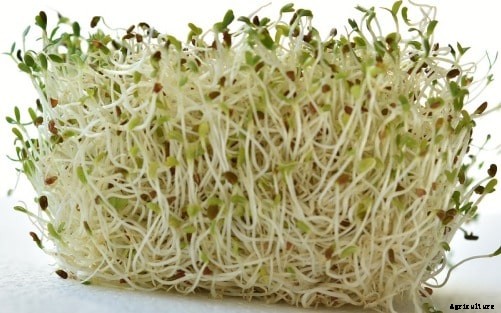 Alfalfa Sprouts.
Skin and Hair Benefits of Alfalfa:
- The chlorophyll, which is present in Alfalfa will help to clean the impurities in our body. This will help in the detoxification of the body and also helps to fight any sort of infection. Alfalfa is the plant which has the capability of breaking down carbon dioxide and decrease any sort of action in which anaerobic bacteria are involved.
- This is richer in the content of Vitamin A and enzymes. These are the ones which are essential for healthy skin. Vitamin A plays a vital role in building healthy skin and also its maintenance. Vitamin A works internally and gives wonderful results externally.
- Vitamin B1 and Vitamin B6 are the ones which are present in this plant which would help the hair to grow in a proper way of protecting its health. Alfalfa has several other nutrients which act as a remedy for baldness.
- Alfalfa, which is rich in proteins which would help in the growth of hair. The seeds, grains, and sprouts of the Alfalfa plant present in your food will help you in providing healthy hair.
- Alfalfa is a plant which is rich in vitamin B1 and Vitamin B6, which helps in healthy growth of hair. Vitamin C plays a vital role in the improvement of blood circulation. Vitamin E helps in raising the intake of oxygen and proper circulation of blood.
- This plant has minerals like zinc, iron, calcium, which play a major role in the prevention and reduction of hair loss. The iron content in Alfalfa helps in the growth of hair as deficiency of iron may be one of the reasons for the loss of hair.
- Silica plays a major role in slowing down the hair loss process. So adding Alfalfa in your daily food will help you to have healthy hair.
Health Benefits of Alfalfa:
- Alfalfa controls the content of cholesterol in the body. It helps in the prevention of levels of cholesterol from your body from increasing which would, in turn, decrease the risk of heart ailments.
- Alfalfa is very popular for the treatment of problems related to digestion. Stomach ulcers, bloating, digestive issues, gastritis can be reduced by using this plant. The sprouts of Alfalfa are well known for their effective treatment for constipation, which is chronic due to raising in fiber content.
- It has properties of detoxification which makes it a wonderful food which cleans the body. If you take this plant daily, it will help you keep your body clean internally.
- Risk of cancer can be reduced by adding Alfalfa in your daily food. It has amino acid which is called convenience, which helps in the prevention of cancer. It also binds carcinogens which are in the colon.
- Alfalfa plant is the one which has diuretic properties which help in the prevention of kidney disorders like retention of water. Urinary tract infection can also be prevented from developing due to the great properties this plant possesses.
- Due to high chlorophyll content, iron content and vitamin K content, extra content of blood would be produced in the body. Alfalfa plant is also used in the treatment of bleeding from the gums and nose, anemia, blood clots.
- The hormones called Phytoestrogens are the ones which will be used to reduce the menopause symptoms. There are three types of hormones, which can be found in Alfalfa called genistein, coumestrol, biocanina. The minerals which are present in Alfalfa are effective in reducing the symptoms of menopause. It also helps in raising the levels of estrogen in women.
- The phytonutrients and chlorophyll in the plant of Alfalfa will raise the resistance of the body towards diseases. It also plays a major role in the reduction of blood sugar and in the prevention of type-II diabetes.
- The tea, which is prepared by using Alfalfa has a very good nutrient content. This tea was used as a tonic in the early days in order to treat any kind of ailments. This tea plays a major role in improving the appetite and gives a rapid recovery from illnesses. Alfalfa tea is a powerhouse of nutrition. No wonder it had been quite popular in the earliest days as a complete tonic to improve the appetite and invoke a quicker recovery from various illnesses.
- By using this, the levels of sugar in the body can be controlled.
- The nature of detoxification present in Alfalfa tea has the capability to control the sugar levels in the body.
Side Effects of Alfalfa:
- Alfalfa should be avoided at the time of pregnancy as it causes stimulation of uterine or contractions.
- When you have thin blood, do not use Alfalfa because the vitamin K which is present in Alfalfa will cause thinning of blood which would lead to severe situations.
- The people who have autoimmune disorders or lupus should not use Alfalfa due to the presence of amino acid I-canavanine in Alfalfa.
- As the Alfalfa sprouts would be moist, there is a chance of bacterial growth. Hence, the people whose immune system are compromised should not take Alfalfa.
Read: Citronella Farming, Cultivation Practices.


