
Welcome to Modern Agriculture!

Here is the information about Davana Farming, Cultivation Practices, its essential oil.
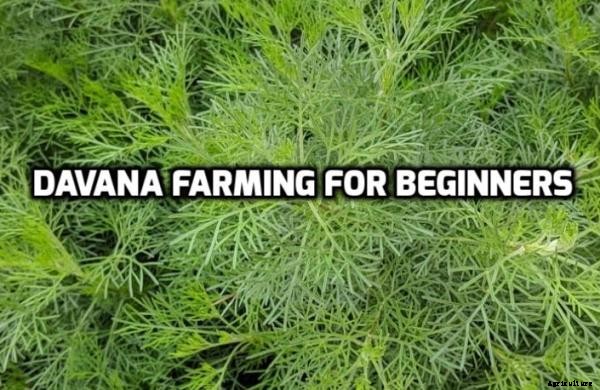
Davana is an herb that belongs to South India. This herb is traditional and is special because of its fragrance which is fruity. This essential oil will be in a yellow-brown color mostly and it is steam distilled. The entire plant will be distilled just before the flowering starts. This is used as the main component while preparing garlands etc. The springs belonging to this herb will add freshness and have a very rich odor.
Davana essential oil is not much popular in India. This oil is a viscous liquid that is brown in color with a rich odor of fruits. Countries like the USA, Japan are showing tremendous interest in this oil and are using it as a flavor for cakes, beverages, etc. This oil can also be used in preparing perfumes.
Suitable Soil for Davana farming: The cultivation of the Davana herb will mostly take place in South India. In South India, the regions with red soil have more plantations of Davana. It also grows well with soils that are rich in loamy.
Climate requirement for Davana farming: If you are growing the crop for the purpose of making garlands, then the season is not an issue. The climate becomes the primary thing when you are producing oil by using the herb.
In the production of oil, the crop will be grown until flowering occurs. Flowering takes place after 120 days of sowing the seeds. This crop will be small from November to February i.e., winter season and as a stubble crop, it keeps growing from March to May. The sunlight, which is bright, winter, which has no frost, a few sprinkles of rain will make the plant grow very well. If the weather is cloudy, the yield of oil gets affected.
You may also check this: Herbal Farming.
In case if you miss this: Organic Farming FAQ.
Before the transplantation of the seedlings, 12 tonnes of the manure from the farmyard, 500 kgs of superphosphate, and 130 kgs of muriate of potash are made to dwell in the soil which is present in 2 hectares of land. 150 kgs of nitrogen are given in three equal intervals. After 10 days of the transplantation, the first dose of nitrogen will be given, the second dose will have a gap of 15 days, and the third dose will also have an interval of 15 days. In stubble or ratoon crop, 170 kilograms of urea is used for the application to two equal parts of the land.
Davana plants start growing quickly and the buds of flowers will start appearing by the end of the month of January. Now, the harvesting of the crop takes place when most of the flower buds are opened. For all the flower buds to open, it takes one more month i.e., February. Harvesting of the plants will take place at a height of 11 cm from the ground level. The sprouts, which are freshly come again and another crop will grow after 60 days approximately.
The herbage of Davana is now dried in a place that has complete shade. This will be dried for a period of 72 hours and then steam distilled so that the oil can be produced.
The herbage which is fresh and also the one which is stubble or ratoon crop will give a yield of 13 tonnes per hectare. This yield, when dried in shade and steam distilled, will give 10 kgs of Davana oil. Maturity of the crop which is approximate and shade drying, which is done in a proper way are the main factors that affect the quality of the crop and the yield of the oil. When the distillation is done on a large scale, the yield of oil on an average of 3% from a dried yield for 48 hours is considered good.
The content of oil in the Davana is more in the flower and is very less in the stem and leaves. While harvesting, the heads of the flowers add 50% of the total weight of the plant, and only 28% is contributed by the stubble or ratoon crop.
In case if you are interested in this: Organic Vegetable Farming Plan.


