
Welcome to Modern Agriculture!

Today, let us discuss Pig Farming Loan, Subsidy, NABARD Schemes, and Eligibility.
Pigs are reared by the poorest of the rural people and they provide meat, dung and few byproducts like bristles, etc. These animals have wide adaptability to suit for different agro-climatic conditions. Pig farming can play an important role in improving the socioeconomic status of this section if existing constraints on their economic rearing are removed. Pig farming as a commercial venture is yet to be adopted in all countries. Pig farming will offer employment opportunities to seasonally employ rural farmers and supplementary income to improve their living standards. Some advantages of pig farming are:
This contains information on land, livestock markets, availability of water, feeds, veterinary aid, breeding facilities, marketing aspects, training facilities, the experience of the farmer and the type of assistance available from State Government Regional Pig breeding centers. This also contains information on the number of and types of animals to be purchased, their breed, production performance, cost and other relevant input and output costs with their description. Based on this, the total cost of the project, margin money to be provided by the beneficiary, requirement of bank loan, annual expenditure, income, profit and loss statement, repayment period, etc., can be worked out and included in project cost.
The following information on technical, financial and managerial aspects in detail based on the kind of unit and capacity.
Borrower’s profile
For pig farming development schemes with large outlays, detailed project reports will have to be prepared. The objects such as land development, construction of sheds and other civil structures, the purchase of the breeding stock, equipment, feed cost up to the point of income generation are normally considered under bank loan. Other items of investment will be considered on need basis after providing that the satisfactory information justifying the need for such items.
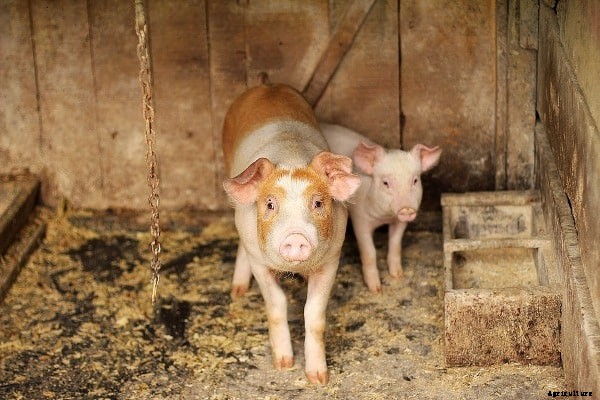
After ensuring technical feasibility and economic viability, the plan is sanctioned by the bank. The loan is disbursed in stages against the formation of specific assets such as the construction of sheds, purchase of equipment and animals. The end use of the fund is verified and regular follow-up is done by the bank.
Read: Greenhouse Farming Subsidy, Loan.
Purpose: Pig farming loans are sanctioned for improving/establishing piggery farms for fattening/ breeding, including the purchase of boars, sows, feeds and construction of a pig sty.
iii. Suitable breeds of pigs should be simply available.
An outlay of the project depends on the local conditions, the unit size and the investment components included in the project. Prevailing market prices or cost may be considered to arrive at the outlay.
Margin depends on the group of the borrowers and may range from 10% to 25%. Banks are free to choose the role of interest within the overall RBI guidelines. However, for working out the financial viability and bankability of the project we have assumed the rate of interest as 12% p.a.
Loans up to Rs.1lakh – Nil
Loans above Rs.1lakh – 15-25%
The security will be as per NABARD/RBI guidelines issued from time to time.
For loan up to Rs.1, 00,000/-: Hypothecation of assets produced out of our finance.
For loans above Rs.1, 00,000/-: Hypothecation of crops/assets produced out of our financial and Mortgage of land properties.
Repayment period depends upon the gross surplus in the plan. The loans will be repaid in suitable half yearly/annual installments, usually within a period of about 5 to 6 years with a grace period of one year.
Animals might be insured annually or on long term master policy, where ever it is applicable.
Eligibility:
Read: Tractor Subsidy, Bank Loan, Eligibility, Schemes.
Under Animal Husbandry Programme, SBI-State Bank of India provides loans for the eligible individuals to start Pig Farming.
EDEG (Entrepreneurship Development and Employment Generation)
EDEG method is for Pigs development. It is a Government plan to encourage Pig Farming in India.
The objectives of EDEG scheme:
Beneficiaries: Farmers, Companies, Cooperatives, individual entrepreneurs, NGOs, Groups of organized and unorganized sector, which include Self Help Groups (SHGs) and Joint Liability Groups.
Subsidy for various areas and different categories of beneficiaries:
Back ended subsidy
Credit
Beneficiary Share/Margin Money
BPL/SC/ST
APL
33.33%25%
56.67%65%
10%10%
Back ended subsidy
Credit
Beneficiary Share/Margin Money
BPL/SC/ST
APL
50%35%
40%55%
10%10%
Pig Development-EDEG
Note: The above information can be applied to all the states in India including:
Read: Prawn Cultivation.


