
Welcome to Modern Agriculture!

• It should be made from locally available materials such as dry thatching grass, polythene sheets, papyrus mats placed over polythene sheets, dry banana leaves placed over polythene sheet or iron sheets
• The roof should be at least three meters above the ground to create a cool environment
• Be rain and sun proof
• Collect rain water if corrugated iron sheets are used
• A minimum slope of 450 is recommended
• Use either bricks or timber off cuts. The off cuts should be nailed on the inside part of the house to prevent the pig from pushing against it easily
• The wall should be well plastered
• Use treated poles to support the structure
• The floor should not be cemented but left bear with a soil surface
• It should be covered by parent material of dry matter ( grass, maize stalk, sorghum straws, twigs or small branches)
• The parent material should be covered by a mixture of either fine saw dust, or rice/wheat bran mixed with lime, table salt, red soil.
• The material is then maintained by sprinkling a solution containing Indigenous Micro Organisms (IMOs)
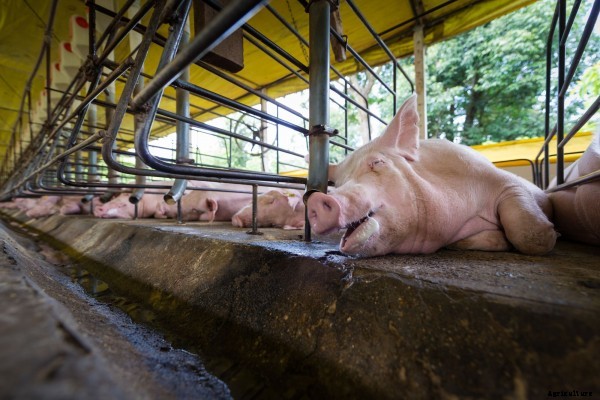
The amount of space will depend on:
The housing unit should not be overcrowded as this will lead to:
Dry Sows should be housed in groups. Boars are kept in individual pens to eliminate fighting, riding and competition for feed. Boars kept separately live longer. Boar pens should be close to recently weaned pig Sow pens. This promotes fast return to heat.
Each lactating Sow should be kept in a separate pen. There should be a creep area for the piglets; the piglets can run to this area to avoid being crashed by the Sow as it lies down’


