
Welcome to Modern Agriculture!

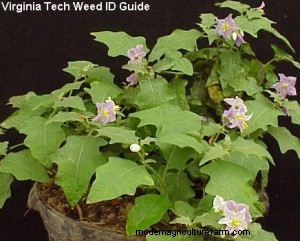
Editors Note: This article was written before I had worked with a farmer, Don Ashford, to teach his cows to eat horse nettle. Read that article here.
When I travel in the eastern U.S. I get this question a lot. Here’s what I wrote to Chris Teutsch at Virginia Tech:
I shared this information with folks in Vermont who asked. Chuck Armstrong wrote back saying:
I think more dialogue is an excellent idea. What I’ve learned from watching tons of cows eat weeds, is that our own biases often color what we think is happening in pasture. I would want to talk directly with the farmer who thinks that horse nettle makes his cows sick and the circumstances under which that may have occurred. The order foods are eaten in, the quantity, the availability of other forages, other things the animals are eating, all these things affect what happens when an animal eats ANY food, and it’s very easy for us to set them up for failure without even realizing it. I also know that animals don’t eat things that they have no experience with if no one they know is eating it, or if they have no reason to eat it. Saying it’s not edible because my cows don’t eat it is the same as saying, vegetables aren’t edible because my 3 year old won’t eat them.
One of the best examples I have of our beliefs coloring what we think happens when an animal eats a weed is cows eating leafy spurge. We’ve all been told that they get diarrhea, burns around their mouths, etc. and some researchers have actually killed cattle by feeding them leafy spurge. But when I started training cows to eat this weed, I knew that there was a herd of cattle that chose on their own to eat it in Nebraska, and I figured if it worked for them, I should be able to figure out how to make it work for others. What I learned along the way is that the reason the researchers killed the cows is that they only gave them leafy spurge, and that the more variety I give my animals, the more leafy spurge they can eat. I also learned that all these years we’d been relying on faulty scientific citations for our belief that it causes burns on the skin and mouth.
So…I think we need to look into it more. If you’re a farmer dealing with Horsenettle, let’s talk. Perhaps we can put together a little project to help folks out with this weed.
Save


