
Welcome to Modern Agriculture!

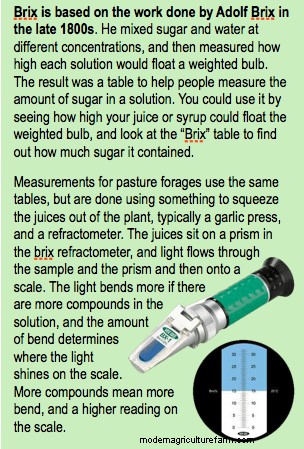 If you want to find out whether a change you’ve made is making a difference on the ground, you want to use a measurement technique that will give you reliable results every time. Brix is not that kind of measurement technique. Because Brix measurements are so susceptible to change based on weather, time of day, barometric pressure, handling of the sample, and more, it’s very difficult to get an accurate baseline. What you get instead is a picture of the sugars in a plant at a very specific instant in time under very specific circumstances. That means it’s not such a useful way of figuring out how things are going in your pasture.
Brix is a measurement of sugars in a plant. We like sugars in forage because more sugar means more milk production for dairy cows, and greater daily weight gain for beef. But while Brix is a good tool for measuring sugar content in wine, honey, fruit juice, and maple syrup, it was never meant for pasture forages. Here’s why:
Photosynthesis adds sugar to a plant, so brix values start increasing a few hours after sunrise and go up by several percentage points as the day progresses. Readings peak in the evening at about 6 pm. If it’s cloudy, less photosynthesis occurs and readings will be lower. In addition to time of day, shade or direct sunlight can affect a plant’s sugars. And all of this can affect your measurements.
If the weather is about to turn and barometer readings are dipping, plants send carbohydrates to the roots, to preserve its sugars and protect itself should an impending storm damage the above ground plant. This movement of carbohydrates to the root can cause a lower brix reading, much like sampling on a cloudy day, or early in the day.
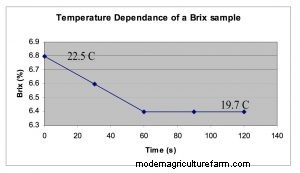 If the sample and the prism in the refractometer are different temperatures, your reading will be inaccurate. Digital refractometers can compensate for this, but it may take 40 seconds to a minute for the compensation to be made, and during that time sugar concentrations can change too. In one study, the brix measurement dropped 6% when the temperature dropped less than 5 degrees.
Plants change over the course of the growing season, and no two growing seasons are quite alike. A good example of seasonal variation due to plant maturity comes from measurement from four New Zealand Dairy farms where digestibility ranged from 65-80%, and crude protein from 13-32%. Those variations also would be reflected in brix readings.
Readings can also change depending on which part of the plant you sample. Leaves have more sugars than stems so you have to use the same part every time. Sugar concentrations can also vary widely among types of plants. If you have multiple species growing in your pasture, will you just look at one species or will you sample multiple species? Mixing clover and ryegrass can be mixing apples and kiwis.
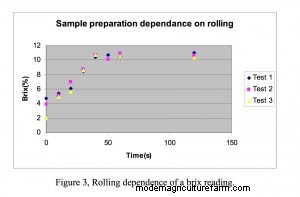
Part of the sampling process includes “pre-juicing” – rolling the grass around in your hands as a way to get the sample ready. This rolling time can change the reading a lot. Rolling the sample for just under a minute increased the reading by 250 to 400%
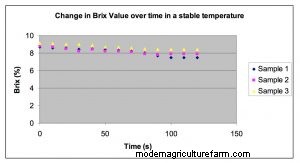 During the time it takes to get a sample and read the result, the sugar content can change. In as little as 2 minutes, the brix reading can change by about 10%. This could be because of enzymatic changes, but no one is quite sure.
Finally, contaminants can affect brix readings. Dirt and water, like dew or the dust on a blade of grass, can contaminate the sample and affect the reading. Your sample can also include bits of plant cell walls, minerals and proteins, and lipids, along with the sugars, all of which can make a big difference in the results.
It’s really hard to take measurements at the exact same time, temperature, and barometric pressure, and then ensure that you choose the exact same part of the same type of plant, and that the rolling and reading of the plant is the same every time. It’s even nearly impossible to do multiple samples in the same pasture on the same day because something will have changed by the time you make it from one end to the other.
All forms of measurement are imprecise to some degree, but brix measurement has so much going against it that we don’t recommend it as a pasture management tool. While it has the appearance of science and data collection, the reality is that the science just doesn’t back it up. For this reason we are also cautious about products sold based on their ability to increase brix measurements.
Next, here are some recommendations for figuring out the quality of your forage.

