
Welcome to Modern Agriculture!

RAS Fish Farming:
Today, we are going to discuss RAS Fish Farming Equipment, Cost, Training, Courses and RAS dealers in India.
Introduction: (RAS) Recirculation Aquaculture System is land-based fish farms, which allows all year-round control and delivery of fish. As per the availability you can use fresh water, brackish or marine water, a R.A.S work on the same principles. The RAS system will provide optimal temperature and optimal and stable production around the year, independent of seasonal variation, location, climate, and environment. These Recirculation systems will occupy very less area and consume very less water consumption compared to other forms of aquaculture. Filtering (Biofilter) system is necessary to purify consumption compared to or detoxify harmful waste products and uneaten feed. Recirculation systems will have filter systems that clean the water for recycling back through fish culture tanks. RAS technology steadily developed over the past 30 years and is widely used for Brood Stock, Hatcheries and Rearing of Fish and increasingly for other species of Fish. Recirculation Systems occupy very little area and require less water consumption compared to other forms of Aquaculture. A Filtering system is necessary to purify the water and remove suspended solids or any other detoxifying waste products. Recirculation system includes Biofiltration, Ozonation Oxygen Generation which in terms helps us to maintain good water quality and yield in higher production. As these Systems occupy a very small area which allows the grower to stock fish at high densities and produces high yields per unit area. Recirculation systems are becoming popular as they provide a predictable and constant environment for growing fish. Species of Fish that can be cultured with recirculation system include Barramundi, Murrel, Pangasius, and Tilapia, etc. The process of Recirculation the waste loaded pond water will reduce the potential pollutants which assure the availability of quality water for fish farming where the source of Fresh Water is limited. This system eliminates water quality problems. This system of farming highly improves survival and growth performances of fish due to the high degree of control over the water quality. Oxygen can be replenished through aeration and most of the carbon dioxide is dispatched hence reduces the risk of disease and parasite infections considerably.
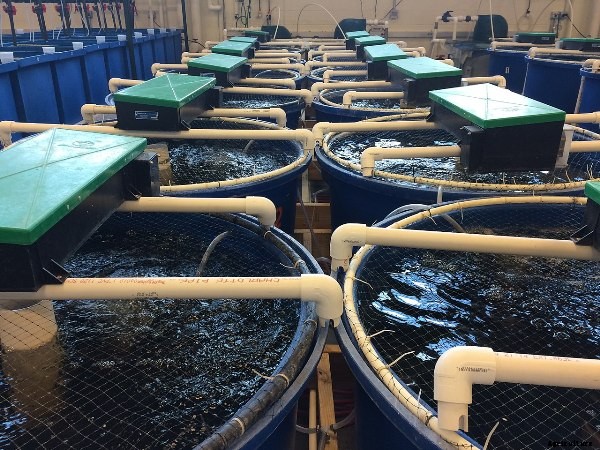
RAS farming has many advantages over open pond culture. The most important benefit is it maximizes the production on a limited supply of water and land, nearly complete environmental control to maximize fish growth year-round, the flexibility to locate production facilities near to the market, RAS farming systems are complete and convenient for harvesting, and quick and effective disease resistant farming method. RAS systems are of various sizes ranging from large-scale production systems (over 1 million pounds per year) to intermediate-sized systems (500,000 pounds per year), to small systems (50,000 pounds per year).
These systems can be used as grow-out systems to produce food fish or as hatcheries to produce eggs and fingerling sports fish for stocking and ornamental fish for home aquariums.
RAS is similar to broiler house or swine barn concept, so prevalent and effectively used in modern poultry and pork production systems, to rear large numbers of fish in a relatively small space. In Indoor fish farming, the tanks may revolutionize fish production in the same way that confinement systems altered the pork and poultry farming industries. RAS is an excellent alternative to open pond cultivation with low densities (extensive culture) of fish are reared free in large ponds and are protected from diseases, parasites, predation, pollutants, stress, and seasonally suboptimal growing conditions.
RAS conserve both water and land. RAS Farming systems will have a maximize production in a relatively compact area of land using a relatively small volume of water. For example, using a RAS we can produce over 100,000 pounds of fish in a 5,000 square foot area, whereas in the traditional open pond culture we need 20 acres of outdoor ponds. And in RAS, the water is reused, the water volume requirements in RAS are only about 20% of what conventional open pond culture demands. RAS is a promising solution to water use conflicts, water quality, and waste disposal.
RAS is mainly useful in areas, where the land and water are highly expensive and in areas where water is not available. RAS method of farming requires relatively small amounts of land and water. This type of farming systems is suitable in northern areas where a climate is very cold, which is not good for fish growth in outdoor and this shows great impact in year-round production. RAS can be the best solution for farmers who are geographically disadvantaged due to short growing season (less than 200 days) or extremely dry (desert) conditions, a competitive, profitable, year-round fish production system. RAS systems can be located close to large markets (urban areas) which reduce the hauling distances and transportation costs. We can use municipal water supplies (dichlorination is necessary) for RAS and you can discharge waste into sanitary sewer systems. Many species of food fish and sports fish are reared in RAS ponds, including catfish, trout, and striped bass can readily be grown in high densities when confined in tank systems.
Read: Pig Farming Loan, Subsidy, Schemes.
RAS is highly suitable for growing catfish, striped bass, tilapia, crawfish, blue crabs, oysters, mussels, and aquarium pets.
Indoor farming methods are flexed to (1) grow a wide range of fish species, (2) you can rear different species simultaneously in the same tank (polyculture) or different tanks (monoculture), (3) you can raise a variety of different sizes of one or several species based on your market demand and price. RAS provides rowers the opportunity to manipulate production to meet demand throughout the year and to harvest at the most profitable times during the year. In RAS you have an option to select species and the low harvest time RAS allows the grower to rapidly respond to a changing marketplace in order to maximize production and profitability. RAS will permit the grower to respond to market price and demand fluctuations by altering harvest rates and times and the species cultured.
In Traditional RAS aquaculture, fish are reared in tanks. Evaporation during warm-weather months and splash-out causes may lead to the loss of water in the pond. You should be sure that the fish have adequate fresh water, you need to install the pumps to fill the small ponds or lakes used for fish farming with fresh water from a larger nearby freshwater source. At the end of a growing cycle, or at the end of the growing season, the farmer will drain the water from the pond. They also use the pumps for draining purposes. In some areas, we need to run the processes to remove impurities and fill the fresh. The pump is used to clean water back into the fish tank for use with a new hatch of fish.
The most commonly used types of pond pumps are centrifugal and turbine. Centrifugal pumps are placed horizontally along the outer perimeter of the fish pond or lake. Turbine pumps are placed vertically. Both styles are efficient at moving water.
Aeration devices are used for moving water in and out of the fish-growing water source, it is necessary to use aeration devices to provide the fish with an adequate level of oxygen. Aeration devices help to rear more fish in less space as well. Fish farmers use recirculation aquaculture systems, or RAS, using these systems, you can grow fish in tanks housed in buildings. The aeration devices help to recycle the water after removing impurities.
During the harvesting the fish, seine reels helps to collect the fish from the water tanks. The seine sinks are placed at the bottom of the tank. to collect the fish into its net. And the reel pulls the fish inside the seine and transfers them to the sorting or grading equipment. During this gathering process, the aerators should be operated in full speed to provide oxygen for the fish.
While fish harvesting, you need to grade them by size. Belts help the fish to move from the seine to the holding tank. During the transfer, grading equipment will sort them based on their sizes.
Read: RAS Farming Project Report.
And there even many more companies that provide a complete set of RAS system.
A proper filtration process and expects to re-use the 90% of the used water through the filtration process. As it will help to culture Pangasius and Tilapia as well other varieties of Catfish too. A recirculation fish farming system comprises of several major components (24*7 electricity, water facility Bulk feed storage, Emergency Generator, and Three Phase Electricity, Pumphouse, Building, and Recirculation components) that are necessary for the management of the whole RAS system which needs to have both site and system components. The implementation of ecological engineering principles will improve the production of high-value fish crops while meeting stringent nutrient/toxicant discharge regulations. Recirculatory systems are indispensable for sustainable fish culture and as a principle that forces to develop the ecological engineering design. This system creates greater efficiency and productivity of ponds. The usage of ecological engineering principles to water pollution control in fish culture ecosystems can reduce treatment costs. Fish culture systems are generated to have large volumes and system backing to have less polluted water. Since nutrient mass loading is the critical factor which always needs to be taken as the most important to look after, treatment of the tank water should be in regular practice which will allow us to achieve better results in tank culture.
Read Tuna Fish Farming.

