
Welcome to Modern Agriculture!

Introduction to Organic Cassava Farming
Cassava is a family member of the Euphorbiaceae. It is also called manioc, mandioca, or yucca. It is a perennial and can grow to a height of around 4.5 meters. The complete plant may be viewed as a food production factory with the end products being tubers for animal and human consumption. Organic agriculture is a system that improves and promotes agroecosystem health, including biological cycles, biodiversity, and soil biological activity. Organic farming mainly focuses on the use of management practices in preference to the use of off-farm inputs, taking into account that regional conditions need locally adapted systems.
In organic farming, crop management starts by giving the plants the best-growing conditions, for example through improving soil fertility, and by using healthy and suitable planting material. This will make the entire crop grow healthier, and thus produce more yields. In Organic farming, some of the farms are strictly following the production guidelines of a specific regulatory code, and others develop their independent systems. Though, all organic systems share common goals and practices;
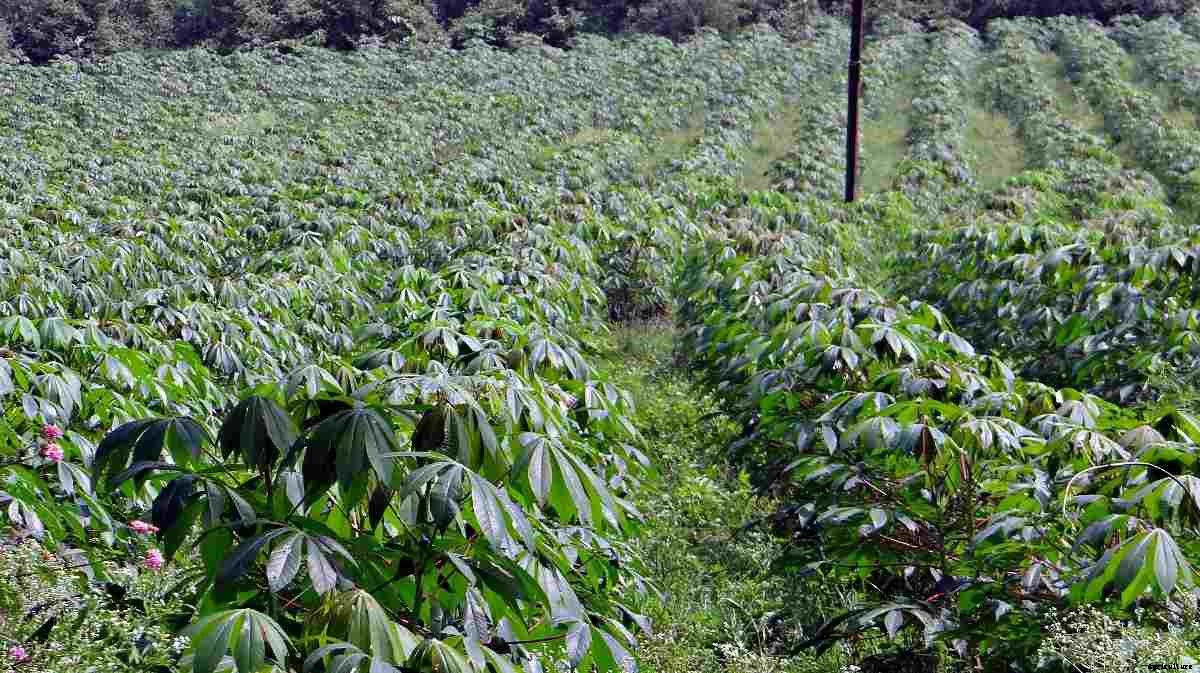
Cassava is usually grown in a savanna climate but can be grown in extremes of rainfall. In most areas, the Cassava plant does not tolerate flooding. In dry areas it loses its leaves to conserve moisture, producing new leaves when rains restart. It takes 18 or more months to produce a crop under adverse conditions such as dry or cool weather. Cassava does not accept freezing conditions. It tolerates a wide range of soil pH values from 5.5 to 6.5 and is most productive in full sun conditions. Although Cassava can produce a crop with nominal inputs, best yields are recorded from fields with average soil fertility levels for food crop production and regular moisture availability. Cassava is grown on low fertility sandy soils without any soil improvement or soil and water conservation. Cassava will be grown well in best drained sandy loam soils with 10 to 12 hours day length, 10 to 30°C temperature, and 500 to 2500 mm/year precipitation.
Thick sandy loam upland soils are perfect for Cassava. If the soil is clayey, drainage is a must and should for this plant. At the time of land preparation, you can add organic manure to the soil to improve soil nutrients, structure, and improve the ability of the soil to hold water. If you cannot avoid Cassava growing on steep slopes you can grow Cassava varieties with early, much and low branching habit to cover the ground rapidly and properly against rain erosion. You can also make ridges across the slopes and mulch the ridges to decrease erosion.
Good soil is one of the most significant factors essential for high Cassava yields. The crop needs a suitable root room to expand, so the best soil is loose (friable) with an abundance of available nutrients for healthy plant growth. Soils can be acid with a pH of less than 7 or alkaline with a pH greater than 7. Cassava can tolerate soils within a wide range of pH values from 4 to 8. Though, the best pH range for growing Cassava is 5.5 to 6.5. Limestone must be incorporated into more acidic soils at 3 to 4 months before planting, using a rate of 2 to 4 tons per hectare, depending on the level of acidity. Liming acid soils have many benefits. It reduces the uptake of aluminium and iron, which are toxic to Cassava plants; provides calcium for proper cell wall formation; and enables good bacteria to decompose soil organic matter making nutrients available for plant growth. One piece of big areas full of natural fertility with water resources that had not been under chemical control for a long time is recommended. Soil and water analysis before organic production is necessary to avoid the residual effect of chemical substances.
Cassava organically grows well between 30°S and 30°N in areas where annual rainfall is more than 750 mm a year, temperatures above 18°C and low to medium altitude (1,500 to 2,000 m). It is sensitive to frost but accepting long dry periods, soils with low pH value, high aluminium, and low fertility.
Cassava is propagated by cuttings. Because it is a root crop, Cassava needs well-drained sandy clay loams. Poor soils must be fed with compost to increase the organic matter level and overall fertility. In the case of shallow soils, ridges or mounds must be created to increase the topsoil volume per plant. In deep soils, Cassava must be planted on flat land.
Steps to Propagate Cassava;
If water is available either through well-distributed rainfall or irrigation, the crop can be planted at any time of the year; if possible, at the beginning of the warm season (growth slows in cold weather). In places where irrigation is not available and rainfall is seasonal, delay planting until rains are reliable. It is planted in April at the beginning of the long rainy season and in September at the start of the short rains. Though, earlier plantings in March and August respectively can significantly improve root yields.
Sets 25 to 30 cm in length are planted vertically in beds, ridges, or mounds to a depth of 5 cm. Proper care must be taken to avoid the planting of sets inverted. Spacing should be based on the branching pattern of varieties. In general, non-branching and erect varieties are planted at a spacing of 75 x 75 cm and semi-branching or branching varieties at a spacing of 90 x 90 cm. If in case, sets are dried after planting, 5% of stakes may be planted as a reserve in the field, separately at a closer spacing of 4 x 4 cm for gap filling after 20 to 25 days.
Use cuttings from healthy, strong Cassava plants between 8 and 18 months old. Younger material tends to be soft and susceptible to dehydration. Older material lacks the food reserves necessary for the development and growth of the plant. Choose cuttings from the middle portion of the stems. By using a clean, sharp cutlass or handsaw, cut stakes into 20 to 30 cm long with an average of 9 to 12 nodes. Sterilize those cuttings in a 1% bleach solution
Nutrient Uptake of Cassava
The crop removes substantial amounts of nutrients from the soil. The degree of nutrient removal fully based on the yield level. Hence, nonstop production without replacement of the nutrient loss in the soil will decrease the soil productivity.
Fertilizers supply the important nutrients that are lacking in the soil. Fertilizers are classified either as organic (manure, compost, etc.) or inorganic (i.e. complete, muriate of potash, etc.).
Return the remainders of healthy harvested plants to the soil by gathering them in one area to let them decompose and later apply it as organic fertilizer or by applying it as mulching material for next cropping.
Application of organic fertilizer on Cassava;
Animal manure comprises plant nutrients and increases the physical condition of the soil. The integration of farm animals can, so, contribute to better recycling of nutrients within the farm, if the animals are fed on farm-own forage legumes and the manure is returned to the field. Cassava plants will profit from the valuable manure the sheep, cattle, goats, pigs, or chicken offer. To decrease nutrient losses from manures, special attention must be paid to their storage, collection, and application.
Organic wastes such as animal manure, kitchen wastes, and plant materials can also be collected, composted, and applied to the Cassava field to refill the nutrients taken away through harvest. These materials increase the number of nutrients also the soil organic matter content, and thus the soil’s physical conditions and water-holding capacity.
The soil must be moist at the time of planting Cassava, otherwise, irrigation is essential. If the irrigation system is not available, it is important to plant the collection at the start of the wet season when rain is reliable.
Prune plants around 9 months after planting when using high densities or if growth is excessive. Note that pruning can create wound entries for pathogens and pests, and can spread them from one plot to another plant by way of the workers’ clothing and cutting instrument. Dip cutting instruments in a detergent solution between plots to extinguish viral and bacterial pathogens on the surface.
Below are some of the common diseases affected in Cassava;
The above diseases can be controlled by using disease-free stakes for plantation. Research centers develop resistant varieties; you can use those for the cultivation of Cassava. Some insects affecting Cassava are;
Frequent field inspection is one of the best options to control the spread of insects and diseases. And another method is to practice intercropping patterns. Crops like groundnut, maize, black grams are cultivated which help in controlling the diseases in Cassava.
Bacterial blight
Bacterial blight is one of the most widespread and serious Cassava diseases. Though potentially devastating, bacterial blight can be controlled efficiently with “Save and Grow” practices. They include;
Mealybugs
Mealybugs feed on Cassava petioles, stems and leaves, and inject a toxin that causes leaf curling, slow shoot growth, and eventual leaf withering.
Below are the best recommendations for the control of Cassava mealybugs;


