Maturity of Fruits and Vegetables-A Beginners Guide
The maturity of fruits and vegetables:
Today, let us discuss the maturity of fruits and vegetables.
The maturity of fruits and vegetables generally refers to the attachment of the last stage of the biological function of the part of a plant or the complete plant. It can also be a specific stage in the plant life of the fruit in which they grow to the maximum size.
You can get a very good quality of fruits and vegetables when the harvest is done at a perfect maturity stage. This will be the stage where any organ or part of the plant will have complete growth and also development. Therefore, this is the stage for the development of fruits after which there would be no growth further. After an organ gets matured, it will start the stage of declining which can also be called ripening.
Harvesting early will give the fruit or vegetable a long lifetime to get ripened. If the maturity is higher, then there would be fewer days needed for the ripening of fruit. But the fruits which are ripened from the early harvests and of quality which is poor can be known by the organoleptic ratings which are low and with the maturity and quality which is increasing. The indices of maturity are also termed as Standards of maturity or the Maturity signs. Signs of maturity would be of great help in the judgement of fruits and vegetable maturity. The maturity signs are completely dependent on skill, judgement and experience. As the value of fruits and vegetables in the market is completely dependent on the quality of produce, complete knowledge about indices of maturity at the correct stage of the harvest will have great importance. One more thing is that the shelf life of the produce in a few fruits will be completely based on the stage of maturity of the produce which is harvested.
Maturity is the process for the determination of the perfect moment or stage to pick up the crop. The moment or the stage at which the harvest of the crops is done is an important factor for good quality. Perfect quality can be attained when the harvest is done at a perfect stage of maturity. The harvest of fruits which is done at best maturity may not have chances to get ripened in an adequate way and there are chances that they might not have a good flavour whereas the crops which are harvested late after the crops are over matured will have less life of postharvest and will get damaged easily.
There are five factors to judge the fruit maturity
Visual
Chemical
Physical
Physiological
Computation
Types of maturity:
Physiological maturity:
This maturity will refer to the development stage of the fruits and vegetables when there is an occurrence of maximum growth and maturation. This stage is generally associated with the complete ripening of the fruits. The stage of physiological maturity is continued by senescence.
For example, A pod of okra will be physiologically matured when it seeds are completely developed and the pod will get split or opened due to a small amount of pressure.
Horticultural maturity:
This type of maturity will refer to the development stage in which the commodity reaches the development level which is enough for use. This kind of maturity is sometimes referred to as a maturity that is commercial.
For example, papaya which has a green pulp and peel and got to its maximum size is matured commercially in the form of a vegetable but when it turns tinge yellow colour, it can be used as a dessert.
Harvest Maturity: This type of maturity is defined as physiological and horticultural maturity. This is a stage, which will let the vegetables or fruits grow to their peak conditions by the time they reach the consumers and also develop the flavour which is acceptable, also the look along with the shelf time which is adequate.
For example, for the local marketing and processing, the tomatoes which are fully coloured will be harvested. And for a market which is at a distant location, the fruits which have just started to develop colour will be harvested.
Maturity Determination:
The determination of maturity of fruits and vegetables can be done either in a subjective or objective observation. As per Reid, the methods used for the determination of harvest maturity are as the following:
Visual: The size, colour of skin, persistent portion of style, the outer part of the leaf drying along with the complete body of the plant, variation in the smell, falling off of the fruits which are ripened.
Physical: Abscission, fruit weight, specific gravity.
Chemical: Acids, starch, TSS, sugar etc.
Computation: The days for the fruit harvesting until the stage of maturity.
Physiological: The rate of respiration, the evolution of ethylene internally.
Apart from all the above factors, specific gravity, heat unit which is an accumulated one, time after flowering, dry matter, firmness, the content of the juice in them, content of oil, tenderness etc can also be made use for the determination of the best stage of harvest maturity.
Few important factors of the fruits and vegetable maturity can be mentioned as the following:
Colour of the fruits: The skin of the fruit will change when the fruit reaches the stage of maturity or it also gets ripened. The determination of these specific changes can be done in a subjective manner by the person who is harvesting. The meters and charts of the colour are also developed for the determination of the times of harvest specifically for the fruits and vegetables like chilli, peppers, peaches, apples, tomatoes etc. Moreover, few types of fruits will not show any changes in colour at the time of maturity and hence this particular condition should not be used in an effective way. The changes in colour will change according to the cultivars of the same fruit.
If we consider an example, the cultivar of the kiwi fruit will have to maintain the green skin at the time of maturity whereas the cultivar of Sanuki Gold will have to change slowly into the colour of golden-yellow. Few cultivars of Avocado will also have to maintain the skin colour in green at the time of maturation.
Firmness:
Few fruits may also have changes in the texture at the time of maturity and these species can also be made use of for the determination of the time of harvest. The changes in texture can be detected in a subjective way by touch or squeezing them in a gentle manner. However, the measurement which is done in an objective way can be got by the usage of the pressure testers and the analyzers of texture.
The content of solids which are soluble and starch:
At the time of maturity, starch in the fruits which are not climatic will get converted into sugars. For the fruits which are climacteric, accumulation of starch will happen at the time of maturity. Hence, the determination of harvest maturity can be done by the measurement of the content of sugar or starch. Generally, the content of sugar will be measured in terms of the complete content of soluble solids by using a refractometer or Brix hydrometer. The measurement of the content of starch is done by the use of iodine for the qualitative determination of the starch amount. This specific method is used for the determination of the pear cultivars maturity whereas the fruit is sliced into two pieces and is dipped in a solution that consists of potassium iodide and iodine.
Time from the Fruit set:
Fruit set will refer to the change of a flower to fruit after they get fertilized. This will generally involve quick division of cell and the ovary gets expanded and seeds also get developed. In a few types of fruits, the time consumed for the fruit setting till the fruit initiates showing maturity signs are recorded and these can also be used for the determination of the time of harvest. For example, in the fruits like Alphonso and Pairi which are varieties of mango, it would take almost 125 days after the fruit gets set for the colour of the surface to get modified from dark green colour to the olive-green colour and the colour of flesh from a white colour to pale yellow colour.
Specific gravity:
The specific gravity of the fruit can be taken as an index for the grading of maturity. Water will have a specific gravity of 1 and 2.5% of the Salt solution will have a specific gravity of 1. Both of these are used in the grading of maturity of the fruits like mango.
To summarize the entire thing, the fruit maturity will have a great effect on the quality all along the chain of post-harvest. Maturity indices that are efficient, effective and accurate will have to be applied to make sure that the quality is high in all the levels including the value chain. The single maturity index will not be used for the determination of fruit maturity in a predominant way. It is always suggested to make use of various parameters parallelly for the improvement of the determination accuracy. Moreover, the application of one maturity index cannot be done all along with the cultivars of a similar crop. There would be minute differences across the cultivars.
Maturity signs of fruits and vegetables:
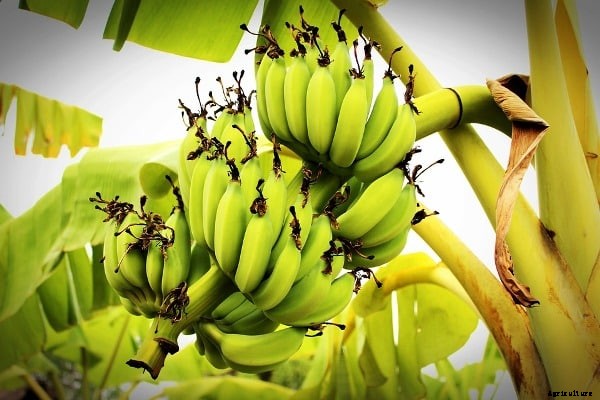
Banana:
The bananas which are dwarf would be ready for the harvest in a span of 12 months after plantation whereas the variety of bananas that are tall will take up to 15 months to reach the stage of harvest.
Fruits would generally get matured in a span of 150 days after flowering takes place.
The bunch of fruits can be harvested when the ridges which are present on the surface of the fruit will change from angular position to round one.
The parts of the flowers which are dried and are present on the top of the fruit will fall off very easily.
The leaf which is at the topmost position will start drying as soon as the maturity of the bunch takes place.
The fruit colour or the finger colour will change from a dark green colour to pale green colour.
Banana Tree.
Mango:
These fruits will usually need up to 120 days for maturity to take place after the occurrence of flowering.
Shoulder building and a minute depression at the stalk end is an indication of fruit maturity.
Fruit colour changes from dark green to pale green.
Two or three fruits that are ripe will drop off from the plant in a natural way which in turn indicate that the other fruit from the same tree is matured.
There would be a development of red blush on the shoulders of the fruit.
The fruits which have a specific gravity in between 1 or 1.3 will be termed as the matured ones.
You may also check this: Mango Tree Grafting, Training, Pruning.
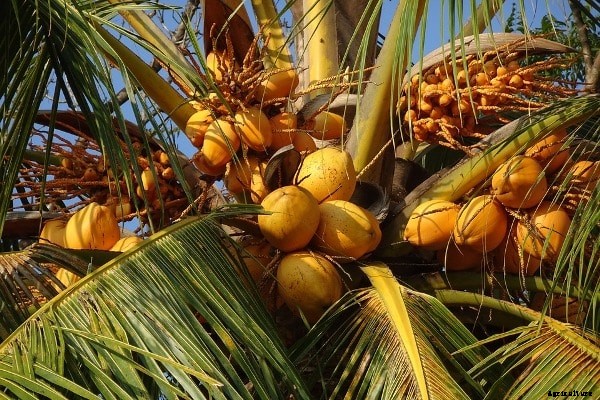
Coconut:
The maturity of coconut will generally take place in one year after the inflorescence appears.
The fruit colours will change from green colour to browning green or yellowish-green.
There would be a peculiar and metabolic sound produced from the fruit when thumped.
All the nuts which are present in the bunch will get matured at the same time in a uniform way.
Ready to harvest coconuts.
Arecanut:
These fruits will be ready for harvest in about 200 days from the stage of flowering.
The colour will change from green to orange or yellow.
Sapota:
Sapota fruits will usually get matured in 250 days after flowering takes place.
Sapota fruits that are matured fully will develop an orange colour or colour of a potato.
The fruit which is matured will show a streak that is yellow rather than the green one when scratched slightly with the nail.
The material which is brown in colour and scaly will not be visible on the fruit surface when the fruit reaches the maturity stage.
The latex content which is milky will get decreased.
The style which looks like a dried spine on the top of the fruit will fall easily when it is touched.
In case if you miss this: Sapota Grafting Methods.
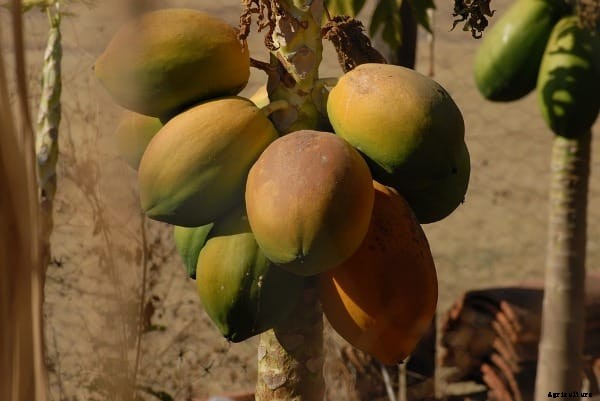
Papaya:
Papaya will need up to 150 days to reach the stage of maturity from flowering.
The fruit colour will change from green to yellow or pale green.
The section of the fruit which is exposed to the un will become dark yellow.
The fruits latex will become watery.
TSS at the time of harvesting should be at a minimum of 6%.
Matured Papaya.
Jackfruit:
The maturity of jackfruit will take place in about 280 days after flowering occurs.
A sound that is dull and hollow will be produced when we tap the fruit with our fingers.
The colour of the fruit will change from green to pale green.
The spinel of the fruit will develop well and become widely spaced.
The last leaf of the peduncle will turn yellow in colour.
An odour that is aromatic will start developing.
The spines will start yielding upon a medium pressure.
Cashew:
The cashews will mature in 125 days after flowering occurs.
Based on the variety, the colour of the apple changes from a green colour to yellow or even red.
The nut will become hard and turns to an ash colour.
Ber:
The ber fruit will require 150 days to reach the stage of maturity after flowering.
The colour of the fruit will change from a green colour to pale green or red or brown or yellow and it is completely based on the type.
The fruit will turn soft.
Guava:
The Guava fruit will reach the stage of maturity in about 150 days after flowering.
The colour of the fruit will change from green to yellow or pale green.
The fruit will become so soft.
A minute depression will develop at the end of the stalk.
Ridges present on the fruit will start disappearing and also become round in shape.
Read:Guava Farming Project Report.
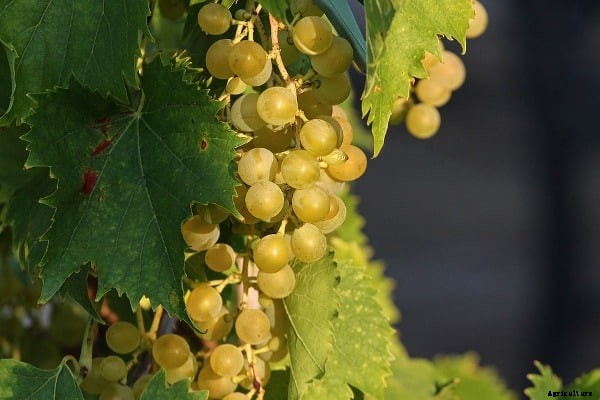
Grapes:
The fruit will reach its maturity stage in about 140 days after the occurrence of flowering.
Based on the type, the colour will change from green to golden yellow or pink or even black.
The separation of barriers easily is an indication that the fruit reached the stage of harvest.
The features like flavour and aroma will be developed.
Grape Vine.
Pomegranate:
The colour of pomegranate will change from green to yellowish-brown or yellow.
The fruits will be ready for harvest in about 175 days.
Development of ridges will take place on the fruits and fruits will become flattened.
The flowering part will get dried.
When you press the fruit with fingers, they get cracks and with a metallic sound.
Sweet Orange:
This fruit gets matured in about 250 days.
The colour of the fruit changes from green to pale green or orange.
The external ring will look shiny and you can also see oil glands on it.
The fruits will become very soft.
Kagzi lime:
Flowers will take about 150 days of time to get matured.
Pineapple:
The pineapple will require 140 days to reach the stage of maturity.
The colour of the lower section of the fruit will become green-yellow.
The eyes on the pineapple will turn smooth and their sides will bulge.
The pineapple which is matured should have a T.S.S. of 12% and acidity of 0.6%, specific gravity of 0.08.
Custard apple:
Custard apple will need 120 days to reach the full stage of maturity.
The scales present on the fruit will become plummy and also with good space.
The fruits will become scales and the segments will turn into creamy white colour.
Read: Custard Apple Farming Project Report.
Kokum:
These fruits will usually need 100 days to reach the stage of maturity after flowering.
The fruit colour will change from green to red or light green or purple when it is ripened.
The fruit will reach the weight of 35 gms and it is completely dependent on the variety.
The specific gravity of the fruit would be 1.5
The T.S.S. will be 13.6%, acidity 3.6 and Total sugar will be at 6.3%.
Jamun:
The plants of seedling Jamun start bearing fruits after approximately 10 years of the plantation whereas the grafted Jamun will bear the fruits after 7 years of plantation.
The colour of the fruit will change from green to dark purple or black.
Karonda:
This fruit will usually need up to 3 months to reach the stage of maturity after flowering.
The colour of the fruit will change from light green to dark green.
Development of red blush will take place on the fruits of some varieties.
The specific gravity will be 1.01 approximately.
The T.S.S. will be at 13%, Total sugars will be at 2.3% and the acidity would be at 2.6%.
Cabbage:
At lower heights, the varieties of cabbage get matured in about 120 days from the set of field and in higher heights, they take approximately 130 days to reach the stage of maturity.
The firmness and solidity of the head are the general characteristics of maturity.
The colour of the head will turn in a light shade of green when the fruit is completely developed.
These fruits will have a tendency to burst out or their leaves get loosened when it has crossed the marketing stage.
Cauliflower:
The determination of the perfect stage of maturity is done by the size and condition of the curd. The local farmers will generally harvest the head on the required size and prior to the discolouring of curds or prior to the curds becoming loose and blemished.
The head should be very compact and it should be-be broken into parts or segments.
The head which is over matured, long and elongation of flower stalks will result in the leafy, loose conditions and give very poor value to them in markets.
Tomato:
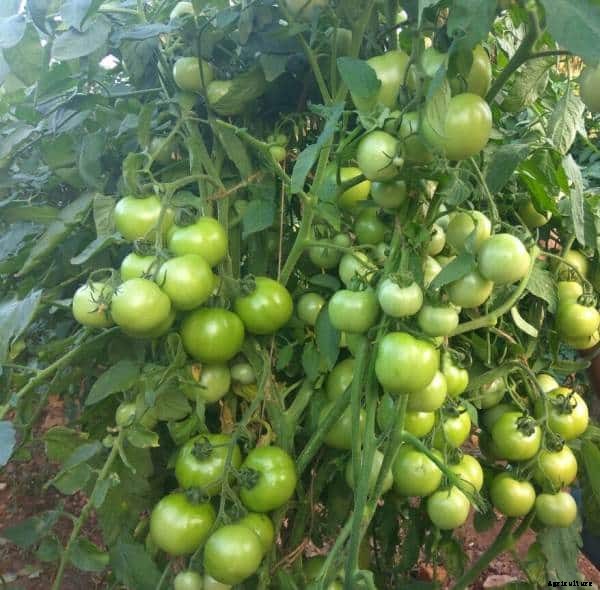
The harvest of tomato is completely dependent on the purpose of the usage. There are four stages of maturity for tomato which are recognized.
Green stage: In this stage, the green fruits which are matured are usually harvested for sending them to the market located at a distant location.
Pink stage: In this stage, the fruit surface will be red or pink in colour at the blossom end. These will be harvested for the markets which are locally present.
Ripe stage: In this stage, the surface of most of the tomatoes will become red and the fruits will start softening.
Fully ripen: In this stage, the fruits will approach the stage of maximum development in colour and are also very soft. Starch will start converting into sugar. These are usually consumed and are also used for processing.
Tomato Plant.
Chillies:
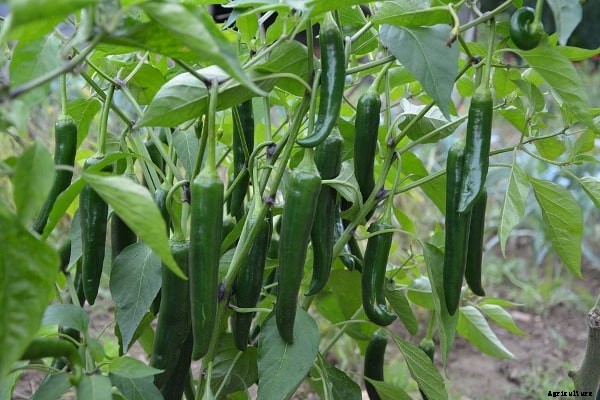
Chillies are basically harvested in two stages. One for the sake of green vegetables and others are dried.
The harvest of green chillies is done when they are matured completely and prior to their colour is changed from green to red.
The dried chillies are harvested when the colour changes from green to red immediately.
Green Chilli Plant.
Bell pepper:
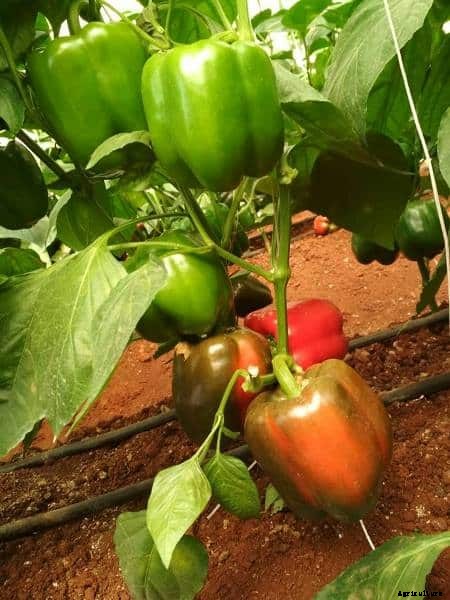
These are usually harvested in the green stage and when they are matured. They should have a very good shape. They should also be firm, shiny and also waxy.
The peppers used for canning are made to attain the complete size and become red in colour prior to harvest.
Matured Bell Pepper.
Brinjal:
The harvest of brinjal should be done as soon as they reach the desired size and colour. They should also be harvested before they start losing their bright and glossy appearance and become very dull.
The brinjals are edible from the time at which they are quarter grown till they are almost near to ripen.
Carrot:
Based on the type, carrots will get ready for harvest within 120 days after sowing is done.
Based on the variety, the required size is the first consideration in root harvesting.
The roots which are oversized are not accepted.
Usually, small and medium-sized carrots are preferred.
At the stage of marketing, the carrots should at least be 4 cms in diameter at the higher end.
Onion:
The harvest will be based on the purpose for which the plantation of the crop is done and the maturity will be based on the type which is being used.
The green onion is the best one when there is a formation of a small bulb-like structure.
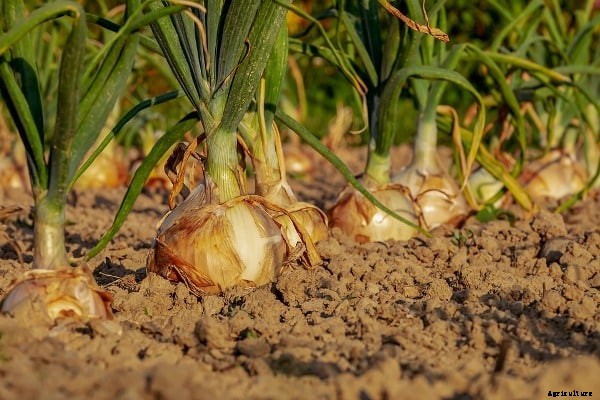
Ripe bulb crop will be prepared for harvest within 4 months after the transplantation. The perfect time for the harvest of onion is when 70% of the top is broken. There would be a red pigment developed.
Matured Onions.
In case if you are interested in this: Onion Growing Tips, Tricks, and Secretes.