
Welcome to Modern Agriculture!

Introduction to Irrigation Methods:- What is irrigation? well, it is a process of providing controlled amounts of water to plants, agriculture crops, orchards, landscapes, etc..at required intervals. Irrigation comes into the picture during dry periods or when there are no rains in the region. Irrigation also helps from frost conditions other than weed control (in growing grain crops) and prevents soil consolidation as well. If the agricultural crops are grown with direct rain-fall, it is referred to as a rain-fed crop. So there are two options to grow crops; Irrigation and Rain-fed. Apart from growing green crops, irrigation is also being used for dust suppression, cooling livestock (dairy, goats, sheep, pigs, etc..) from heat, sewage disposing, and in a mining area.
Irrigation plays a major role in any agricultural crop growing. One should be aware of different types of irrigation adapted in orchards or crop growing to become a successful farmer. You can choose the appropriate irrigation methods based on soil type, the layout of the field, and water availability. There are mainly 2 categories of irrigation; Traditional Irrigational methods and modern irrigation methods.
In this write-up, let us discuss different types of irrigation methods along with their adaptations, advantages, and disadvantages.
Irrigation Methods – Types of Irrigation Methods:- There are many Irrigation methods available to adapt based on soil, crop type, water availability, and method of planting.
Irrigation Methods- Surface irrigation (Traditional Irrigation):- This type of irrigation old and most popular irrigation method used in most countries for centuries. Surface irrigation covers 4 types of variations to supply the water.
Irrigation Methods – Flooding Irrigation Method: This type of irrigation method consists of opening a water channel in a field so that the water is allowed freely in all directions of land and covers the surface of the land in a continuous sheet kind. This method is the most inefficient method of irrigation as only about 20 to 25% of the water is actually used by plants or crops. The rest of the water would be lost as runoff, seepage, and evaporation. In this method, water distribution is uneven and you cannot expect uniform crop growth. you can adapt this method in case of uneven lands where the cost of levelling is high and regions where an abundant supply of water is available. This method of irrigation is not suitable for agricultural crops that are sensitive to water-logging conditions. This method of watering suitably where broadcast crops, particularly peas, small grains, green pastures, and alfalfa are grown as major crops.
Where can we adapt the Flooding Method: This type of irrigation method is applied in situations like
Benefits and Advantages of Flooding Method: The following are advantages of the flooding method.
Disadvantages of Flooding Method: The following are disadvantages of the flooding method.
Irrigation Methods – Bed or Borderstrip Irrigation Method: In this technique, the field is levelled and divided into little beds/strips surrounded by bunds of 20 cm to 30 cm high. Little irrigation channels should be provided between 2 adjoining rows of beds. For high-value plants or crops, the beds might be still smaller especially where water is pricey and not so abundant. This procedure is adaptable to many soil textures except sandy soils and is suitable for high-value plants. It requires levelled soil or field for uniform water distribution. This method provides a more effective way of uniform application of water in the field. This method is suitable for plants in lines or sown by the broadcast method. This method requires more initial investment and less labour. You can expect less maintenance in this type of irrigation.
Where can we adopt this method: The following conditions favor this method of irrigation.
Benefits and Advantages of Bed Irrigation Method:
Disadvantages or Bed irrigation Method: The following are some of the disadvantages of this method.
Irrigation Methods – Basin Irrigation Method: This irrigation technique is much more suited to horticulture crops/orchids. In this technique, a raised platform known as ‘Thanvla’ is shaped around trees or bushes and they’re connected to one another through drains and the water reaches from one tree to another. This process is not suitable for crops.
This method of irrigation is suitable in which the size of this plot to be irrigated is tiny. The basin could be square, rectangular, or circular form based on the planting method. Ring and basin is widely used for irrigating fruit trees. A little causeway (bund) of 15 cm to 24 cm high is shaped around the stump of plants/ trees with a distance of approximately 30 cm to 60 cm to maintain the soil dry. The height of the outer bund varies depending on the water depth required /recommended to retain. Basin irrigation additionally requires levelled soil rather than suitable for all kinds of soil. It is also efficient in using water however its initial price is high.
There are lots of variations in its usage, but all involve dividing the field into smaller unit regions so that each includes a virtually flat surface. Bunds or ridges are built around the regions forming basins within which the irrigation water could be controlled.
Where can we adapt Basin Irrigation Method: This method can be adapted to high-value crops, smooth topography areas, all kinds of soil textures, and high water requirement plants/orchids.
Benefits and Advantages of Basin Irrigation: Possible advantages of Basin Irrigation are provided here.
Disadvantages of Basin Irrigation Method: Possible disadvantages of Basin Irrigation are given below.
Irrigation Methods – Furrow Irrigation Method: Furrow irrigation process is resorted to where plants are developed in rows. Across the side of rows of plants, ‘Dol’is shaped, and in between 2 such ‘Dols’, a furrow is formed in which water flows for irrigation. The quantity of stream of water is dependent upon the demand for water from plants and also the rate of infiltration.
Row crops like cotton, sugarcane, potatoes, vegetables could be irrigated by the furrow technique. It is suitable for cluttered lands in which the furrows are created along contours. The length of the furrow is determined largely by soil permeability. In sandy and clay loams, the length is more than in clay and clay loams. Water doesn’t come in contact with the plant stalks. On slopes of 1 to 3 percent, furrow irrigation with straight furrows is quite profitable. But on steeper slopes contour furrows, not just check erosion but guarantee uniform water penetration. Within furrow irrigation, the following methods are used depending on the situation.
Furrow Irrigation Method Advantages: Expect the following benefits using this method.
Furrow Irrigation Method Disadvantages: The possible disadvantages of Furrow Irrigation are given below.
Irrigation Methods – Subsurface Irrigation Method:- Subsurface irrigation or sub-irrigation may be natural or artificial. Natural subsurface irrigation is possible in which an impervious layer exists under the root zone. Water is permitted into series of ditches dug up to the impervious coating, which then moves laterally and also wets the root zone.
In artificial subsurface irrigation, perforated or porous pipes have been laid out underground below the root zone and water is directed into the pipes with suitable means. The system involves an initial high price, but maintenance is very cheap. There is a risk of soil getting saline or alkaline and neighboring soil ruined due to heavy seepage.
It is very efficient in using water as evaporation is cut away almost completely. The plant roots don’t suffer from logging, there is absolutely no reduction of agricultural property in laying out irrigation methods and implements may be worked out openly. This method of irrigation is very rare in India and used in other parts of the world.
Irrigation Methods – Drip or Trickle Irrigation Method (Modern Irrigation Method):- A recently developed irrigation system known as drip irrigation also known as “Trickle Irrigation” originally developed in Israel, is becoming popular in areas of water scarcity. In this irrigation system, a little bit of water is applied at regular intervals in the form of water droplets through nozzles connected to tubes spread over the soil to irrigate a limited area around the plant.
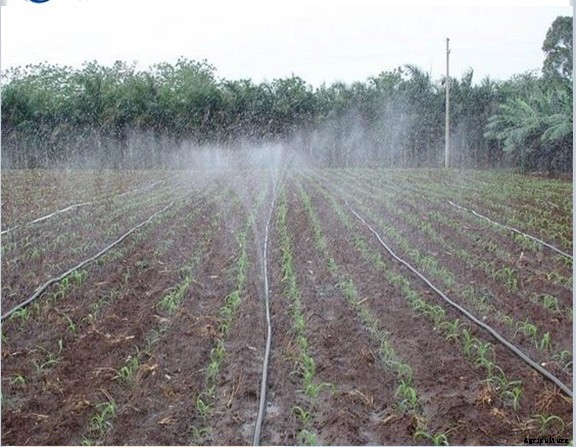
A precise amount of water equivalent to the daily consumptive use or the depleted soil water needs to be applied. The soil water could be maintained in the field capacity during the crop growing period. Deep percolation losses could be completely prevented and the evaporation loss is also decreased.
The application of water and piping systems needs to be designed according to the type of plants, topography, and weather conditions typical to the geographical area.
The basic equipment for drip irrigation consists of a water supply head, the main pipe, lateral pipes, and drippers. The water leak in the pipe system is controlled with control valves and fertilizers can be applied at the water resource. As water moves through the very small sockets of drippers, it is filtered until this distributed in the pipe system.
Advantages of Drip Irrigation Method: Expect the following advantages of a drip irrigation system.
Disadvantages of Drip System: There are some disadvantages of the drip system.
Irrigation Methods – Sprinkler Irrigation (or) Overhead irrigation (Modern irrigation Method):- This method consists of the application of water to soil in the kind of a spray, somewhat as rain. It is particularly useful for sandy soils because they absorb water too fast. Soils that are too shallow, too intense, or rolling could be irrigated efficiently with sprinklers.
This method is suitable for regions having uneven topography and in which erosion hazards are somewhat high.
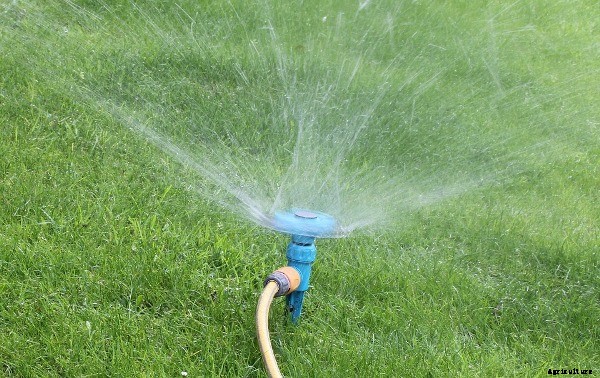
In sprinkler irrigation, water is conveyed under pressure through pipes to the area to be irrigated where it is passed out through or sprinklers. A centrifugal pump may be used for suction lift up to 37 to 50 cm. A piston-type pump is preferable in which water is extremely deep. The pipe consists of two sections, the mainline, as well as the laterals.
The mainline might be permanently buried underground or might be laid above ground if it is to be utilized on quite a few fields. The main pipes are usually made of steel or iron.
The laterals are lightweight aluminum pipes and are usually portable. The sprinkler nozzles could be single or double, revolving or stationary, and mounted or riser pipes attached to the riser. Each sprinkler head applies water to a circular area whose diameter depends upon the size of the water, which varies in 0.25 (1/4) to 0.75 (3/4) inch/ hour is determined by selecting the correct combination of sprinkler nozzles.
The main parts of the sprinkler system are;
Where can we adapt the Sprinkler Irrigation?
Advantages of Sprinkler Irrigation: Expect the following benefits of the sprinkler irrigation method.
Sprinkler irrigation Disadvantages: Expect the following disadvantages of this method.
Irrigation Methods – Pot irrigation Method:- Pot irrigation procedure is much more suitable for regions having scanty rainfall. In saline areas where flow irrigation is not suited, the bud irrigation procedure is successful. An earthen pitcher is utilized in this method. The pitcher is fixed on the floor up to the throat.
Holes are made in the pitcher and water is filled with it so that seepage of water through the pockets keeps the nearby soil moist. Water is filled in these pitchers at regular intervals.
Advantages and Disadvantages of Pot Irrigation Method:
In case if you are interested in this: How To Grow Organic Lettuce.


