
Welcome to Modern Agriculture!

Today, we are learning the Drip Irrigation system.
Introduction to Drip Irrigation:
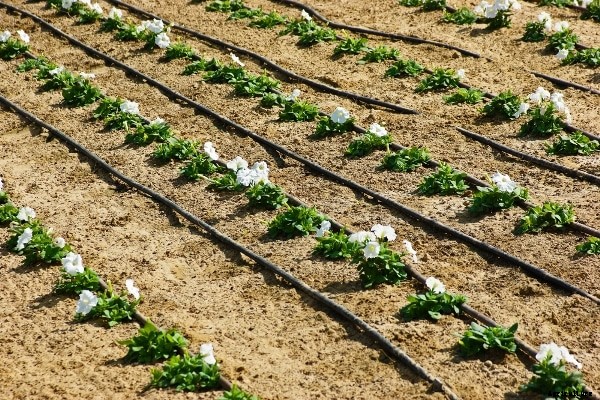
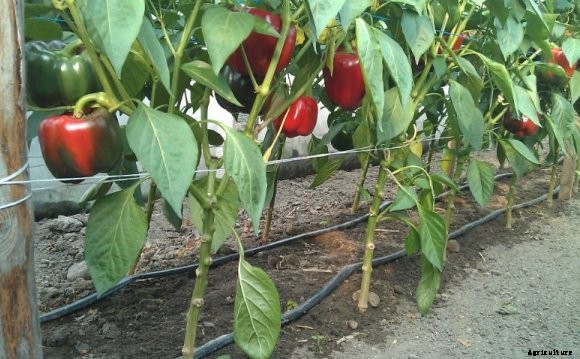
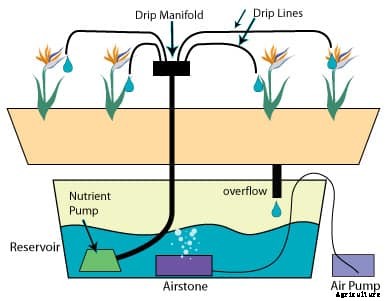
What is drip irrigation? Well, drip irrigation is a form of irrigation that saves water and makes use of manure/fertilizer efficiently by allowing water to draw slowly to the roots of plants/trees, either onto the soil surface or directly onto the root area of the plant. The drip irrigation works through a network of valves, pipes, tubing, and emitters. It is done through narrow tubes that deliver water directly to the base of the plant/tree. The drip irrigation system may also use devices called “micro-spray heads”. This device sprays water in a small area of the field instead of dripping the water from emitters. Generally, this type of spray heads is used on tree and vine crops with wider root zones.
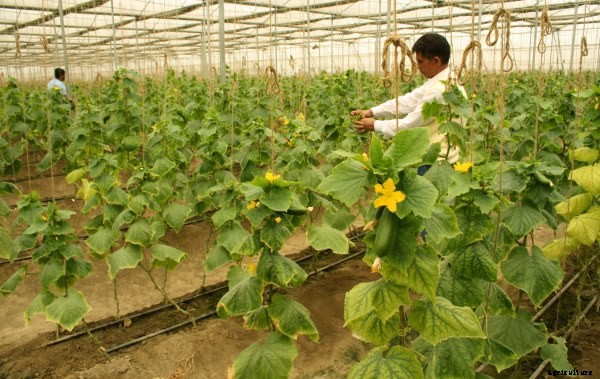
In the case of less water available or recycled water utilization, sub-surface drip irrigation (SDI) uses permanently or temporarily buried dripper line or drip tape located at or below the plant roots. In order to find out a suitable drip irrigation system to be installed, One should consider factors like land topography, soil, water, crop, and agro-climatic conditions. The drip system can be used in most of the farming methods like commercial greenhouse farming, residential gardens, polyhouse farming, shade net farming, hydroponics, and open field farming. Drip irrigation will be more beneficial when compared to the sprinkler irrigation system. Drip and subsurface drip irrigation is used when using wastewater. Generally, large drip irrigation system consists of some kind of filters to prevent clogging of the small emitter flow path by small waterborne particles. Nowadays, one can get drip systems which minimize the clogging. Currently, drip irrigation for the home garden is available in the form of drip kits and these are getting popular for the homeowners. This kit consists of a timer, hose, and emitter.
The following components are used as part of the drip irrigation system.
Note: In the drip system, pump and valves may be operated manually or automatically.
The following are the advantages of a drip irrigation system.
The following disadvantages of the drip irrigation system.
Drip Irrigation Vs Sprinkler Irrigation:
Drip irrigation is more beneficial when compared to drip irrigation. The following are the main disadvantages of the sprinkler system.
Cost of drip irrigation depends on the region/area. Here we are providing a rough (ballpark) estimate which will cover from low to high range. However, they may change time to time because of market conditions. Some countries like India is providing up to 90% of subsidy for small farmers who are holding less than 5 acres of land. Contact your agriculture department for subsidy information.
Item Details Quantity Low High Drip Irrigation System Cost$53
$80 Drip Irrigation System Labor Cost
Generally, drip Irrigation provides the facility to irrigate the plants at the root zone through emitters fitted on a network of pipes. The emitting devices could be drippers, microjets, misters, fan jets, micro sprinklers, mini sprinklers, micro sprayers, foggers, and emitting pipes, which are designed to discharge water at prescribed rates. Basically, the use of emitters depends on specific requirements that may vary for each crop. Generally, the factors that decide the choice of the emitting system are; water requirement, the age of the plant, spacing, soil type, water quality. Sometimes micro-tubes are also used as an emitter, though it is inefficient. All types of surface and subsurface irrigation systems are covered under micro-irrigation. An indicative list of system components required for installing a drip irrigation system in areas ranging from 0.4 ha to 5 hectares is given in below table. The estimated cost of the drip irrigation system in India is given in Indian Rupees here.
Area in Hectares
Spacing in meters
0.4
1
2
3
4
5
12mx12m
10,700
16,800
25,400
32,700
53,900
71,500
10mx10m
12,200
18,200
27,900
36,100
58,200
77,100
9mx9m
12,500
22,300
35,700
56,000
61,700
81,300
8mx8m
13,000
20,100
31,400
41,700
65,700
86,300
6mx6m
14,400
30,300
51,300
70,300
1,05,900
1,37,500
5mx5m
15,100
32,900
56,700
83,100
1,17,300
1,50,800
4mx4m
16,900
39,400
63,200
1,00,700
1,42,400
1,79,400
3mx3m
17,900
35,700
71,400
96,100
1,30,900
1,58,400
3mx1.5m
19,700
40,100
80,500
1,09,700
1,46,300
1,80,900
2.5mx2.5m
20,000
39,900
81,400
1,11,200
1,99,700
2,39,600
2mx2m
21,400
49,900
86,400
1,22,700
1,65,000
2,23,400
1.5mx1.5m
26,100
55,000
10,9500
1,65,100
2,06,000
2,81,000
1mx1m
26,500
57,600
96,500
1,46,500
2,00,000
2,49,300
 Basically, the unit cost of Drip Irrigation system depends on plant spacing and location of the water source. Another fact is that the cost of the drip system differs from each state. Accordingly, the States have been categorized into three categories, like Category “A”, “B” and “C”. States in India where more than 10,000 hectares have been brought under drip irrigation as on 1.4.2004 would come under ‘A’ Category. This would include the States of Andhra Pradesh (AP), Telangana, Gujarat, Karnataka, Kerala, Maharashtra, and Tamil Nadu. All the States except those covered under Category ‘A’ and those falling in the Himalayan belt comes under Category ‘B’. All the North Eastern States, Sikkim, Jammu and Kashmir (J&K), Uttaranchal, HP (Himachal Pradesh), and Darjeeling district of West Bengal comes under Category ‘C’. the cost of drip system in Category ‘B’ States is estimated to be 15 to 16% higher than Category ‘A’ States while for Category ‘C’ States it is estimated to be 25 to 26% higher than Category ‘A’ States. Accordingly, the average unit cost of drip irrigation system for different state categories in India is provided below.
Using Drip Irrigation in Greenhouse -Polyhouse.
State Category
Average Cost, Indian Rupees/ha A 40, 000 B 46,000 to 47,0, 0 C 50,000 to 5100The following subsidy information is applicable to Indian farmers/growers. However, you can contact your local horticulture/agriculture departments for current subsidy information on an agriculture drip system.
Centrally Sponsored Schemes and State government schemes are available for drip system subsidy in India. This subsidy varies from state to state and extent of the land owned by the farmer.
The following criteria should explain about Farmer’s eligibility.
Note: The above-given information may not be accurate but a rough estimate, Please contact local horticulture/agriculture technical department for current schemes/subsidies/loans and other information.
Properly designed, installed, and managed, the drip irrigation system helps in achieving water conservation and efficiently using fertilizers/manures.


