Organic Agriculture Information:
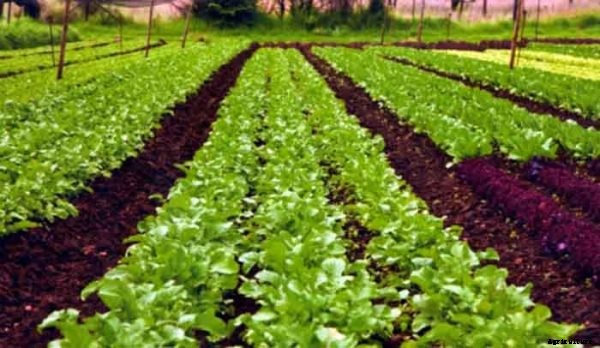 Organic Agriculture.
Organic Agriculture and its Importance:- What is organic farming / organic agriculture? Well, it is a farming system in which organic wastes like crop, animal and farm wastes, aquatic wastes and other biological materials along with bio-fertilizers are being used instead of pesticides, fertilizers, genetically modified organisms, hormones / growth regulators, feed additives. What is the importance of organic farming? As we all know current crop /agriculture farming system is completely polluted with pesticides and chemicals, to protect environment and overcome the current situation in agriculture sector, organic farming is very important and essential to release nutrients to crops for increased sustainable production in an eco-friendly pollution free environment. As we all know using both the fertilizer and the pesticide has led to increased crop production and greater economic return to the farmers. However, this is also impacting soil fertility and water environment and crop quality. This has been realised lately and people started thinking of organic agriculture which can protect soil as well as food. With increasing health consciousness, people are showing more interest in organic foods (pest and chemical free); hence the demand for organic agriculture is increasing day by day. In India, demand for food is going up every year because of population increase, one should think of cultivating crops organically to protect the soil health and human health. As there is widespread organic movement in the world and large demand for organic products; with proper organic agriculture practices, one can obtain decent profits by growing quality produce organically. In the following write-up, let us discuss about major components of organic agriculture and its advantages and benefits.
Advantages and Benefits of Organic Agriculture:– The following are some of the advantages of organic agriculture.
- Organic agriculture helps in maintaining environment health/Soil health by reducing the level of pollution.
- Organic agriculture reduces human and animal health problems by reducing the level of residues in the produce.
- Organic agriculture helps in keeping agricultural production at a sustainable level.
- Organic agriculture reduces the cost of agricultural production and also improves the soil health.
- Organic agriculture ensures optimum utilization of natural resources & helps in conserving them for future generation.
- Organic agriculture not only saves energy but also reduces risk of crop failure.
- Organic agriculture improves the soil physical properties. These include good aeration, easy root penetration, granulation, good tilth, and improves water holding capacity and reduces soil erosion.
- Organic agriculture improves the soil’s chemical properties. This includes supply and retention of soil nutrients, reduction of nutrient loss into water bodies and environment. This also promotes favourable chemical reactions.
Major Components of Organic Agriculture:- The following are major components of organic agriculture.
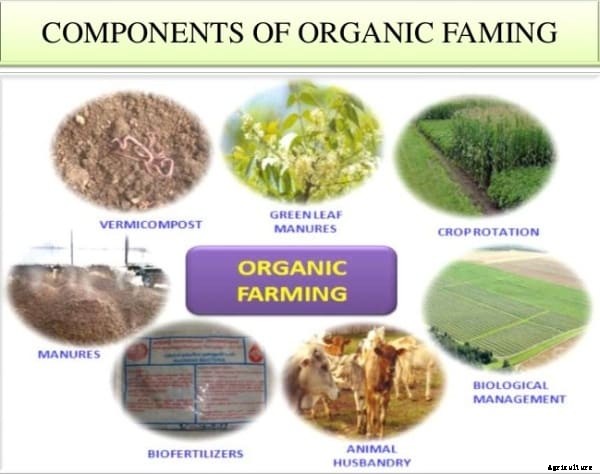 Organic Farming / organic agriculture Components. (Photo Courtesy by TNAU).
Organic manure: What is organic manure? Well, It is derived from biological sources such as plants, animal and human residues. Organic manure augments the soil microorganisms and their activities and these results in increasing the availability of major and minor plant nutrients. The following are type’s organic manures.
- Bulky Organic Manure: This manure contains less plant nutrients when compared to concentrated organic manure. This includes farm yard manure (FYM), compost and green manuring.
- Farm Yard Manure (FYM): Farm yard manure refer to the well decomposed mixture of dung (like cattle/cow dung), urine, farm litter & left over materials from roughages or fodder fed to the cattle/animals. The waste material of cattle shed consisting of dung and urine soaked in the refuse should be collected and placed in 6 meter x 2 meter x 1 meter(6 m long, 2 m wide and 1 m deep) trenches. Each trench should be filled up to a height of 0.5 meter above the ground level and plastered over with slurry cow dung. The material should be allowed to decompose for 3 to 4 months for completion of fermentation. Farm yard manure becomes will be ready for application after 3 to 4 months. Well-rotten farm yard manure contains of 0.5% ‘N'(Nitrogen), 0.2% P205 (Phosphorus), & 0.5% K2O (Potash).
- Compost: Large quantities of waste material are available as vegetable refuse, farm litter. This may include weeds, sugarcane trash, stubble, bhusa, sewage sludge and animal wastes in houses and in areas like human and industrial refuse; this excreta can be converted into useful compost manures. Thus prepared compost can be used in the same way as farm yard manure (FYM) and is good for application to all soils and all crops for high yields and .
- Green Manuring: It is a practice of ploughing or turning of under- composed green plant tissues into the soil to improve physical structure as well as soil fertility. Basically green manuring acts as a principal supplementary means of adding organic matter to the soil. The green manure crops supplies organic matter as well as additional nitrogen. Generally leguminous crops producing 25 tons of green matter per hectare will add about 70 to 90 kg of nitrogen (‘N’) when incorporated into the soil (ploughed under). This amount would equal an application of 4 to 10 tons of farm yard manure (FYM) on the basis of organic matter and its nitrogen contribution. The green manure crops are also useful against erosion and leaching. The most commonly used green manuring crops are; Cowpea, Cluster bean, Sunhemp, Dhaincha, Senji, and Berseem.
- Concentrated Organic Manure: Concentrated organic manures are those materials that are organic in nature and contain higher % of essential plant nutrients such as nitrogen ‘N’, phosphorous ‘P’ and potash ‘K’, when compared to bulky organic manures mentioned above. These concentrated manures are actually made from raw materials of animal or plants origin. The common concentrated organic manures used are; fishmeal, oil-cakes, blood meal, meat meal and hoof meal.
Crop rotation: It is a process of growing of different type’s crops in a regular sequence on the same field covering a period of 2 years or more. The crop rotation plays an important and major role in successful sustainable agriculture sector. Crop rotation is very important for soil fertility, weed control , insect pests and disease control. Legume crops are essential in any rotation and should be 40 to 50 % of the cultivation field. A mixed cropping, pasture and livestock system is essential for the success of sustainable agriculture.
Crop Residue: There is a great potential for utilization of crop residues / straw of major cereals and pulses. These crop residues are about 50% utilized as animal feed and the remaining could be very well used for recycling of nutrients. Incorporation of crop residues has excellent beneficial effect on crop yields. This also helps in Physico-chemical properties of soil.
Vermicompost: Vermicompost is produced by earthworms by eating biomass and excreting it in digested form. Vermicompost is organic manure produced by earthworms that generally live in soil. It is estimated that 1800 to 1900 earthworms per 1 sq. meter can be fed on 80 to 85 tons of humus / year. These are very rich in vitamins, growth hormones ,macro & micro-nutrients. The vermicompost nutrient content would be more when compared to farm yard manure (FMY). The vermicompost contains 1.65% of ‘N’, 5.05% of ‘P2O’ & .85% of ‘K2O’. Vermicompost is one of best organic manure which is very much essential to provide nutrients to crop in organic agriculture.
Waste: There are two types of wastes are available; Industrial and Sewage.
- Industrial waste: Among the industrial by products, waste from ditilisers and molasses and press-mud from sugar industry have good manurial value. Make sure to use well-decomposed press mud at 8 to 10 tonnes/ha. This press mud helps in increasing soil fertility. The by-product waste from coir industry can be used as manure after proper decomposition of waste.
- Municipal and Sewage waste: This also forms a component of organic waste which can be used for crop nutrients. In India, the total municipal refuse is said to about 12 Mt/year containing about 0.5% of ‘N’, 0.3% of ‘P2O5’ & 0.3% of ‘K2O’. Sewage sludge is also available to an extent of 4 million tonnes/year containing 3% of ‘N’, 2% of ‘P’ and 0.3% ‘K’. Sewage sludge particularly from industrialized cities is contaminated with heavy metals and these pose hazards to crops and plants, animals and humans. Separation of the toxic waste at the source will minimize the concentration of such elements in the sludge.
Bio-pesticide: Bio-pesticides are natural plant products that belong to alkaloids, terpenoids, phenolics. Their biological activity is beneficial against insects, nematodes, fungi and other organisms.
Among the botanical pesticides Neem is number one. All parts of the Neem tree possess insecticidal property but seed kernel is most active. Some of the commonly used botanical Insecticides are Nicotine, Rotenone, Subabilla, Ryanin, Quassia, Pyrethrum, Margosa, and Acorus. These should be promoted under the Integrated Pest management Programmes (IPMP).
Bio-fertilizers: Bio-fertilizer offers an economically attractive and ecologically improving the quality and quantity of internal sources. Bio-fertilizer is microorganism’s culture capable of fixing atmospheric nitrogen when suitable crops are grown with them. The benefits of Bio fertilizers are as follows:
- Bio-fertilizers help in establishment and growth of crop plants and trees.
- Bio-fertilizers enhance biomass production and grain yields by 15-20%.
- Bio-fertilizers are useful in sustainable agriculture/farming.
- Bio-fertilizers are excellent for organic agriculture/farming.
- Bio-fertilizers play an important role in Agroforestry.
Types of Bio-fertilizers: There are 2 types of bio-fertilizers available.
- Symbiotic N-fixation: These are Rhizobium culture of various strains which multiply in roots of suitable legumes and fix nitrogen symbiotically. Rhizobium is the most widely used bio-fertilizers and this Rhizobium legume association can fix up to 125-300 kg N/ha in one crop season.
- Asymbiotic N-fixation: This includes Azospirillium, BGA, Azolla, Azotobacter, & Mycorrhizae, which also fixes atmospheric nitrogen ‘N’ in suitable soils. They grow on decomposing soil organic matter and produce nitrogen (‘N’) compounds for their own growth. Apart from this, they leave behind a good amount of nitrogen ‘N’ in surroundings.
- Azotobacter: Azotobactor helps to increase the crop yields rice, maize (corn), wheat, pearl millet & sorghum by 0-25%.
- Azospirillium: It is an important bacterium, which colonize the root zones and fix nitrogen in loose association with plants. The Azospirillum is mainly produced by these crops; maize, barley, oats, sorghum, pearl millet and forage crop. Azospirillum applications increase gain productivity of cereals by 8-20%, of millets by 25% and of fodder by over 40%.
- Blue Green Algae: The blue-green algae are used as bio fertilizers in rice cultivation due to its excellent advantages.
- Azolla: It is nothing but a small floating fern and mostly seen in low land fields and in shallow fresh waters. This fern harbours mainly blue-green algae, anabaena azollae. The Azolla anabaena can fix atmospheric nitrogen amounting to 1250-150 kg ‘N’/ha/year from about 40-65 tons of biomass.
- Mycorrhizae: Mycorrhizae are the symbiotic association of fungi with roots of Vascular plants. The main advantage of Mycorrhizae is to increase phosphorous uptake to the host plants.
Insect Pest and Disease Management in Organic Agriculture:- In order to avoid serious pest problems in organic agriculture, planting schedules and locations should be adjusted. The main solution to fight with pests in organic agriculture is to build up a population of beneficial insects, whose larvae feed off the eggs of pests. In order to achieve this, you should establish host crops( borders of the field should be planted with blends of flowering plants which beneficial insects like). In case of pest outbreak or out of control, natural pesticides like neem pesticides should be applied.
Crop diseases are major constraints for low yield and low quality of produce. By implementing balanced macro and micro-nutrients in crops along with crop rotation will check some of the diseases in organic farming / organic agriculture. Ultimately increasing soil fertility and health by implementing major organic components will result disease resistant crops. In case of outbreak of any diseases, natural organic or bio-fertilizers can be applied.
Weed Management in Organic Agriculture:- Weed free field is necessary for any farming (organic or in-organic). As we know organic farmers cannot use herbicides or weedicides to control or prevent the weeds. However, there are other ways (practices) such as mulching; tillage may be used to control weeds. Any cover crops should be cultivated to suppress weeds and increased soil fertility. Drip irrigation is another best method of controlling weeds in the crop as it can restrict the water distribution to only main plants.
Limitations (Disadvantages) of Organic Agriculture:- Though there are many benefits and advantages of organic agriculture, there are some limitations with organic farming / organic agriculture in India.
- Because organic manures are not available enough(abundantly) for current agriculture needs, this will result in more expenses than chemical pests and fertilizers when purchased outside
- Most of the Indian farmers do not know how to make organic manures on their own (at the field) and Indian rural farmers don’t have enough knowledge about advantages and benefits of organic farming / organic agriculture; this should be taken on serious grounds and should be given rural trainings about making organic manures/compost.
- Usually, the yield or production in organic farming / organic agriculture declines during initial few years, so the farmer should be given premium prices for organic produce.
- Apart from above mentioned the guidelines for organic production, processing, transportation and certification are beyond the understanding of ordinary Indian farmer.
- The organic farming / organic agriculture sector in India is not streamlined for proper marketing.
- Initial investment or cost involved in organic farming / organic agriculture is very high and it is not affordable for many farmers.
- Multinational companies are everywhere to sell their chemical products such as fertilizers, seeds and other growth regulators. It’s very hard to overcome this situation.
- Commercial organic farm may need certificate from the government which involves documentation and cost, this is also making farmers to back to regular agriculture.
Bottom Line of Organic Agriculture:- Everybody should go for “An eco-friendly approach for sustainable Agriculture” which promotes and enhances agro-ecosystem health, including biodiversity, biological cycles, and soil biological activity.
For Azolla Cultivation: Read here.


