
Welcome to Modern Agriculture!

Vanilla is a tropical climbing vine of the orchid family, grown for its pleasant flavor. Vanilla is one of the costliest spices in the market after saffron and grows with the support of bark of trees. There are more than 40 species of vanilla exist. However, only three of them are considered as important ones. Vanilla planifolia Andrews is the variety widely cultivated on large scale. This cultivar (variety) has more commercial value for its vanillin. Vanilla vine is perennial in nature which belongs to the family of “Orchidaceae” and genus of “Vanilla”. Madagascar is the top producer of vanilla in the world. Usually, Vanilla plants start the first yield after 3 years of planting and continue to give the yield up to 12 to 14 years. Generally, the vanilla crop is grown as an intercrop in the fields of ‘coconut’ and ‘areca nut’. As India is concerned, Indian exports of vanilla multiplied rapidly and accounted for approximately 2% of world vanilla exports. In India, Karnataka tops the country’s vanilla cultivation followed by Kerala and Tamil Nadu states. The vanilla vines can be grown in indoors, greenhouse even in pots and containers. The initial investment for the cultivation of vanilla is little when compared to other spices. Vanilla also can be grown hydroponically. Vanilla gives higher yields when it is grown under shade net or as a pure crop rather cultivating as intercrop. Basically, Vanilla is a tropical orchid crop which requires high humidity, shade, and moderate temperatures. Due to this fact, the demand for cultivating vanilla in shade houses fitted with micro-sprinklers for creating the required micro-climate is increasing in India. In India, as natural self-pollination is not possible, artificial pollination is carried out to effect fertilization and fruit set.
The following are the top 10 production countries of Vanilla.
1. Madagascar.
2. Indonesia.
3. China.
4. New Guinea.
5. Mexico.
6. Turkey.
7. Tonga.
8. Uganda.
9. French Polynesia.
10. Comoros.
The following are some of the health benefits of vanilla extract.
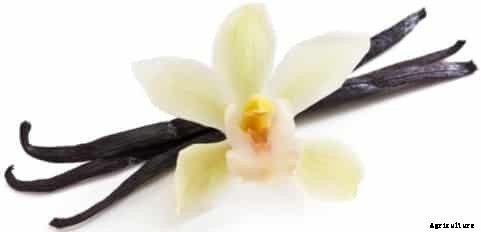
In most of the Indian languages, vanilla is called ‘vanilla’.
Basically, Vanilla crop requires warm and humid conditions for its growth. This crop also requires a well distributed annual rainfall of 150 to 350 cm. A temperature range of 25 °C to 34°C is best for vanilla cultivation. Vanilla can be grown above mean sea level (MSL) of 1400 meters. Vanilla crop prefers more than 45% shade and grows well under filtered light. The area where these conditions are not met, vanilla cultivation can be taken in shade house/nets fitted with micro -sprinklers and foggers.
The vanilla crop grows well in loose and friable soils with any of loamy texture. However, it requires high organic matter content in the soil for better yield. Well-drained soils are important for vanilla cultivation and it prefers lands with a gentle slope. The required soil pH range for Vanilla cultivation is 6.5 to 7.5. Western Ghats areas in India are best suited for vanilla cultivation as these soils are rich in organic matter and humus. These soils are also having excellent drainage. If you are planning for commercial cultivation of the vanilla crop, make sure to go for a soil test and fill any nutrient gaps based on the soil test results.
Give a couple of ploughings to bring the soil to a fine tilth stage and remove any weeds from previous crops. Soil should be prepared to drain out the water. In case of the soils which are not fertile, make sure to supplement the organic manure during land preparation. As vanilla vines need support to grow, any kind of living trees or rock pillars, iron pillars can be arranged for supporting the vanilla vines.
Read: Profitable Planting Techniques.
The vanilla crop is propagated by shoot cuttings or seeds. However, shoot cutting method is followed in commercial cultivation of the vanilla crop. The reason being is the seed propagation is very difficult to establish a vanilla orchard as the seeds are very small. When you select the planting material there are two options; one is longer cuttings and other is shorter cuttings. Longer cuttings start flowering in the second year itself whereas short cuttings take 3 years to flower. However, longer cuttings have slow growth when compared to shorter ones. It’s up to you judge the cutting length depending on the availability of material and the area to be planted. Strong, healthy and actively growing vines should be selected as planting material in vanilla cultivation. Shoot cuttings preferably having 8 to 10 internodes should be selected as planting material as these flowers earlier than the shorter cuttings.
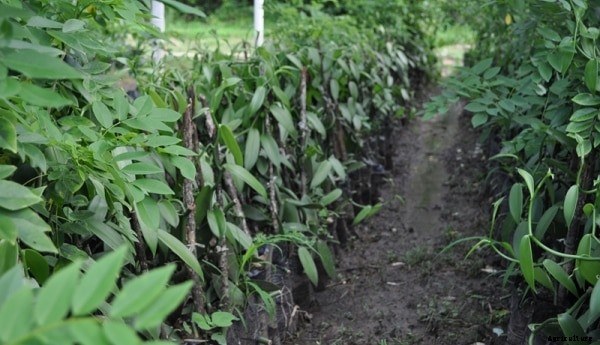
The ideal planting time for the vanilla orchard is when there is moisture present in the weather which is not too rainy or dry conditions. Cuttings should be close to the base of the support. Make sure that the vines are not directly exposed to the sun in the afternoon by planting the cuttings in the North East direction.
As vanilla vines need support to grow, provide any support such as living trees, wooden stakes, stone pillars or any iron pipes. Vanilla cuttings should be planted in the soils which have a medium in organic content. Well-decomposed organic manure or vermicompost should be filled in the trenches made at a spacing of 8 ft. in these trenches support pillars of 7 ft long should be placed at a spacing of 6 ft. Two cuttings of each should be planted around one pole. As per this spacing, the vanilla plant density would be around 2400 to 2500 vines per acre. These vines should be trained on GI wires tied between the pillars at 5 ft height.
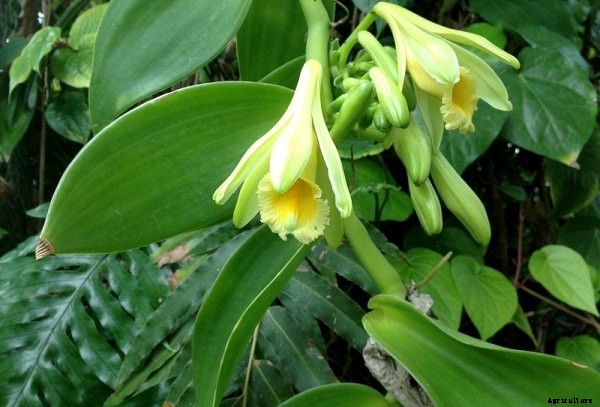
Vanilla plants produce more yields in a controlled environment like greenhouse and shade nets. In this environment, the required humidity, light, and temperatures can be maintained which is pretty much essential for commercial cultivation of vanilla. Any net providing 60% of shade can be considered and support of 12 feet pillars can be used to provide required shade. For proper irrigation and humidity requirement, micro-sprinklers with both irrigation and misting/ fogging facility should be installed in the shade net house.
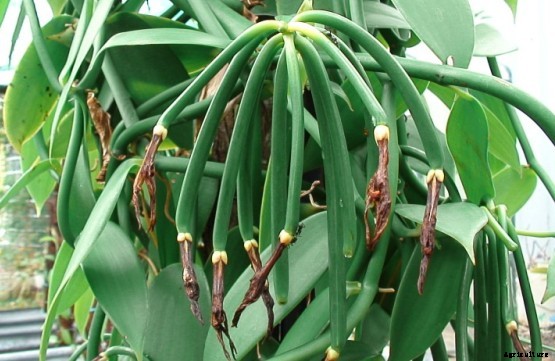
Usually, Vanilla plants start flowering from the third year of planting during January and February month. Irrigation should be stopped during the month of December and the tips of the vines should be pruned. During this stage, abundant irrigation should be provided to induce more flowers. Natural self-pollination is not possible in India because of the absence of specific pollinating agents. However, artificial pollination should be carried out by hand with the help of a pointed bamboo splinter a stiff grass or a sharpened toothpick to get fruit set. The best time for pollination is 7 am to 12 p.m. On average, a skilled worker can pollinate 1000-2000 flowers/day. It is preferred to pollinate only the first formed 7-10 flowers on the lower side of the inflorescence. It is also recommended to maintain only 10-12 inflorescences per each vine in order to get beans with maximum length and girth and of high-quality standards. The flowering is spread over a period of 3 weeks.
Read: Top 10 Banks Providing Poultry Farm Loan.
Mulching, irrigation, shade management and trailing are main intercultural activities in vanilla plantation.
The following pests are found in vanilla cultivation:
The following are the common diseases found in vanilla cultivation:
Note: Contact your local department of Horticulture for pests and disease symptoms and their control. They are the best source for pest control solutions in vanilla cultivation.
Read: Greenhouse Farming Training.
The vanilla beans develop very quickly and obtain a full size in 6 weeks after pollination and manuring. However, it takes beans 8-11 months for getting matured. Vanilla is ready for harvest between 6 and 9 months after flowering when the pods are still dark green and the tip is beginning to turn yellow. The vanilla beans should be harvested when the distal end turns pale yellow in color. Generally, on an average, 80 to 90 mature beans make 1 kg of vanilla. There are different stages involved to get the final product. Curing, sweating, drying, and conditioning are the stages involved.
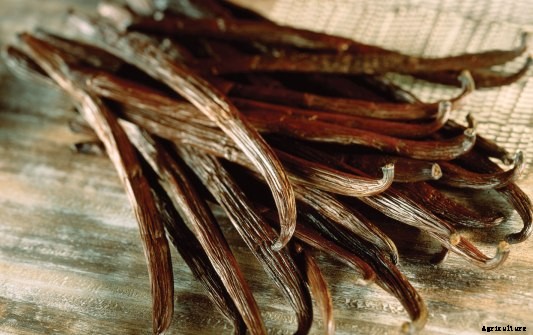
Vanilla Dried Beans.
Yield in Vanilla Cultivation:
Yield depends on many factors such as soil, irrigation, and cultivar. The following table shows the vanilla yield.
Year. Yield (Green) in Grams/Plant. Third 250. Fourth 500. Fifth 750. Sixth to Fifteenth 1000.As we said before in this article, vanilla is the costliest spice after saffron. The market price of fresh vanilla beans is about 3500 Rs/kg. However, once assume a price of 500 Rs/kg of green pods (Note: this price for green pods). When marketing is concerned, there are herbal, pharmaceutical, food processing companies who can buy vanilla beans in bulk. It is very important to have a proper marketing plan if the vanilla crop is grown commercially on a large scale.
There are subsidies available from local agriculture departments and banks. Growing vanilla in shade net houses with a unit holding size of 1 acre is technically feasible, financially viable and bankable.
Read: Bonsai Gardening Techniques.


