
Welcome to Modern Agriculture!

In the following write-up let us talk about ” Common Plant Tissue Culture Questions and Answers”
Well, plant tissue culture is the process of producing plants from tissues of the required plant in an artificial nutrient medium under controlled environment (like a greenhouse). The plants produced under this process are going to be 100 % replica (similar) of mother plan in all aspects.
Totipotency signifies a feature which is nothing but producing a whole plant (100% similar in all aspects) by a single cell or the inherent potentiality of a plant cell to give rise to a whole plant is described as cellular Totipotency.
As part of plant tissue culture, a small part of plant tissue is taken and used from the mother plant (donor plant) and grown (cultured) on a nutrient medium in sterile containers. The whole plant can be re-generated by changing the composition of the medium and other conditions like temperature and light (environmental conditions). Finally, the plant is re-produced from single plant tissue which will be 100% identical in all aspects.
The following are the reasons why one should go for tissue cultured plants.
Well, an explant is a small portion of the plant which has the potential to regenerate and capable of giving rise to the whole plant which would be similar to donor plant in all aspects. The frequently used explants for regeneration purpose are; petiole, nodal segments, leaf disc, leaf blade, apical meristems, roots, cotyledons, embryo, pedicle, anther, and ovary.
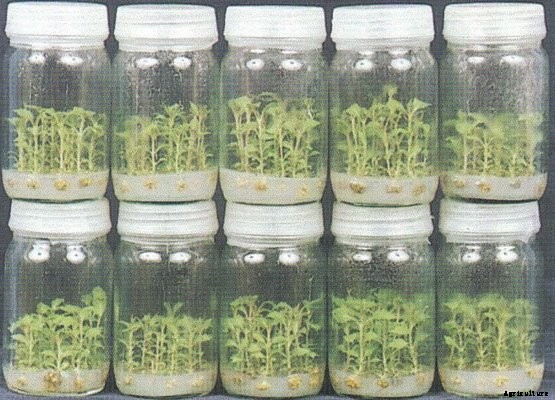
The following crops are being commercially propagated using plant tissue culture in India.
Well, the mother plant is the source of tissues (explants) to be used for further multiplication of plants.
Are Tissue Culture Plants are prone to Pests and Diseases?
Of course, the tissue cultured plants are pests and disease free when the standard procedures are adopted while producing or re-generating the plants. Tissue cultured plants are also vulnerable to pests and diseases unless standard procedures are followed. However, tissue cultured plants are free from all soil-borne diseases.
When compared to conventional plants, tissue culture plants are uniform, vigorous and disease free. Under proper cultivation practices, tissue culture plants yield more when compared to conventional plants cultivation.
The following are the constituents of tissue culture plant nutrient media: Plant growth regulators, Amino acids, Water, Inorganic salts, Vitamins, Carbon sources and Solidifying agents (For solid medium).
Two plant growth regulators Auxins and Cytokinins affect plant differentiation:
Usually, the ratio of these two growth regulators determines plant development.
It is the process of initiation and development of a structure that shows natural organ form.
It is the process of initiation and development of embryos from somatic cells.
It is a vitro technique in which the embryo is cultured.
What are the Merits of Embryo Rescue Technique?
The merits are given below.
What are the Different Stages of Micro-propagation?
The following are the various stages of micropropagation.
Artificial seeds can be formed by encapsulating the somatic embryos in 0.2% sodium alginate solution. This solution forms a gel at later stages and acts as a seed coat. These somatic embryos are called artificial seeds.
It is a phenomenon of growing a plant in vitro environment without the addition of carbon source in the medium.
Water, photoperiods, plant growth regulators, temperatures, carbon sources, macro, and micronutrients and vitamins.
Temperatures, soil type light, relative humidity, and soil characteristic.
Read: Growing Safed Musli, Planting, Farming Guide.


