
Welcome to Modern Agriculture!

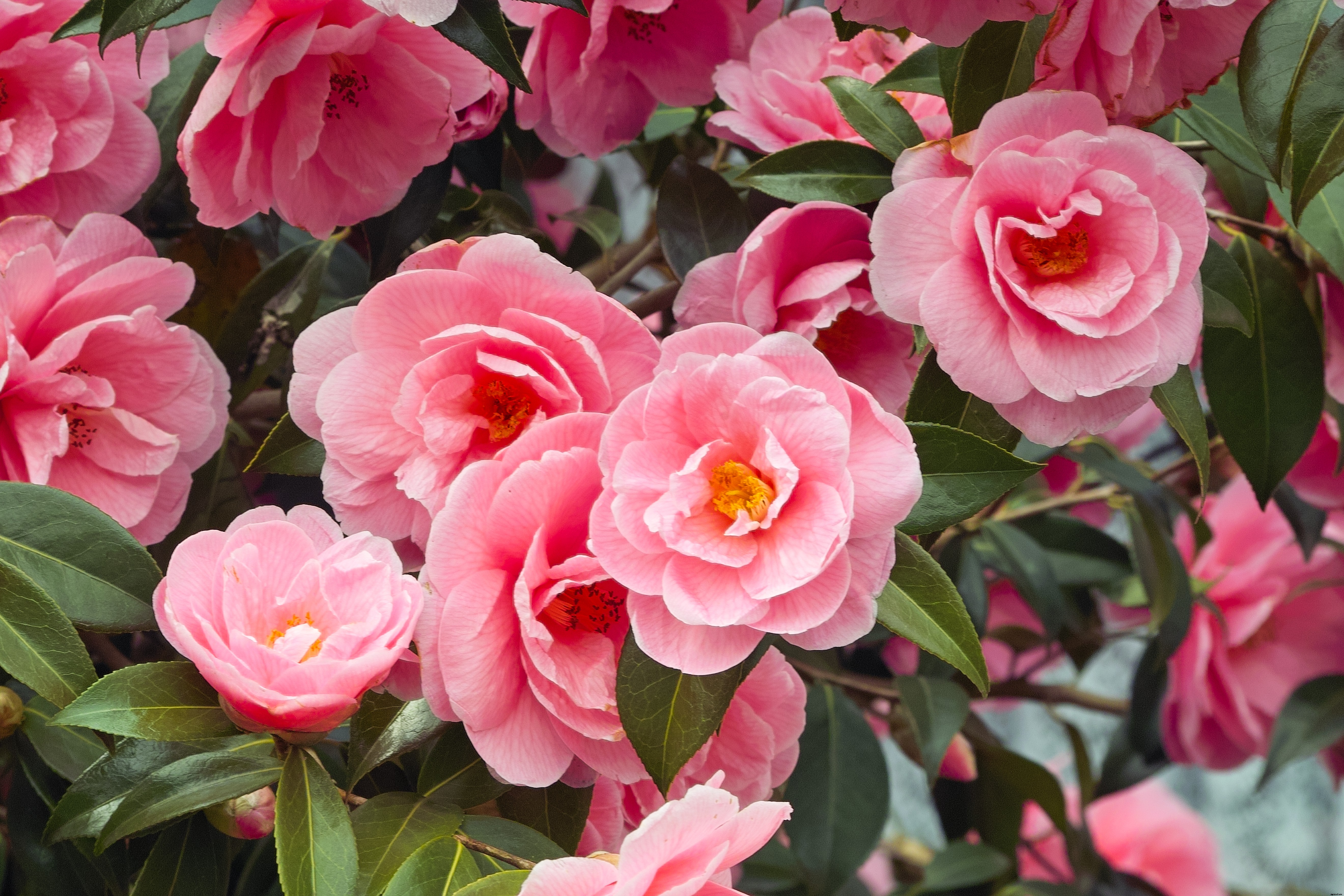
Camellias are one of the most popular woody ornamental plants. They are also known as queens of the winter flowers. They are attractive, evergreen shrubs that are extensively grown for their beautiful flowers and magnificent evergreen foliage.
Camellia is a genus of flowering plants belonging to the family of Theaceae. They consist of a range of 100-300 tropical and sub-tropical species, mainly belonging to the regions of eastern and southern Asia, from the Himalayas east to Japan and Indonesia.
Camellias grow to the height of 20 meters tall and have leaves that are alternately arranged, simple, thick, serrated, and glossy. Their flowers are large and conspicuous with five to nine petals in their naturally occurring species. They generally appear in late winters but some varieties bloom in late fall or mid-spring.
These plants have several economical uses such as leaves C. sinensis are popular teas used in the regions of East Asia, Southeast Asia, and the Indian subcontinents; C. japonica, C. sasanqua, and their hybrids are ornamental plants that are used as garden cultivars; and C. oleifera produces tea seed oil that is used in cooking and cosmetics.
About caring for the plants, they prefer moist, well-drained soil, having 6.5 pH; they need to be regularly watered for a couple of years to keep them wet, but don’t overflow them, and often pruning is needed to remove crossover limbs or diseased/deadwood.
The conventional techniques to grow Camellia are cutting, grafting, or using seeds. But, these techniques are laborious and inefficient for use on a commercial scale. And, tissue culture is the best alternative. Based on the purpose the in vitro propagation of plants is categorized into two groups:
Here’s a procedure of tissue culturing C. sasanqua using nodal explants, that’s taken from the Torres K.C. (1989) Micropropagation of Camellia. In: Tissue Culture Techniques for Horticultural Crops. Springer, Boston, MA. https://doi.org/10.1007/978-1-4615-9756-8_10.
2000-ml beaker and 250-ml beaker, sterile plastic or glass Petri dishes, bunsen burner, forceps, scalpels, culture tubes, 20% Clorox solution, Tween-20, sterile distilled water, 95% ethanol, IBA solution, MS media, sugar, agar, thiamine, Myo-inositol, BA, NAA, GA3, peat, and vermiculite.
If you’re a beginner or a commercial scale company, plant cell technology is helping all sizes of culturists around the world. It provides world-class tissue culture equipment and tools. Its store contains MS media, agar, PPM (plant preservative mixture), plant growth hormones, gellan gum, and culture vessels.
Plant cell technology also provides unique consultation services to cannabis culturists and others to help with their processes. Using our consultation service, you can get instant solutions for your tissue culture problem by talking with our scientists!
Visit www.plantcelltechnology.com now to learn more about its offerings and programs!


