
Welcome to Modern Agriculture!

Radishes are a fast-growing, cool-season crop that can be harvested in as little as twenty days. There are well over 200 varieties: including French radishes, daikon radishes, and other specialty varieties in a surprising array of colors, including white, purple, black, and even green. Eaten raw they can be whole, sliced, diced, or grated. You can also cook and pickle them. Most of them are typically eaten fresh and make a good addition to a salad or a substitute to pepper on a sandwich.
Radishes require a spot with full sun, fertile soil, and good drainage. Some varieties can be grown in partial shade. They will thrive in cool, moist soil. In cooler climates, they can be planted in both the spring and fall. In warmer climates, they should be grown over winter.
Radishes are not very particular about soil type but will do best with rich, well-drained soil with a pH of about 6.5. Till the soil 6-10” deep, removing all rocks and mix in good compost. If your soil is clay, you may want to add some compost and sand to loosen it up a little. As most plants, they would prefer a healthy addition of compost worked into the soil at planting time to provide some good organic matter to the soil. Radishes do nicely where leaves have been worked into the soil the previous fall.
| Temperature | |
| Germination | 45 - 85 F |
| For growth | 60 - 65 F |
| Soil and Water | |
| Fertilizer | Not required. |
| Side-dressing | Not required. |
| pH | 6.0 - 7.0 |
| Water | Even and moderate to heavy. |
| Measurements | |
| Seed Planting Depth | 1/2" |
| Root Depth | 3 - 6" |
| Height | 2 - 6" |
| Width | 2 - 6" |
| Space between plants | |
| In Beds | 2" |
| In Rows | 1" (small) 2" (large) - thin to 4 - 6" eventually |
| Space Between Rows | 8 - 12" |
| Average plants per person | 10 - 20 |
| Harvest | |
| Harvest radishes once the root has become plump. Harvest the whole crop at once. | |
| First Seed Starting Date: | 21 days before last frost date |
| Last Seed Starting Date: | 45 Days before first frost date |
| Companions | |
| Companions | Beets, carrots, spinach, parsnips, cucumbers, beans, lettuce |
| Incompatibles | Cabbage, cauliflower, Brussels Sprouts, broccoli, kohlrabi, turnips |
Radishes are particularly sensitive to any interruptions to their growth and consequently are best direct-seeded outdoors. They are sensitive to frost, but if required, they can be sown indoors about 2 weeks prior to the first frost. If sown indoors, use a biodegradable pot so that you can plant the whole pot when it comes time to transplant them outdoors to minimize disruptions to their root system. Whether you plant indoors or out, the most important thing is to keep the soil moist. Sow seeds about 1/2“ deep and about an inch apart, with 8-12” between rows, depending on how large your variety is. Once the radishes begin to grow, you can thin them to about every 2”.
Radishes can be sown wherever there is an empty space, from early spring until early summer, and starting again in the early fall. They make useful “row markers” sown among slow germinating plants like carrots and parsnips. By the time the carrots or parsnips have germinated, it is close to the time to harvest the radishes. Since they germinate in a few days, it makes weeding between the rows much easier.
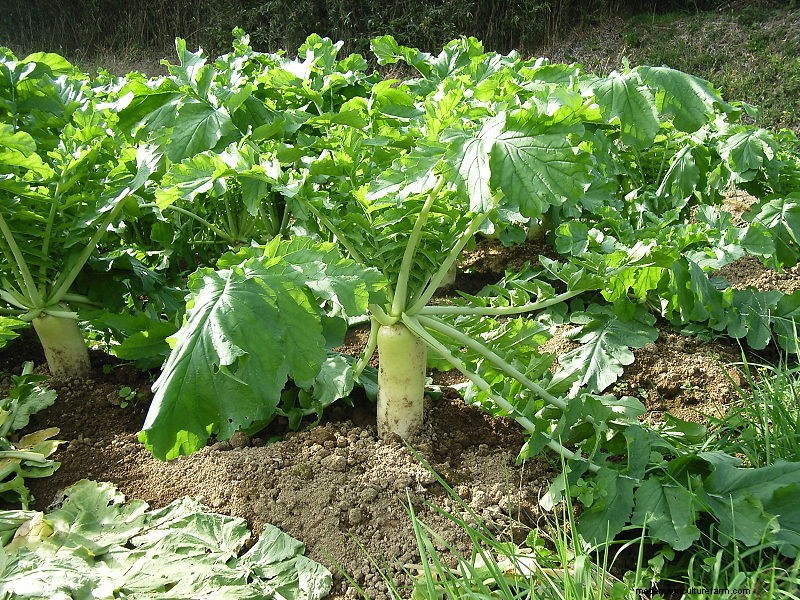
Keep your rows of radishes weed-free and give them a heavy watering every three days to ensure proper root development.
Radishes are at their best for a very short time. If they are left in the ground too long, they will develop a sharp taste and a pithy texture, and their roots will eventually split. Radishes are ready to harvest in as little as 20 days, depending on the variety. Once the root has become plump, they are ready to pick. Harvest the whole crop once it matures, and store them in the refrigerator. If harvesting in hot weather, pull radishes from the soil and drop them into a bucket of cold water. Remove greens and refrigerate for up to 3 weeks. Storage can be extended up to several months in a properly maintained root cellar.
| Storage Requirements | ||
|---|---|---|
| Remove green tops and store in plastic bags or containers with some water inside the refrigerator. | ||
| Fresh | ||
| Temperature | Humidity | Storage Life |
| 32F | 95 - 98% | 2 - 4 weeks |
| Preserved | ||
| Method | Taste | Shelf Life |
| Canned | Good | 12+ months |
| Frozen | Poor | Poor |
| Dried | Poor | Poor |
A lightweight, floating row cover applied at the time the seeds go into the ground will keep flea beetles away, and also prevent root maggots from spoiling the roots.
None of major concern.
Insects tend to have preferences, much like humans when it comes to what they eat. They may eat one garden plant when it is the only thing available, but if given the choice, they might choose something they like better. These preferred plants are often within the same plant family. The same root maggots that like broccoli roots, also like radish roots. Flea beetles like broccoli and cabbage seedlings, but also like kale, turnips, pak choi, and radishes. That’s the idea behind a trap crop. You could, for instance, plant radishes with the primary intent that they would attract the root maggots and flea beetles and leave your broccoli and cabbage alone. Many gardeners have found radish to be a good trap crop to protect many of the cabbage family plants.


