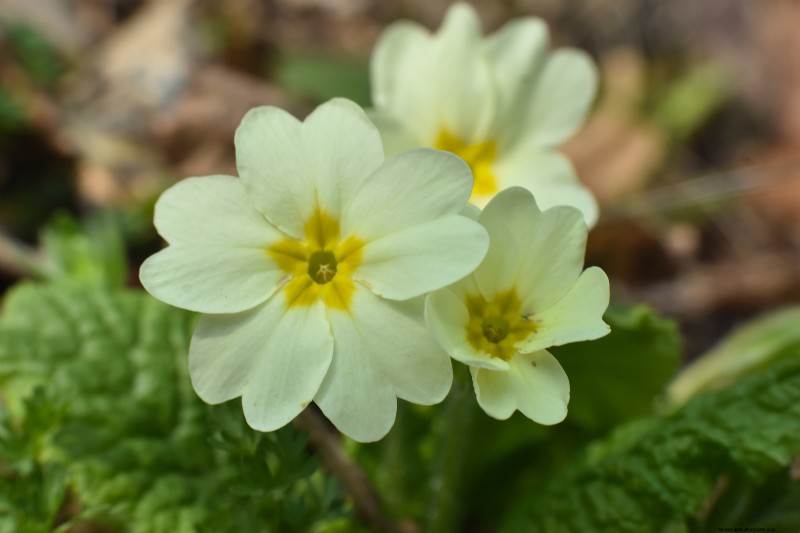
Polyanthus primrose is a tender semi-evergreen hybrid perennial that produces single blossoms or umbels of up to 20 flowers in spring. Polyanthus primroses are often called English primroses.
Polyantha or English primroses are widely hybridized and cultivated. There are many cultivars and strains widely available at garden centers and nurseries. Polyantha primroses are often listed as the Polyanthus Group of primroses and also as Primula x poloyanthus. Polyanthus primroses are crosses between various hardy primroses.
Hybrid polyanthus primroses along with the primrose species Primula vulgaris are often called English primrose. There is a separate entry on this website for Primula vulgaris and also for Primroses in general.
Polyantha primroses form low 8 to 12 inch (20-30cm) wide rosettes of evergreen to semi-evergreen, rough-textured leaves. In mid-spring, clusters of showy 1- to 2-inch-wide flowers bloom on 6-inch (15cm) tall stems in a wide range of colors including pale to deep yellow, red, orange, violet-blue, white, and pink–often with yellow eyes.
Polyantha primroses are hardy to Zone 3. Florist’s types are usually less hardy.
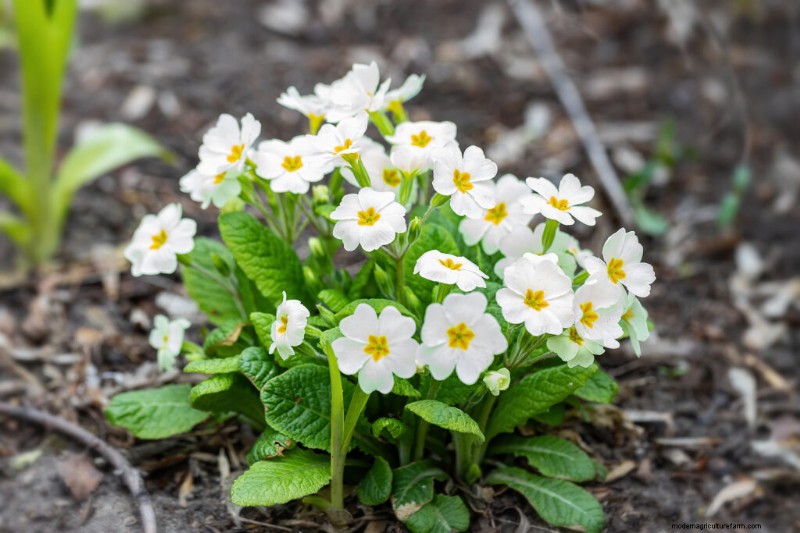
Polyantha primrose
Polyantha Primula Overview
Polyantha primulas (Primula x polyantha) are popular spring-flowering perennials known for their vibrant clusters of blooms. They are hybrids of Primula vulgaris (common primrose) and Primula veris (cowslip). These plants feature rosettes of lush green foliage and produce upright stems topped with clusters of brightly colored flowers in shades of red, yellow, pink, blue, purple, and white, often with contrasting eyes. They thrive in cool climates and bring early-season color to gardens.
Using Polyantha Primulas in the Garden
- Borders and Edging
- Plant them at the front of garden beds or borders to create a vivid display of color. Their compact size (6–12 inches tall) and bold blooms make them ideal for edging.
- Combine them with early spring bulbs like daffodils or tulips for a dynamic and layered look.
- Cottage Gardens
- Polyantha primulas fit perfectly into cottage-style gardens, where their natural, cheerful appearance blends with other perennials and spring-flowering plants.
- Pair them with forget-me-nots, hellebores, and lungwort for a classic spring palette.
- Containers and Window Boxes
- Use polyantha primulas in pots or window boxes to brighten patios, balconies, or entryways.
- Combine them with other cool-season plants like violas, pansies, or sweet alyssum for eye-catching arrangements.
- Woodland Gardens
- Their preference for cool, moist conditions makes them a great choice for shaded or woodland gardens.
- Underplant them beneath deciduous trees or along paths for a naturalized look.
- Seasonal Bedding Displays
- Polyantha primulas are excellent for creating temporary seasonal displays in spring gardens. Use them to fill gaps in flower beds or add vibrant color to public spaces and formal gardens.
- Pollinator Gardens
- Their nectar-rich flowers attract bees, butterflies, and other pollinators, making them a valuable addition to wildlife-friendly gardens.
Quick Care Tips for Polyantha Primulas
- Light: Prefer partial shade but can tolerate full sun in cooler climates. Avoid harsh midday sun, especially in warmer regions.
- Soil: Thrive in rich, well-drained soil with plenty of organic matter. Maintain consistent moisture but avoid waterlogged conditions.
- Watering: Keep the soil evenly moist during the growing season. Regular watering is important during dry spells.
- Fertilizing: Apply a balanced, slow-release fertilizer in early spring to encourage strong growth and flowering.
- Deadheading: Remove spent blooms to prolong flowering and improve the plant’s appearance.
- Division: Divide clumps every 2–3 years in early autumn or after flowering to rejuvenate plants and increase stock.
Polyantha primulas are reliable and colorful garden companions that provide a cheerful burst of springtime color.
Get to know Polyantha Primrose
- Plant type: Perennial usually grown as an annul
- Growing Zones and range: Zones 5 to 8; grow as an annual or perennial depending on the climate; grow as an annual in Zones 3 to 7
- Hardiness: Hardy to Zone 5, -20°F (-29°C)
- Height and width: 6 to 12 inches (15-3-cm) tall; 8 to 12 inches (20-30cm) wide
- Flowers: Brilliant large flowers in clusters; colors include yellow, red, blue, white, purple
- Bloom time: Winter blooms in mild winter regions; early spring in most regions; bloom time is about 6 weeks; summer in cool-summer regions.
- Uses: Winter and early spring bedding
- Botanical name: Primula x polyanthus
- Common name: Polyantha primrose
- Family: Primulaceae
- Origin: Bogs and marshlands in the Northern Hemisphere
Where to plant Polyantha Primrose
- Plant polyantha primrose in full sun in Zones 3-6; plant in light shade in Zones 7-10.
- Grow polyantha rose in humus-rich, moisture-retentive but well-drained soil.
- Primroses grow best in cool climates and regions with cool summer. In warm summer regions, grow primroses in a spot that is shaded during the warmest part of the day.
- Growing indoors, give primroses a light, cool, airy windowsill.
- The optimal soil pH for primroses is 6.5.
Primrose uses and companions
- Primroses can be used in beds and borders.
- Plant primroses in a naturalistic setting, cottage garden, or along a stream or bog.
- Good garden companions for English primrose include Aquilegia, Dicentra, Epimedium, Mertensia Polygonatum.
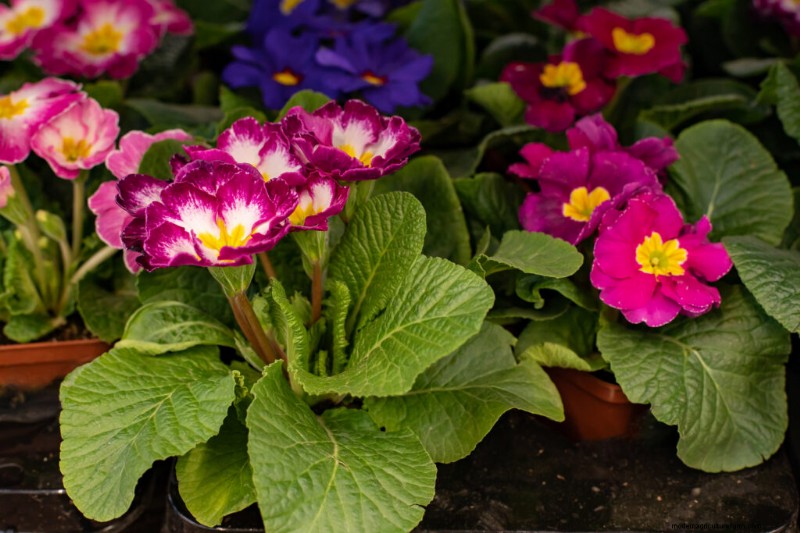 Primula
 primrose
When to plant Polyantha Primrose
- Set polyantha primrose in the garden when the soil is workable in spring. In mild-winter regions set plants in the garden in winter.
- Plant in early spring in Zones 3-7. Plant in late autumn in Zones 8-10 for winter bloom.
- Start primroses indoors in early spring for transplanting out in late spring.
Planting and spacing Polyantha Primrose
- Start primroses indoors in a sterile seed starting mix. Sow seeds 1/8 inch deep or press the seed into the medium.
- Transplant seedlings into separate small pots when 2 true leaves have appeared. Repot into a 5 inch (13cm) pot when the roots are full.
- Set primroses in the garden when plants are fully rooted after hardening off.
- Space polyantha primroses 8 to 12 inches ( 20-30cm) apart.
How to water and feed Polyantha Primrose
- Give polyantha primroses ample moisture; keep the soil evenly moist but not wet. Water primrose regularly during dry spells.
- Fertilize polyantha primrose with slow-release, all-purpose fertilizer added to the soil at planting time.
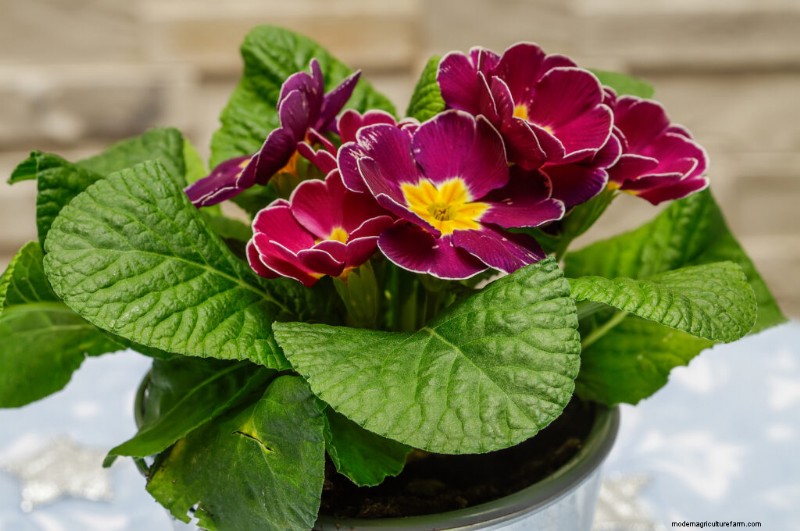
Polyanthus Primrose
- Discard spent plants when hot weather arrives.
Polyantha Primrose pests and diseases
- Primroses are susceptible to aphids, spider mites, weevils, and slugs.
- Diseases that attack primrose include gray mold, root rot, rust, and leaf spots.
- To avoid disease, avoid wetting flowers and foliage.
Polyantha Primrose propagation
- Polyantha Primrose seeds germinate in 7 to 15 days at 60° to 65°F (15-18°C). Plants will be large enough for transplanting in 25 to 35 days. Flowers usually appear 20 to 25 weeks after sowing.
Polyantha Primrose cultivars
- There are many strains and cultivars of polyantha primrose. Large-flowered strains include Clarke’s, Concorde, Barnhaven, Pacific, Santa Barbara.
Primrose species
- Primula acaulis, English primrose, same as Primrose vulgaris, see below.
- P. alpicoia, moonlight primrose. Grows to 20 inches tall and 12 inches wide; wrinkled medium green leaves and clusters of yellow sometimes white or purple bell-shaped flowers.
- P. auricula, Auricula. Hardy perennial with vivid flowers that may include contrasting zones; grows to 8 inches (20cm) tall; blooms in early spring. Zones 3-8.
- P. denticulata, Himalayan primrose, drumstick primrose. Perennial bears clusters of pink, lilac, or white flowers with yellow eyes to 2 inches (5cm) across on 12-inch (30cm) stems; prefers wet zones; grows best in Zones 3-8.
- P, beesiana grows to 24 inches tall and wide; leaves to 14 inches long; bears tired blossoms with 2 to 8 dense whorls per stem; flowers are usually reddish-purple with yellow eye; need deep watering,
- P. bulleyana grows to 24 inches tall and wide; blooms mid to late spring; tiered flowers with 5 to 7 whorls pr some; blooms are bright yellow, opening from orange buds.
- P. denticulata, drumstick primrose, grows to 12 inches tall and wide; spoon-shaped, medium-green leaves; dense ball-shaped flowers on stout stems in early spring; colors from blue-violet to purple, also pinkish lavender and white.
- P. elatior, oxlip primrose. Evergreen to semi-evergreen species blooms early to mid spring dainty clusters of tubular yellow flowers. Zones 4-8.
- P. florindae, grows to 3 feet tall and 2 feet wide; yellow bell-shaped, nodding flowers in clusters; long-stemmed, medium green leaves; hybrid varieties bloom in red, orange, and yellow; flowers lates in spring to summer; ill grow in a few inches of water.
- P. japonica, Japanese primrose. Perennial species in Zones 5-8; red, white, or pink flowers on ball-shaped umbels that open in tiers or whorls on 12 to 24 inch (30-61cm) stems; blooms in late spring; foliage disappears in late summer, fall, and winter; pre-chill seeds before planting; naturalizes well in moist, boggy soil. This is a favorite of gardeners because it is easy to grow.
- P. juliae, Juliana primrose, grows just 3 to 4 inches high and 10 inches wide; magenta, yellow-eyed flowers borne singly on long stak in spring; ‘Wanda’ is a white-flowered old-time variety.
- P. malacoides, Fairy primrose. Tender annual with frilly flowers; blooms in spring; blooms are pink, white, or violet; flowers appear above attractive leaf rosettes; start plants indoors in winter for blooms the following spring and summer.
- P. obconica, German primrose. Tender perennial grows 9 to 16 inches (22-40cm) tall with tiers of whorled, 1- to 2-inch (2.5-5cm) wide flowers sometimes with frilled petal edges; flowers come in shades of pink, red, lilac-blue, and white. Touching foliage can cause a skin rash.
- P. x polyantha, Polyanthus primrose. This is a group of hybrids, Popular polyanthus hybrid primroses, crosses between very hardy primroses; hardy in Zones 3-8; blooms in spring at the same time as daffodils, earlier indoors; prefers humus-rich soil. Plants grow 8- to 12-inches (20-30cm) wide, rosettes of evergreen to semi-evergreen, rough-textured leaves. Clusters of 1- to 2-inch (2.5-5cm) wide flowers in a wide range of colors including yellow, red, orange, violet-blue, white, and pink, sometimes with yellow eyes.
- P. prolifera (P. helodoxa) grows 2 to 3 feet tall and 2 feet wide; tiered blossoms with up to 7 whorls per stem; fragrant, light to bright yellow inch-wide flowers; blooms late spring into summer.
- P. pulverulenta grows 3 feet tall and 2 feet wide; wrinkled leaves; tiered blossoms with several whorls per stem; blooms red to purple with purple eye. Bartley hybrids have flowers in pink and salmon hues.
- P. sieboldii, Siebold primrose. Clusters of delicate, lacy-looking 1-inch-wide flowers on 12-inch (30cm) stems; flower colors are pale pink, rose, white, pale purple, and purple-red. Zone 3-8.
- P. sinensis, Chinese primrose. Grows to 12 inches tall; hearts-shaped, lobed, hairy leaves; flowers are all colors; ‘Filicifolia’ has crisped leaves; ‘Fimbriata’ has fringed flowers; ‘Stellata’ has star-shaped double flowers.
- P. x tommasinii grow 6 to 12 inches tall and 18 inches wide; green tongue-shaped leaves; a single flower emerges from the center; types include Hose-in-hose and You and Me series; flower colors are yellow, cream, maroon, red, rose, white, purple, apricot, and blue.
- P. veris, English cowslip. Bright yellow in the wild with hybrids in many other colors; grows to 8 inches (20cm) tall; hardy in cool, shady gardens in Zones 3-8. ‘Grandiflora’ is used in the names of large-flowered cultivars.
- P. vialil (P. littoniana) grows 1 to 2 feet tall and 1 foot wide; oblong, irregularly toothed leaves; dense , narrow spikes of fragrant flower to 5 inches; blooms late spring into early summer; flowers are violet-blue, opening from red buds.
- P. vulgaris (synonm P. acaulis), English primrose. Very popular primrose bloom in early spring; hardy if grown in cool, moist shade in Zones 3-8; flowers available in bright colors; foliage remains partly evergreen in winter; produces 6- to 8-inch (15-20cm) wide rosettes of evergreen to semi-evergreen 9- to 10-inch (23-25cm) long leaves and clusters of 1-inch (2.5cm) wide, pale yellow flowers in clusters. Cultivars are available with single or double flowers in white, orange, magenta, purple-pink, and yellow.
Primrose Frequently Asked Questions
Q: What primroses can I grow indoors in winter?
A: Chinese primrose, Primula sinensis, can be grown indoors. Fairy primrose, P. malacoides, has small, violet blossoms throughout winter grown indoors. Giant fringed primrose, P. grandiflora fimbriata can be grown indoors as can P. obconica. Keep these primroses in a cool window with a dish of water nearby or provide humidity.
Q: What can I do to make my primrose bloom indoors?
A: Indoor primroses like a cool temperature, bright light, and high humidity. Fertilize plants every two weeks in spring, summer, and fall. Nip off spent blooms. Plants are usually discarde
Also of interest:
How to Grow Primrose


