
Welcome to Modern Agriculture!

Subscribe to Growing for Market Full Access for thousands of how‑to articles on growing and selling food and flowers. Click here to learn about print and online subscriptions.
Among the many season‑extension structures used on vegetable farms today, the caterpillar tunnel is one of the most affordable options. Named for its segmented appearance, the structure is built from PVC pipe, rebar, and rope, and can reach lengths of up to 300 feet. With a typical height of 5–6 ft at the center, growers can walk in from any point along the width, though the experience is slightly different from that of a high tunnel.
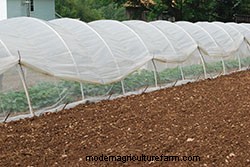
Caterpillar tunnels are simple to construct and relocate, and most materials are locally available. They offer strong protection while allowing excellent airflow—critical for healthy crop growth.
These tunnels are versatile: early in the season, a poly film can create a warm environment; later, shade cloth supports cool‑loving crops like lettuce; and with row cover or insect mesh, they protect against pests throughout the summer.
This article focuses on using caterpillar tunnels for summer crops such as cucumbers, tomatoes, eggplants, and cut flowers.
The hoops can be galvanized steel, electrical conduit, or PVC. They are driven into the soil or anchored on rebar stakes, with about 12 inches of the hoop below ground. Hoops are spaced 6–10 ft apart based on wind exposure. A rope purlin is then tied from hoop to hoop along the tunnel’s length and secured to stakes at both ends. The cover—poly, shade cloth, or insect mesh—is pulled over the tunnel and fastened to the ground with pegs, sandbags, or rocks. Additional stakes are driven between hoops on both sides, and a top rope is tied to the stakes to keep the cover in place.
Beech Grove Farm’s Anne and Eric Nordell use this method. They set 30‑inch rebar sections (5/8" diameter) 6 ft apart, 18 in deep, in two rows 10.5 ft apart. PVC pipe (Schedule 40, 1‑in diameter, 20 ft long) slides over the rebar to form flexible hoops. A clothesline ridge purlin is looped over the tops of the hoops and tied to 36‑inch rebar posts set 8 ft beyond each end. A stabilizing rope runs from the final hoop to the end stake.
The Nordells’ short mountain season makes a cost‑effective extension essential. They grow lettuce, spinach, salad mix, cucumbers, tomatoes, basil, chard, and kale in caterpillars.
For three years, they tested an organic cucumber pest control program with the Pennsylvania Association for Sustainable Agriculture (PASA). They compared cucumbers grown in the tunnel—using Enviromesh anti‑insect screen and 6‑mil greenhouse poly—to their standard floating row cover. Pollination was enhanced by placing bumblebee hives inside the tunnel during flowering.
Results were striking: yields were 78 % higher in the tunnel, and the field’s 28 % cull rate dropped to 20 % in the tunnel (primarily due to misshapen fruit). The tunnel also advanced the first cucumber harvest by nine days. For tomatoes, the tunnel provided a six‑week head start, protecting the crop from the late blight outbreak that devastated field tomatoes in mid‑July.
Enviromesh (also sold as Proteknet) is available from Purple Mountain Organics in the U.S. and Dubois Agrinovation in Canada (they ship to the U.S.). Other greenhouse insect screens can be sourced from G&M Agricultural Supply.
Windflower Farm’s Jan and Ted Blomgren have achieved longer stems and higher‑quality blooms by growing cut flowers in caterpillars. Using row cover to exclude leafhoppers—vectors of aster yellows—they grew China asters with 3‑ft stems. They now cover flower tunnels with 3–4 mil greenhouse film and grow asters under row cover in low tunnels.
With about 12,000 sq ft of tunnel space, the Blomgrens produce both vegetables and flowers. For deeper insight, consult the University of Vermont Center for Sustainable Agriculture’s free PDF, High Tunnels: Using Low Cost Technology to Increase Yields, Improve Quality, and Extend the Growing Season. An accompanying DVD (US$15) features six farmers explaining their high‑tunnel systems.
Copyright Growing For Market Magazine.
All rights reserved. No portion of this article may be copied in any manner for use other than by the subscriber without permission from the publisher.


