
Welcome to Modern Agriculture!

Mango (Mangifera indica L Family Anacardiaceae) is the second major fruit crop in Pakistan. At present it is grown on an area of 93.42 thousand hectares with production 915.7 thousand tonnes Table-1. The area under mango crop has increased but the rise in production is comparatively slow. The main mango growing districts in the Punjab province are Multan, Bahawalpur, Muzzaffargarh and Rahim yar Khan. In the province of Sindh it is mainly grown in Mir pur Khas, Hyderabad and Thatta in the province of NWFP it is grown in Peshawar and Mardan. The climate of Sindh gets warmer about one month earlier than the Punjab which has given the province the privilege to grow early varieties of mango. Subsequently, a new trend of growing late varieties in Punjab has received a wide popularity which has extended the market period and added to the exportable surplus.
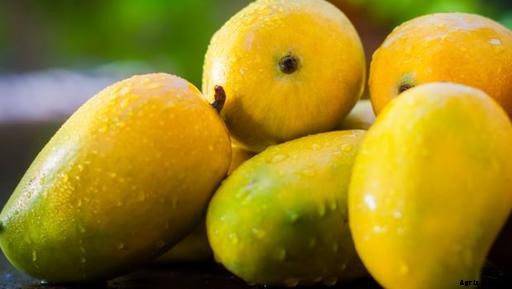
This delicious fruit is nutritionally superior, source of several vitamins and minerals. Pakistan produces 5.86 percent world’s mangoes being the third largest producer. Its export is progressing resulting into substantial foreign exchange earnings. Mango export including Middle East has also found its way to the UK and other European markets. It is believed that the demand would rise to as high as 50 percent given the right impetus and expanding the export to Germany, Japan China and Hong Kong.
The ecological conditions suitable for mango cultivation are :
Mango usually assumes a graceful dome shape shading the main trunk. No pruning is practiced however, annually after fruit harvest diseased, dried, broken branches and those touching the ground should be pruned off. To rejuvenate the orchard after every 3-4 years it is advisable that 15-20% of old wood should be removed.
Picking should be done when the fruit is fully developed and mature. Natural drop of the fruit is the main indication that the fruit is ready for picking. Different varieties in different areas ripe at different times. In Sindh, mango varieties start ripening from May to June. In Punjab ripening starts from June and continues up to mid-August. In NWFP, the harvest is a later which helps to extend the period that mangoes are available. Expected yields vary from 40 to 100 kg per tree.
The symptoms can be noticed on the inflorescence, stalk of inflorescence, leaves and young fruits. The characteristics symptoms of disease are white superficial powdery growth of the fungus on these parts. The effective flowers may fall prematurely and young fruits may remain on the tree until they reach up the marble size and then drop prematurely. Dropping of unfertilized infected flowers and young fruits leads to serious crop loss (20-80%).
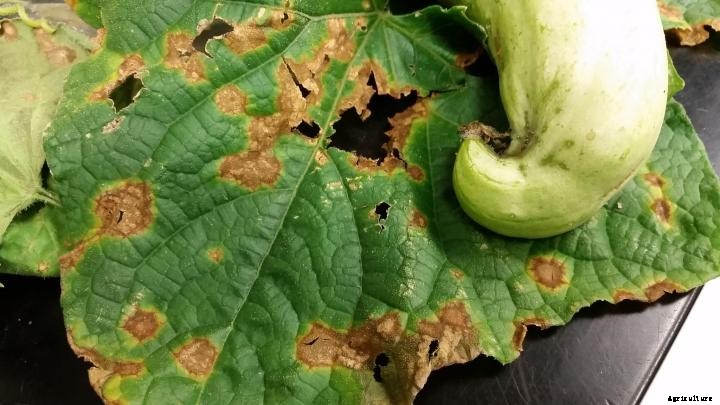
Anthracnose manifests on different parts of mango tree. On the inflorescence, the earliest symptoms of the disease are the production of blackish brown specks on peduncles and flowers. Small black spots appear on the panicles and open flowers, which gradually enlarge and cause death of flowers. The infected flowers fall off, leaving the more persistence spikes on the peduncles, this leads to serious crop loss (10-90%).95-97% R.H.Excessive in Nitrogen.
Malformation is a serious threat to the mango growing areas of Pakistan as it causes crop loss upto 70%. Recent findings have demonstrated that the disease may be of fungal origin. Two distinct types of symptoms described by the workers are vegetative malformation (MV) and floral malformation (MF). Vegetative malformation is more pronounced in young seedlings as well as seedling trees than in the grafted plants. The affected seedlings developed excessive vegetative branches, which are of limited growth, swollen and have very short internodes.
Malformation of inflorescence (MF) is a disease of inflorescence. The most characteristic symptoms of (MF) are the reduction and compact of internodes giving malformation a broom like appearance.Infected Grafting Material & wounds
At present, no definite control measures for mango malformation can be advocated. However the following may reduce the incidence of malformation
Mango plant more or less is prone to various leaf diseases which are mentioned below but the most important ones are discussed in detail:</>
Characteristics symptoms appear as oval or irregular brown to deep brown spot of various sizes scattered all over the leaf surface. Under damp conditions, the fungus grows rapidly. Young leaves are more prone to attract than the older ones. Insect attack may facilitate the entry of pathogen resulting into heavy incidence of disease.
The foliar infection can be controlled by sprays of copper based fungicides during spring and after monsoon season.
Symptoms first appear as small, brownish circular spots on the surface of leaves. Later on, high concentration of brown black spots occurs evenly over the leaf lamina. Symptoms are more prominent on the lower side of the leaves. The tender leaves are found to be more susceptible than mature ones.
The disease can be controlled by regular field spray program including copper based fungicides.
On leaves, minute water soaked irregular to angular raised lesions is usually crowded at the apex. On young leaves halos are larger and distinct, while on older leaves, they are narrow could be observed only against light. Under severe infections, the leaf turns yellow and drop off.25-30 0C & >90% R.H. Rainy weather
Regular inspection of orchards, sanitation and seedling certification are recommended as preventive measures against the disease.
Spray of copper based fungicides has been found effective in controlling bacterial canker.
The disease is more common on young fruits and during transit and storage. Latent infection during pre-harvest stage is responsible for post-harvest rots. On storage, black spots are produced. Initially the spots are round but later form large irregular blotches on the entire fruits the spots have large deep cracks and the fungus penetrates deep into the fruit causing extensive rotting.
Pre-harvest infections can be managed by spraying copper based fungicides after completion of heavy showers.
Post harvest infections can be managed as pre harvest sprays in the field to reduce the latent infection and treatment of the fruit with hot water/ fungicides after harvest to eradicate left over latent infection.
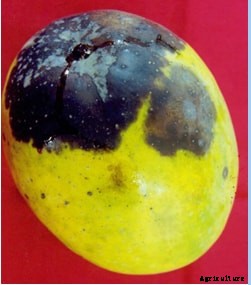
The fruit while ripening suddenly becomes brown to black typically at stem end. Within two three days whole fruit becomes a black and disease progress downwards, thus involving half of the area of the fruits. Though the flush of the whole fruit often wrinkles are also observed. Affected skin remains firm but decay sets into the pulp below and emits unpleasant odour.
Decline is a general term and mango plant is affected with different decline disorders which are usually associated with biotic as well as abiotic stresses.
The important mango decline disorders are described below:
The disease is noticeable throughout the year but it is most conspicuous during October and November. It is characterized by drying up of twigs from top to downward particularly in the older trees followed by drying up of leaves which gives an appearance of fire scorch. The upper leaves lose their color and gradually dry. Drying of the whole leaf is accompanied by upward rolling of the margin. Such leaves shrivel, fall off within a month leaving the shriveled twigs all together bare, which is the characteristic symptom in the advance stage of the disease.
Drought, hard pain, high temperature, weak trees, sun scorch, high humidity, nutrition deficiency & physical damage.
Disease produces elongated black necrotic areas on the twigs. The leaves droop down slowly during up and ultimately fall off. The very young braches start drying from tip downward. Injuries, Insect attack, high temperature weak plant, water stress, frost & physical damage.
Diseased twigs lying on the floor of the orchard should be collected and all infected twigs from the tree should be pruned and burnt.
Foliar sprays of copper based fungicides reflect good control.
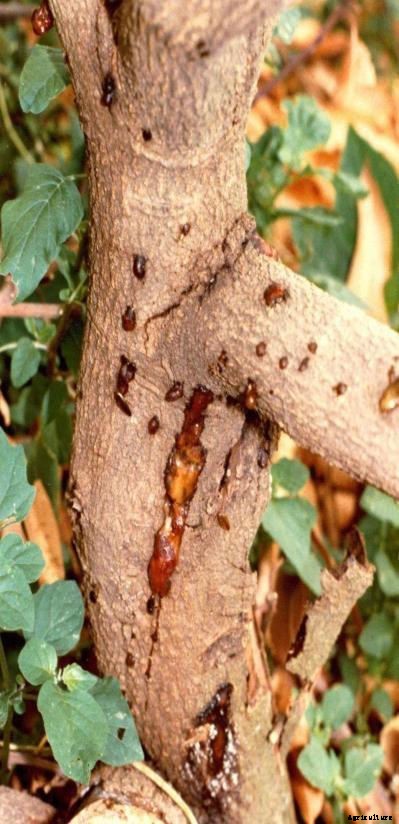
About 30-40% of young mango trees are affected by the gummosis especially when the mango tree is planted in sandy soil but its prevalence has also been noticed in other mango growing soils. The diseases is characterized by the presence of profuse oozing of gum on the surface of affected wood, bark of the trunk and also on larger branches but more common on the crack branches. In severe cases, droplets of gum trickle down on stem and bark turns dark brown with longitudinal cracks.
Bark cracking is characterized by the development of deep longitudinal cracks. Rooting is not associated with the cracks but the underlying wood is found severely pitted. Gum pockets are also noticed along with the cracks. Later bark gets dried and pulled off resulting in girdling effects, yellowing and shedding of leaves followed by the die back of branches.
Control:-
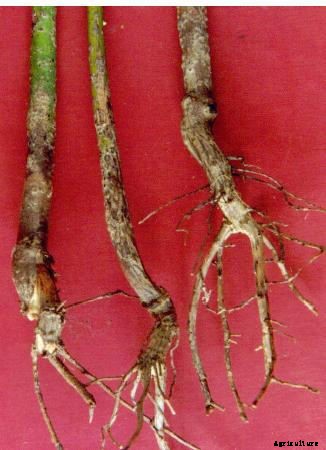
Infection occurs at/or below the ground level the circular to irregular water socked patches. These patches enlarge and ultimately girdle the entire base of the stem. On account of rotting, the diseased tissues become soft, dark brown or black.
Soil treatment with Thiophanate methyl, carbendazim or copper oxychloride @ 2g/ft2 is recommended.
During the growing period any copper based fungicide should be sprayed on the plants.
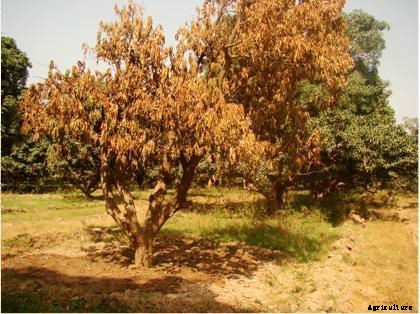
Mango sudden death syndrome (MSDS) has become an important disease in Pakistan since 1997 which is closely associated with infections by Ceratocystis fimbriata possibly in concert with Botryosphaericaceous fungi like Lasiodiplodia theobromae. Improper irrigation and root injuries have been found as major predisposing factors for this disease. Affected mango trees have wilting symptoms. Cankers may develop over areas of vascular discoloration and the cankers my exude gum from the stem. Wilted leaves typically become dry and curled rather suddenly but remain attached to the tree for several weeks. It is a serious disease and aggravating day by day by which apparently healthy looking mango plants die within days and it is destroying the Precious wealth of Pakistan. Up till now 4-12% mortality rate has been observed in different mango growing areas of Pakistan.
Early detection is very important for the proper management of this disease. For this purpose scientists have divided this syndrome into five categories (0-5 stages) with collective wisdom. The detailed pictorial presentation of each stage has been developed for the guideline of mango growers under ASLP project. However some important points are being discussed over here.
Uproot the plants showing 3, 4 & 5 stages immediately and treat the soil with fungicide. Soil solarization of this area is also recommended.
Treat the plants falling in 1 & 2 stages with the following way:
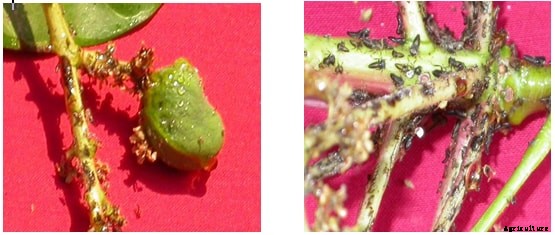
The wedges shaped Nymphs and adult insects puncture and suck sap of tender parts, reducing vigour of plants and particularly destroying the inflorescence and causing fruit drop. Heavy puncturing and continuous draining of sap causes curling and drying of infested tissue. They also damage the crop by excreting a sweet sticky substance facilitates the development of sooty mould .
The adult bugs are covered with whitish powder and colonize between bark of tree trunk, young shoots and panicles. The nymphs’ ascent the trees and settle on inflorescence causing flower drop, affecting fruit set. They also excrete honey dew, a sticky substance, which facilitates development of sooty mould).
Symptoms: The larvae tunnel the axis of inflorescence and destroy it completely. Damage by E. indica causes bending and drying of the inflorescences. Second attacks starts at fruit setting as young maggots bore into these tender fruits which slowly turn yellow and finally drop. Third attack is on tender ‘new leaves encircling inflorescence. The most damaging one is first attack in which the entire inflorescence is destroyed. The inflorescence shows stunted growth and its axis bends, at the entrance point of larva (Fig 7 & 8).
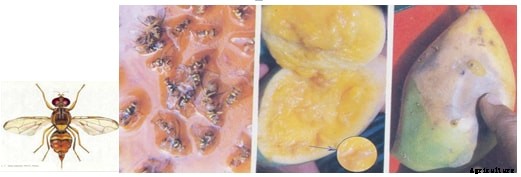
Symptoms: The female punctures outer wall of mature fruits with the help of its pointed ovipositor and insert eggs in small clusters inside mesocarp of mature fruits. On hatching, the maggots feed on fruit pulp and the infested fruits start rotting due to further secondary infection .
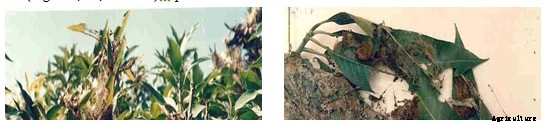
Symptoms: Initially caterpillars feed on leaf surface gregariously by scrapping/Later they make web of tender shoots and leaves together and feed within. Several caterpillars may be found in a single webbed up cluster of leaves.
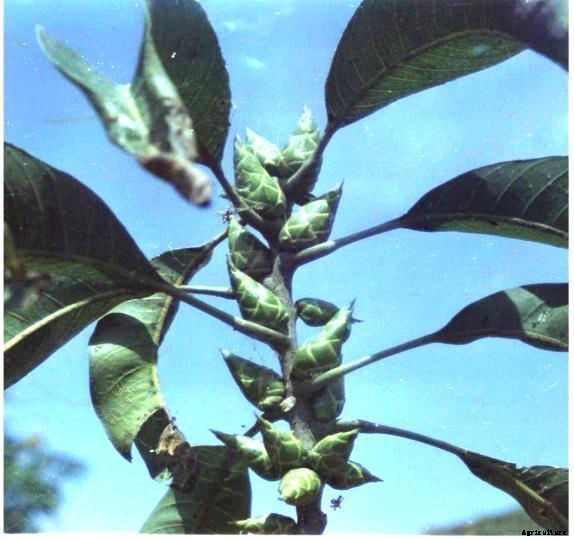
Symptoms: Nymphs emerge during August September and suck cell sap from adjacent buds. As a result of feeding, buds develop into hard conical green galls.The galls are usually seen during September-October. Consequently there is no flowering and fruit setting. Nymphs pass winter inside the galls.
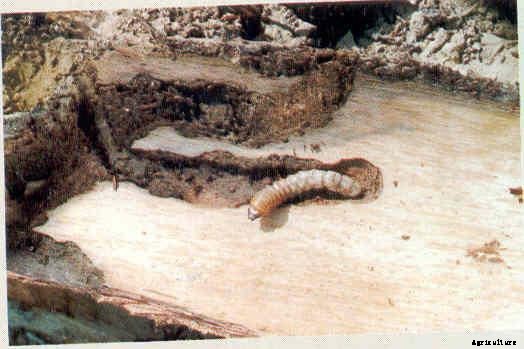
Symptoms: The damage is caused by grubs either to roots or stems. The grubs after hatching from eggs first feed on bark and make irregular cavities. It makes tunnels which may either be in boring upward, resulting in drying of branches
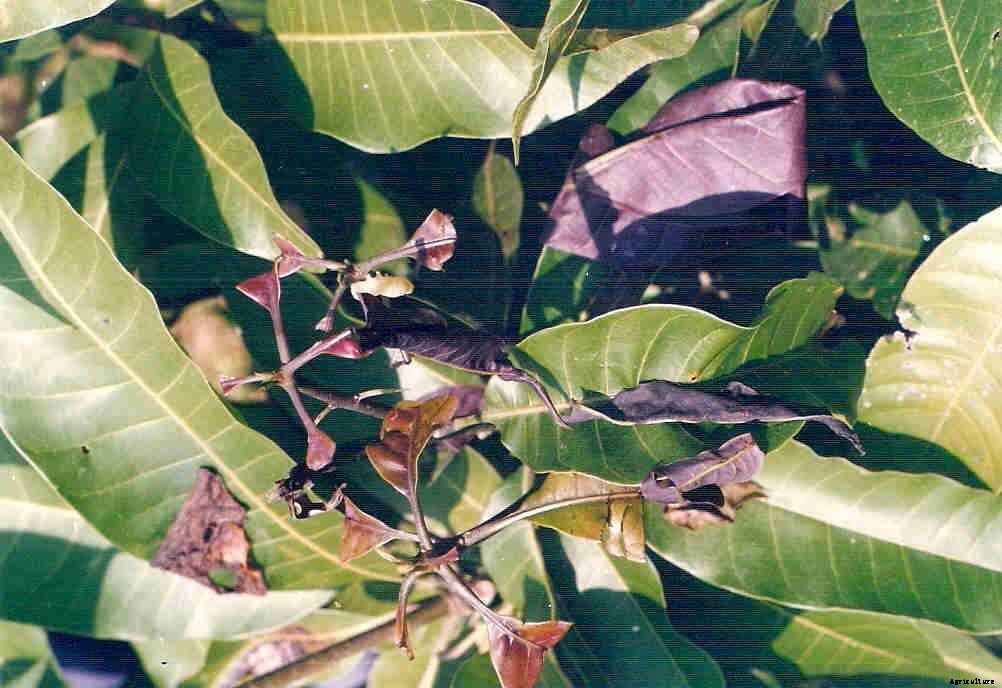
Symptoms: Larvae bore into young tender leaves during August and freshly hatched caterpillar bore into mid rib. After a couple of days, they bore into tender shoots near the growing point tunneling downward, throwing their excreta resulting in dropping of leaves and wilting of terminal shoots.
Symptoms: The caterpillar spins brown zig-zag ribbon-like silken web on tree which consists of their excreta and wood particles. Larvae also make shelter tunnels inside where they rest.
Symptoms: The nymphs and adult scale suck the sap of leaves and other tender parts reducing vigor of plants. They also excrete honeydew which helps in the development of sooty mould on leaves and other tender parts.
Symptoms: Nymphs and adults lacerate the tissues and suck the oozing cell sap. C. indicus and R. cruentatus feed on leaves and S. dorsalis on in florescence, and young fruits.Leaf feeding species feed on mesophyll near leaf tips.Affected leaves show silvery sheen and bear small spots of faecal matter.
If the infestation is severe, can be controlled by either dimethoate (0.1.5%) or Monocrotophos (0.1%)
Symptoms: Major pest of cashew, occasionally damages mango and other fruit crops. Adult is a reddish brown bug with black head, red thorax, and black and white abdomen. Eggs are inserted into epidermis of tender shoots and axis of inflorescence. Adult and nymphs feed on petioles, tender shoots and leaf veins causing necrotic lesions.
Spray Dimethoate (0.05) or quinalphos (25 EC) 2 ml/ liter.
Symptoms: A major pest in Orissa, West Bengal and Coastal Andhra Pradesh. Pest is active from January to May Adults lay eggs on fruits. After hatching larvae bore into fruits. Fully grown caterpillars (25 mm) have red bands on body alternating with white bands caterpillars bore into the fruit at the bottom (beak region) and feed inside reaching Kernels. Entrance hole is plugged with excreta. Affected fruits rot and fall prematurely.
Symptoms: Tiny caterpillars mine under the dorsal epidemics of tender leaves and feed within as a result grayish white blisters appear on leaves.
Symptoms: The ants web and stitch together a few leaves, usually at the top of the branches and build their nests. The ants are carnivorous and prey upon small insects. However, indirect damage is caused by protecting insects like aphids and scales, which excrete honey dew.
Symptoms: The caterpillars attack inflorescence and if not controlled cause heavy loss through reduced fruit bearing.
For efficient management spray Monocrotophos or Dimethoate1ml/l at early panicle emergence.
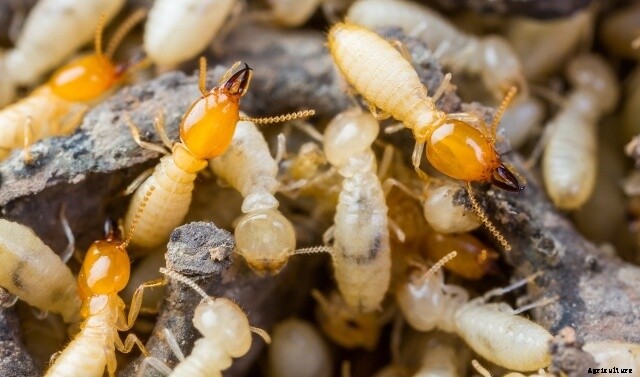
Symptoms: Termites are white in colour, shy to light and remain underground. They feed on root or move upward making the tunnels. They construct mud galleries on tree trunk and under the protection of these galleries; they feed on the bark of the trunks.
Remove the mud galleries on trunk and swab or spray the trunk with Malathion (1.5 ml/l).
After two month, drench the soil at the base of the tree with chlorpyriphos 1.5 ml/l.
Symptoms: Pathogen attacks the inflorescence, leaves, stalk of inflorescence and young fruits with white superficial powdery growth of fungus resulting in its shedding. The sepals are relatively more susceptible than petals. The affected flowers fail to open and may fall prematurely (Fig 28). Dropping of unfertilized infected flowers leads to serious crop loss. Initially young fruits are covered entirely by the mildew. When fruit grows further, epidermis of the infected fruits cracks and corky tissues are formed. Fruits may remain on the tree until they reach up to marble size and then they drop prematurely.
Infection is noticed on young leaves, when their colour changes from brown to light green. Young leaves are attacked on both the sides but it is more conspicuous on the grower surface. Often these patches coalesce and occupy larger areas turning into purplish brown in colour. The pathogen is restricted to the area of the central and lateral veins of the infected leaf and often twists, curl and get distorted.
Symptoms: The pathogen causes leaf spot/leaf blight, wither tip, blossom blight and fruit rots. On leaves characteristic symptoms appear as oval or irregular vinaceous brown to deep brown spots of various sizes scattered all over the leaf surface. Later lesions get blighted and rupture and show, shot hole symptom
Young leaves are more prone to attack, than older ones. Petiole, when affected, turns grey or black. Disease also produces elongated black necrotic areas on twigs. The tips of young branches start drying from tip downwards. On blossom small black spots appear on panicles and open flowers, which gradually enlarge and coalesce to cause death of flowers. The infected flowers fall-off, leaving more persistent spikes on peduncles.On fruits, it is more common during transit and storage
Symptoms: The pathogen causing dieback, tip dieback, graft union blight, twig blight, seedling rot, wood stain, stem-end rot, black root rot, fruit rot, dry rot, brown rot of panicle etc. The disease is most conspicuous during October November. It is characterized by drying back of twigs from top downwards, particularly in older trees followed by drying of leaves which gives an appearance of fire scorch (Fig.36 & Fig. 38). Internal browning in wood tissue is observed when it is slit open along with the long axis. Cracks appear on branches and gum exudes before they die out. When graft union of nursery plant is affected, it usually dies.
Mode of spread
Sooty Mould
Symptoms: It is very common wherever honey dew secreting insects, viz. mango hopper, scales, coccids and mealy bugs are found. Black velvety thin membranous covering on leaves, stems and fruits are its symptoms. In severe cases, trees appear black and look ugly.
Mode of Spread:
Symptoms: The disease is noticed on matured / old leaves only. Fully developed spots are characterized by dark margin and dull grey necrotic centre. In severe cases, spots coalesce to form patches, which result in withering and defoliation of infected leaves .
Management
Bacterial canker disease
Symptoms: The disease is noticed on leaves, leaf stalks, stems, twigs, branches and fruits, initially producing water soaked lesions, later turning into typical canker. On leaves, water soaked irregular satellite to angular raised lesions measuring 1-4 mm in diameter are formed. These lesions are light yellow in colour, initially with yellow halo but with age enlarge or coalesce to form irregular necrotic cankerous patches with dark brown colour.
On fruits, water-soaked, dark brown to black coloured lesions are observed which gradually developed into cankerous, raised or flat spots. These spots grow bigger usually up to 1 to 5 mm in diameter, which covers / almost the whole fruit. These spots often, burst extruding gummy substances containing highly contagious bacterial cells.
Symptoms: Vegetative malformation is pronounced in young seedlings. The affected seedlings develop vegetative growths which are abnormal growth, swollen and have very short internodes.
Floral malformation: The flower buds are transformed into vegetative buds and a large number of small leaves and stems, which are characterized by appreciably reduced internodes and give an appearance of witches broom. The flower buds seldom open and remain dull green.
Symptoms: The disease is characterized by the presence of profuse oozing of gum on the surface of the affected wood, bark of the trunk and also on larger braches but more common on the cracked branches. In severe cases, droplets of gum trickle down on stem, bark turn dark brown with longitudinal cracks, rots completely and the tree dries up because of cracking, rotting and girdling effects.
Management

Symptoms: The scab fungus attack leaves, panicles, blossoms, twigs, bark of stems and mango fruits. Spots are circular, slightly angular, elongated, 2-4 mm in diameter, brown but during rainy season, lesions differ in size, shape and colour. Symptoms produced by the disease are very much like those of anthracnose. On young fruits, the infection is grey to grayish brown with dark irregular margins. As the fruit attains in size, spots also enlarge and the centre may become covered with the crack fissure and corky tissues.
Symptoms: The disease is noticed on the midribs/ veins of the leaves, twigs and branches as black velvety raise fungal out growth in the form of spots which gradually increase insize encircle the trunk limbs branches and twigs. The incidence of disease is very low on the main branches. The disease occasionally spread on the leaves and cause loss. It presents a characteristic and conspicuous black banded appearance and thus considered appropriate to name it as Black banded diseases.
Symptoms: The leaves of affected tree area lusterless and sparse. Diseased tree wilts and dies. Infected roots are very light in weight and get easily crumbled and powdered with fingers. The fruiting bodies of the fungus (brackets) appear at the base of the tree in rainy season.
Symptoms: The disease is characterized by sudden dropping of leaves after the emergence of seedlings from the soil. During prolonged rainy and humid weather, infection occurs at / or below the ground level with circular to irregular water soaked patches. These patches enlarge and ultimately girdle the entire base of the seedlings.
Symptoms: The disease is readily recognized by the presence of the rusty red fructification of the alga on the surface of the leaves, veins, petiole and young twigs and fruit. Initially the spots are greenish grey in colour and velvety in texture which finally turn into reddish brown in colour.
Symptoms: Lichens are found on full grown trees of mango, mainly on trunks, branches and twigs in the areas of high humidity, heavy rainfall and poorly managed orchards. It is seen in the form of whitish, pinkish, superficial patches of different shapes on the main trunk, branches, leaves and twigs of the trees.

The post harvest infection starts form the field as latent infection. On stored fruits, black spots are produced. Initially the spots are round but later coalesce to form large irregular blotches. Sometimes, it covers the entire fruits surface. The spots have large deep cracks in which fungus penetrates deep into the fruit,causing extensive rotting. Under moist conditions, the blackened areas become covered with minute pinkish reproductive bodies of the fungus. Staining, russetting and tear streaking, involving only the skin of the fruit, are attributed to the same fungus .
The disease starts on fruit at the base of the pedicel. A circular brown area develops near the stem end, which gradually starts developing as dark brown to black area towards the lower portion of the fruit and later even cover the entire fruit surface. The rotting is so fast that the entire fruit rots within 2-3 days. The disease may start on fruit from some point other than the stem end, when fruit get bruises. The disease is observed on ripe fruits only.
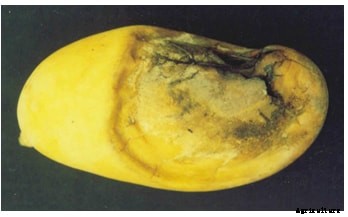
Affected fruits show characteristic yellowing with irregular dull grayish spots, which develop into the black necrotic area with growth of black mould. Tissue below and around the spots disintegrate and emit foul dour. The fruits rot very fast. The rotting may; start from any point but injury is essential for the start of rot. It may also start form the stem end as there remains natural opening.
Management
Reason: Many post harvest diseases begin while the crop is still in the field. Some harvested fruits carry latent infection that may not be detected at harvest level.
Reason: Bruises, wounds and other mechanical injuries serve as portal of entry for microorganisms.
Reason: These may carry the microorganisms from the field.
Reason: Free moisture on the fruits surface enhances the growth of spores.
Reason: Diseased commodities may contaminate healthy fruit when they come in contact with diseased ones.
Reason: Disease-causing microorganisms do not grow at low temperatures. Growth will resume upon transfer of commodity to room temperature.
Reason: Moist conditions favour the growth and multiplication of disease- causing microorganisms.
Reason: Dirty and unsanitary containers and areas may serve as sources of infection.
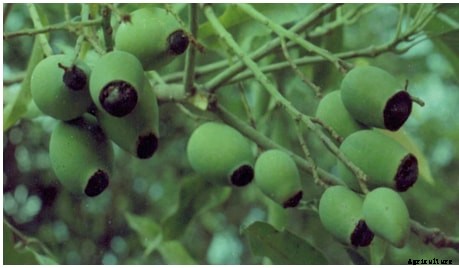
Symptoms: Symptoms become visible when the mango fruits attain some size. Small etiolated area develops near the distal end of the fruit which gradually spreads, turns nearly black and covers the tip of the fruit completely. The black area remains hard and the growth of the fruit is checked.
Through toxic gas viz. Sulphurdioxide, ethylene,carbonmonooxide and fluoride emitting from brick klins operating nearby orchard.
Symptoms: First, water soaked grayish spots develop on the lower side of the fruit. Late, the spots enlarge and develop into dark brown necrotic area. The internal tissue starts disintegrating. The pericarp and mesocarp is disintegrated exposing the flesh.
Yellow coloured droplets also come out and such affected fruits drop easily.
Symptoms: This abnormality is characterized by formation of several fruit lets at the tip of panicle. The fruitlets are darker green in colour and their shape is slightly curved than the normal fruits. These fruits generally hang for more time compared to some normal fruits, which subsequently drop due to other fruit drop reasons. However these fruitless do not grow more and later drop. The fruits do not have formation of seeds.
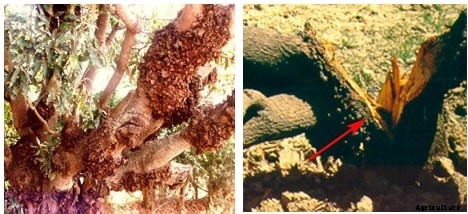
Symptoms: Woody galls of 10-15 inches diameter are formed on limbs and branches. The galls are abundant on CVS. Chinnasuvarnarekha, Langra and moderate in Neelam.
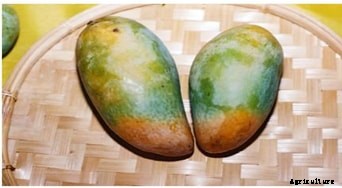
Symptoms: The malady is severe in late maturing Neelam and Mallika varieties particularly in delayed harvest leading to substantial loss. The fruits with red nose are unfit for export. Numerous red nosed fruits are seen on tree during fag end of summer with onset of showers. Red nose gradually becomes soft and rot.
Management
Symptoms: Tumors of pea to marble size develop on fruit and are very ugly to look at. The stylar end part is much affected while stem end is practically free from tumors
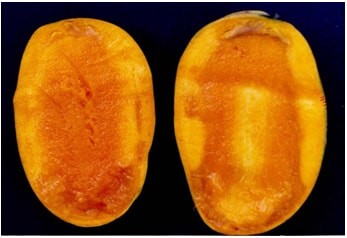
The problem of jelly seed have been recorded in several mango varieties. However, Dashehari cultivar of mango is found more susceptible to this disorder as compared to other cultivars like Chausa and Langra. In this disorder, the pulp near the stone becomes jelly like with tissue disintegration while the outer pulp near the peel is normal. The taste of fruit becomes repulsive and loose table quality. From the outer appearance fruits look normal. It incidence is more in Lucknow region particularly in late harvested fruits (Fig. 74).
Most of the prone orchards of this disorder have been found with imbalance of nutrients. Among the nutrients, P and Zn deficiency were more prevalent. Slow movement of nutrients particularly Ca++ to the fruits from soil and leaf through transpiration stream in Dashehari at maturity was found to be one of the reasons for this disorder.
Management
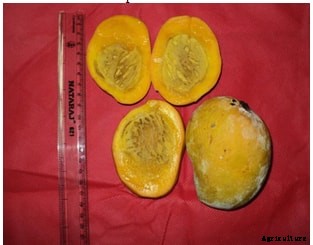
Alphonso mango, which is the main export cultivar, suffers from a serious malady known as spongy tissue or internal breakdown in the ripe fruits. This disorder renders the fruit unfit for consumption and hence, it has become a bottleneck in export and expansion of its cultivation in the State of Maharashtra and Gujarat where it is grown commercially. There are many biochemical changes associate with spongy tissue; however, no conclusive results have been obtained to control this malady. Convicting heat arising from soil and intense solar radiation are reported to be the main cause for this disorder.
Symptoms:Scorching of leaf margins is the characteristic symptom of potassium deficiency. Scorching starts from tip downwards. Fruit quality is reduced. Trees with potassium deficiency are easily prone to pest and disease attack.
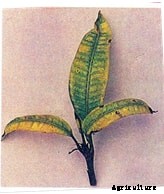
Symptoms: The leaves become small and narrow with leaf margins bent upward or downward. Inter nodal length is reduced drastically and the twig with crowded leaves gives rosette appearance. Pale inferential areas and green veins are typical of zinc deficient leaves. The tree with zinc hunger does not grow well and the yield, size and quality of the fruit are reduced. Small plants with severe zinc deficiency may die. Zinc deficiency is conspicuously seen in alkaline, saline and sandy soils.
Symptoms: The leaves loose green colour and turn white and is called Bleaching. The size of the leaf is reduced. In severe cases of iron deficiency, the leaves dry from tip downwards. The deficiency is common in soils with high calcium content. Hence, the effect is known as calcium induced iron chlorosis.
Management
Symptoms: Cracking of fruit is the characteristic symptom of boron deficiency. Lusterless leathery leaves with thickened veins are the other associated symptoms. Brown areas in yellow fruit pulp are conspicuous.
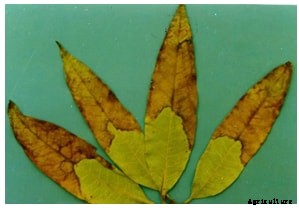
Symptoms: The leaves are scorched due to excess salt in soil or irrigation water. The leaves lose their natural colour and turn to bronze colour. Tip burning is also seen in severe cases of salt injury.
Management:
Symptoms: Copper deficiency symptoms frequently develop on young trees which generally occur due to heavy nitrogenous fertilization. It may also be accompanied by Zinc deficiency symptoms. The appearance of weak terminal shoots followed by defoliation and die back of branches, on the top of long drooping or shaped branches of the proceeding cycle of growth usually makes evident that copper is needed
Survey: To monitor the initial development of pest and disease in the endemic areas survey is prerequisite. Therefore, for field scouting farmers should be mobilized to observe the pest and disease occurrence at the intervals as stipulated under different development stages. The plant protection measures are required to be taken only when bio control potential does not show promise and pest and disease incidences shows increasing trend.
Field Scouting: Field scouting for pests/disease and bio control fauna/flora by extension agencies and farmers once in a fortnight should be undertaken to assess increasing/decreasing trend in the pest/disease incidence and availability of bio control potential. This should be done soon after the appearance of new flush after the fall of old leaves as such stage of the crop having succulent tissues in valuable to attack by pests and diseases. The state Departments of Horticulture should make all possible efforts by using different media, mode and publicity to inform the farmers for field scouting in the specific crop area having indication of pest and disease build up.
A large number of parasites, predator and pathogens are very active against pests of mango in the fields. These are Rodolia fumida, Suminus renardi, Coccinellids, Beauveria bassiana, Verticillium lacani, Mallada boninensis, Chrysopa spp., Tertrastichus spp., Trichoderma spp., Gonatocerus spp, Podynema spp., Platygaster sp, Eupulmus sp., Systasis dasynearue, Micronimus timidis, Baccha pulchrifrons, etc. which pay a significant role in population suppression of various insect pests and diseases. These should be conserved in the field.
Chemical pesticides recommended for control of diseases and pests are given in the text.


