
Welcome to Modern Agriculture!

The lychee (Litchi chinensis Sonn) an important sub-tropical evergreen fruit crop belonging to family Sapindaceae, is believed to have originated in China, where it has been grown in Southern Guangdong state for thousands of years. It is highly specific to climatic requirements and probably due to this reason its cultivation is restricted to few countries in the world.

The lychee tree is handsome, dense, round-topped and slow growing with evergreen leaves having 6-9 elliptic oblong and lanceolate abruptly pointed leaves. Colour of leaves varies from light green to dark green. Greenish white or yellowish flowers are borne in clusters. Fruits are round or heart shaped having thin, leathery skin. The colour of fruits varies with cultivar, and is red or rose or pinkish. The edible portion or fruit is the aril, which is immediately beneath the skin. Flavour of the aril varies with cultivar, which is distinctive. Seeds are bold but in some cultivars seeds are partially developed, due to failure of pollination, referred to as ‘chicken-tongue’ seed. The trees with small seeded fruits are prized because of the greater portion of pulp.
The origin of this cultivar is not known but the name indicates that it was selected for its superiority and named ‘China’. It is tolerant to hot waves and fluctuations in soil moisture, which cause fruit cracking. Rains at the time of fruit bud differentiation cause emergence of vegetative flush resulting in loss of crop. It bears fruits in cluster of 12-18. In some cases more than 30 fruits per cluster are also recorded. The plants bear less fruit in eastern and southern directions. Fruits are large in size, medium-heavy in weight, oblong in shape, and tyrant rose in colour with dark tubercles at maturity. The aril is creamy-white, soft, juicy, sweet having 18 to 17° brix TSS, 11 percent total sugar and 0.43 percent titratable acidity. Seeds are glaucous, dark chocolate in colour, oblong to concave or planoconvex in shape, medium in size (2.9 cm length and 1.5 cm diameter), and average in weight (3.49 g/seed).
Since, flower bud differentiation, flowering, fruit set, fruit quality and flavour development in Lychee is influenced significantly by temperature and humidity, it has adapted well in the sub-tropics where summer months are hot and wet and winter months are dry and cool. Hot summers free from hot wind and winters free from frost are essential.
Lychee cultivation is highly successful in areas having minimum temperature of 10°C from December to February and 38°C from April to June. However, temperature of 32° C during these months is considered to be optimum. It is highly specific to climatic requirement for its establishment, plant growth and fruiting, and consequently spread of area. A moist atmosphere, occasional rainfall, cool dry winter free from frost and hot winds are ideal for its cultivation. In lychee growing areas in Pakistan the temperature varies from 21° C to 37.8°C during flowering and fruiting. It has been observed that flower initiation in lychee requires comparatively low temperature. Seasonal variation in temperature is favourable for proper fruiting. A dry climate, free from rains for about 2 months before flowering induces flower bud differentiation, blossom and consequently give high production.The fog free dry winter, mild sub-tropical summer and intermittent pre-monsoon showers during April-May have been observed to be highly favourable for blossoming, better aril development and improvement in fruit quality. The sub-tropical to mild temperate climate in the foothills and valleys of the Himalayas are also suitable for lychee cultivation. Depending upon the temperature rise after winter the time of flowering and maturity is determined. No fruiting has been recorded when lychee has been grown in tropical conditions. However, on hills in southern states flowering is observed and harvesting commences in November-December.
In Pakistan, lychee is grown successfully on a wide range of soil types, which include sandy loams, laterite, alluvial sand, and calcareous soil, but the best lychee orchards are seen in alluvial sandy loam soils with good drainage and access to the water table. The performance of orchards is very poor on clay soil with poor drainage. Lychee grown in sandy soils have a root system network, while trees grown in clay soil have very poor root distribution. It grows well even in calcareous soil with 30 percent free lime content.
Lychee is generally multiplied by vegetative methods of propagation as plants raised through sexual method (by seed) grow slowly, have a long juvenile period and do not produce fruit true to the type. However, earlier introduction in different parts of the country was perhaps through seeds, which enabled the selection of superior types and perpetuation the cultivar through vegetative means. The most commonly practiced method of vegetative propagation is air-layering, though cutting, grafting and budding have been found to be successful.
Air-layering, known as ‘marcottage’ in China is commercially practiced for large scale multiplication both in public sector and private sector nurseries. When and how this practice was adopted is not documented but the process of development and modification in the method of layering suggests that the method has gone through transformation. Earlier layering was done using clay soil having provision of watering, however, the air-layer practiced now uses growth hormone and nutrient mixed media of peat moss or coir pith, which is covered with polythene. For preparation of the air-layer a healthy terminal branch receiving good sunshine with a thickness of about 1.2-1.5 cm is selected and a 2.5 cm ring is made by removal of bark about 45-50 cm below the apical growth. The cambium layer is rubbed off and the woody portion is exposed. Rooting hormone (1000 ppm IBA) is used as paste or powder. A layer of moist sphagnum moss or coir pith is placed and wrapped with a piece (20 x 25 cm) of 400 gauge polythene sheet and tied properly at both ends to ensure supply of proper moisture which facilitates the development of roots. It is advised to enrich the rooting medium using organic nutrients. After about 50-60 days, the adequate root system develops from the upper end of the ring, which is visible through the polythene film. The layer is removed by making a sharp cut about 5 cm below the lower end of the ring, preferably in 2-3 stages. The detached layers are planted in partial shade. Success in rooting of the layer is determined by temperature and humidity. When night-time temperature falls to less than 20°C the root becomes brittle. Thus, June is considered to be best time for air-layering. In order to enhance the success of the detached layer, defoliation of leaves up to 50 percent is advocated. At the time of planting excess vegetative growth may be removed to maintain balance between the top and newly developed root system. Regular irrigation and weeding is done to facilitate better establishment and growth. Beds are kept weed free. Lychee layers become ready for field planting in 4-5 months. Growing of layers in the greenhouse has been found to enhance success.
Some nurseries practice, pot layering wherein a lower branch of mature wood is cinctured and the cut surface is buried in a pot or container filled with rooting medium. The pot is watered regularly. The roots develop in the cinctured portion of the branch in about 2 months. Then the branch is detached from the main plant by giving sharp cut, preferably in 2-3 stages. No repotting is required before transplanting in the field. Application of IBA (2000-5000 ppm) improves rooting and survival of the layers.
For large scale multiplication stooling is also recommended. In this method, planting is done closely at 1 x 2 m. Once the plant attains the required growth it is headed back to the stump during January-February which permits new shoot (stools) emergence from the stump within two months. A ring of 2 cm is made at the base of the newly emerged shoots and rooting hormone is applied. Then a mound of soil is raised around the shoots to encourage rooting and watering is done regularly. Profuse rooting occur in the stools within two months. These stools are detached and kept in the nursery for hardening and become ready for transplanting in July-August. In stooling, one must be careful not to allow the soil mound to dry, otherwise the rooting process is affected adversely. Therefore, the stool beds should be irrigated at weekly intervals from April-June.
Although this method is advocated it has not been practiced by nurserymen on a commercial scale. The propagation of lychee has also been tried through cutting under mist conditions. A high percentage of rooting was also obtained from the cutting treated with IBA and planted in April-May under mist. But this has not been adopted commercially.
Grafting in lychee is mainly practiced for changing scion cultivar or seedling tree or unproductive and old orchards by top working. The apical, side and approach grafting are mainly practiced. In apical grafting 10 cm long scion wood (non-terminal) with at least 2 slightly swollen buds gives better results. The technique of splice or tongue grafting is successful. Apical grafting has not been commercially used for large scale multiplication. Grafting appears to be promising provided seedling growth and percent germination improves. It is observed that the highest germination of lychee seeds could be obtained if fruits are harvested one week before maturity. A higher rate of growth in seedlings is possible under greenhouse conditions. Softwood grafting has been found to be successful in many nurseries. Budding of lychee has also been successful. However, much more work is required to be done before these methods become accepted practices.
Since, air-layering is a commercial practice, a large number of private nurseries have come forward for large scale multiplication of plants especially in lychee growing regions. It is estimated that about 300,000 lychee plants of different cultivars are produced annually. The regulatory framework to ensure the quality of plants is not in place, thus the creditability of public institutes or private nurseries determine the preference of growers. The cost of plants also becomes a factor in determining the preference of farmers.
Orchard establishment is a highly specialized activity, which requires proper planning, selection of site, land preparation, layout, planting of saplings, as well as orchard protection and management.
Lychee can be cultivated in a wide range of soils, starting from sandy to clay loam with good drainage and rich in organic matter. However, well-drained deep sandy loam soils having good moisture holding capacity, rich in organic matter and calcium content have been found ideal for lychee cultivation. The well-drained soils rich in calcium content have been observed to be most suitable for better growth and quality fruits. Soils with poor physical conditions, lacking in available nutrients can be improved for lychee cultivation by adding sufficient quantities of decomposed farmyard manure (FYM), compost and green manure. Lychee growth is restricted in clay soil, thus the site selected should have the above characteristics. When selecting the site, climate also given due consideration. Lychee should not been grown in excessively humid regions when winter temperature is not below 12°C. Also when selecting a site the source of water and transport facilities should be given due consideration.
Before layout the land is cleared of bushes and other weedy vegetation and is leveled with a mild slope in the opposite direction of the water source. To improve the fertility of the soil organic matter is added. A green manure crop is grown and incorporated into the soil, which improves its fertility, moisture holding capacity and physical condition.
Pits 90 x 90 x 90 cm in dimension are dug at the spacing decided for the orchard. Pit opening is normally recommended in April-May to have a sterilization effect for about 3 days. Before the onset of monsoon pits are filled with topsoil mixed with about 40 kg decomposed compost, 2 kg neem/karanj cake, 1 kg bone meal/single super phosphate and 200-300 g muriate of potash. Incorporation of about 2 baskets of soil from the root zone of old lychee trees encourages the mycorrhiza growth. Then the soil is allowed to settle with the first few rains and leveled properly. Planting is done during June to July. At the time of planting a hole the size of ball of earth is made in the centre of the pit at the marked point where the plant is fixed and the soil is pressed to remove air. Watering is done immediately after planting for proper establishment. Subsequently the plant is regularly irrigated till it is properly established.
Lychee is an evergreen spreading tree, which attains the height of about 10-12 m at its full growth and development. Light penetration of its canopy is also desirable for proper fruiting, hence planting in square system at a distance of 9-10 m within and between the rows has been practiced. Planting of lychee in a double hedgerow system at a distance of 4.5 x 4.5 x 9 m accommodating 329 plants/ha has been found to be the best and gave higher yield of equally good quality fruits up to 16 years of plantation. High density planting adopting a double row system has also been found to be superior at other locations in terms of yield and quantity of fruits. Through appropriate canopy management high density planting accommodating about 1,200 plants per hectare could also be done as has been found successful in mango. However, this would need further investigation.
Training of the plant in the initial stage is essential to provide the required framework. Unwanted branches should be pruned to provide definite shape and to promote growth of the trunk and crown of the tree. Three to four branches 60-75 cm from ground opposite to each other are allowed to form the proper frame of the tree. Further, crowded and crisscross branches are removed to facilitate better growth. The branches with narrow angles are also avoided as they are prone to breakage. Non-fruiting unproductive branches inside the canopy in growing and mature trees should also be pruned. Dried, diseased and scissors-shaped branches should also be periodically removed. Light pruning after harvest has been found congenial for better growth, fruiting and yield. While harvesting the fruit the panicle is plucked along with 8-10 cm of twig to promote new flush and better bearing for the succeeding year.
Among the several factors associated with production of lychee, balanced nutrition is considered to be the most important which determines productivity and quality. Lychee responds to exogenously applied manure and fertilizers and response varies depending upon cultivar (Kotur and Singh, 1993), climatic conditions and soil types. A survey conducted in the Doon valley indicated that 80 percent of orchards are low in N and P and need N and P application (Kunwar and Singh, 1993). In West Bengal, NPK was reported to be below the optimum level (Rao et al, 1985). However in Punjab N, K, Mg, Zn and Mn are reported to be in deficit range. Recently, a survey conducted by Babita (Personal Communication) has clearly shown that low yield and poor quality fruits in lychee are associated with a sub-optimal range of nutrients. Variation in nutrient content was also observed among varieties.
Field experiments conducted on different cultivars at different locations have clearly demonstrated the effect of a graded dose of NPK on growth, yield and quantity of fruits. Application of 600-800 g N, 200-300 g P2O5 and 400-600 g K2O per plant is recommended for 12-15 year old trees. Nitrogen and Potassium should be applied in 2-3 splits and P2O5 in two splits. Excessive application of nitrogenous fertilizer before flowering should be avoided. Phosphorus application at the time of flower bud differentiation improves flowering and fruiting. Application of cakes and manure is generally practiced to get better quality fruits. In general, lychee orchards maintained with higher doses of organic manure have better yield and quality as compared to orchards maintained with chemical fertilizers.
Additional application of Ca, Zn, B, Cu and Mn is recommended. Application of 0.6 percent Ca as calcium chloride improves fruit weight and quality. Zn is applied in the form of 0.5 percent zinc sulphate hydrated with lime, which helps in reducing fruit drop and enhancing fruit yield and quality. Boron in the form of borax (600 ppm) enhances fruit setting and reduces fruit cracking.
In acidic soil application of 10-15 kg lime/tree once in 3 years has been found to increase the yield. In general, application of FYM, potassic and phosphoric fertilizers in major lychee growing areas of the country is done during June-July, just after harvesting of the crop.
However, in heavy rainfall areas like West Bengal, Uttaranchal, and Uttar Pradesh, manure and fertilizers are applied in the month of September-October just before the end of monsoon. The nitrogen is applied in two equal spilt doses. The first dose is applied after fruit set, in the month of March-April while the remaining half dose is applied immediately after harvesting of the crop. After application of fertilizer, irrigation of the tree is essential to maintain proper soil moisture. The total requirement of nitrogen, phosphorus and potash is applied through basal application. However 2 percent urea spray is practiced once or twice during the period of fruit growth as needed.
Foliar application of zinc sulphate (0.1 percent) is done twice, 10-15 days before flowering for improving sex ratio and to reduce fruit drop. If a deficiency of zinc and magnesium is observed, application of 150-200 g ZnSO4 and 150-200 g MgSO4, respectively per plant during September has been found to be beneficial. Foliar application of 0.1 percent borax, 2-3 times during the period of fruit growth and development of the trees enhances fruit retention, minimizes cracking, improves fruit colour and sweetness, and advances maturity. Other micronutrients like Fe (Ferrous sulphate), Cu (Copper sulphate), Mg (Magnesium sulphate) are applied if deficiency symptoms are observed. Two to three spray in a year is sufficient to maintain the trees in good health.
Foliar application of the plant bio-regulator, NAA (20 ppm) at an interval of 10-15 days during the period of fruit growth and development, twice or thrice, has been found to be useful for minimizing the fruit drop. IAA may be substituted for NAA if the latter is not available. Spraying plain water four to six times in the early morning hours of the day during the advanced stage of fruit growth and development have been found to be highly effective for achieving better growth with minimized fruit cracking.
Monitoring of plant nutrients is done arbitrarily although some farmers get their soil analyzed for pH and nutrients content once in a while. However, it is advocated to use leaf nutrients as diagnostics for monitoring nutrient needs (Kotur and Singh, 1993). Application of fertilizer based on leaf analysis values, though holding promise, is not yet a reality. Babita (Personal Communication) observed that the critical value of nutrients could be used as a guide to determine the nutritional needs, and could economize on fertilizer and provide higher yields of quality fruits.
Lychee being an evergreen plant, the maintenance of optimum soil moisture is critical for growth, development and fruit production. If the rainfall is evenly distributed lychee is grown successfully and supplementary water requirement depends upon cultivar and evaporation demand. Water requirement ranges from 600-800 mm. Investigations carried out to determine the irrigation needs have clearly indicated that irrigation is critical at the fruit development stage to get better yield and quality of fruits. Interestingly, differential management of water in the vegetative phase and reproductive phase is also suggested. To achieve faster growth of the plant no water stress should be permitted, while in the reproductive phase water stress is beneficial at the time of fruit bud differentiation. Light irrigation during summer and winter months and cleaning of the basin is advocated. Irrigation at the intervals of 2-3 days during the initial stage of plant establishment is considered essential. Further, the young plants should be irrigated during dry periods and winter months at intervals of 3-5 days. For young plants mulching with dry leaves or residues in the basin help in better moisture conservation. Experiments conducted at Ranchi indicated that irrigation of plants at alternate day intervals, 6 weeks before harvesting improves fruit retention, encourages better fruit development, and minimizes the cracking, apart from the quality of fruits. Certain physiological disorders like poor sex ratio, poor fruit set, heavy fruit drop and high fruit cracking, besides sunburn of the fruits can be minimized with proper water management. The basin or flood method of irrigation is normally practiced. However, adoption of drip irrigation has been found to be effective in the economic use of water and enhanced growth, especially in an area where water availability is not satisfactory.
Moisture conservation through mulching using dried weeds or black polythene sheet has been found useful. Trials have also been conducted to conserve moisture using farm residues and polythene sheets. Through adoption of mulching, frequency of irrigation is reduced. In a trial conducted at Ranchi mulching with 3 irrigations was effective in reducing cracking and enhancing yield and quality of fruits (Singh, 1986). To check fruit cracking mulching with 3-4 irrigations during fruit growth has been found to be satisfactory.
Lychee is a slow growing plant and takes about 15-16 years to develop canopy and cover the area. During the initial period of establishment, the space between the plants can be utilized for planting of filler plants/intercrops. The planting of guava, custard apple, lime/lemon in the centre, between and within the rows of lychee have been found to give additional income in the initial stage of planting without competing with the main crop. Papaya is also planted as filler plant at the spacing of 2.5 x 2.5 m. In between the plants in the initial stage, cowpea, french bean, okra, brinjal or other suitable crops of the regions are grown as intercrops. In the mature lychee orchards, cultivation of partial shade loving plants (ginger, turmeric, elephant foot yam) is practiced successfully, which provides additional income.
Lychee plants and fruits are affected by insect pests and diseases, which causes considerable losses, if not managed. Lychee plants as compared to many fruit bearing species are least affected by diseases. A few leaf spot diseases have come to light that are caused by fungal pathogens. No bacterial or viral infections have been reported so far. Powdery mildew (Oidium spp.), anthracnose or leaf spot (Botryodiplodia theobormae Pat, Colletotrichum gloeosporioides Penz) and red rust (Cephalexros mycoides) are some diseases which cause some damage to the lychee crop, but severity varies from season to season even in the same locality. Their control measures consist of 1-2 applications of proper fungicides, while for red rust sulphur washes in September-October and February-March is sufficient.
Although about 40 insect and mite pests are reported to affect lychee trees and fruits at different stages of growth, erinose mite, lychee bug and fruit borer are the insect pests of most concern.
Lychee mite (Aceria litchi) is a serious pest in all the lychee growing regions in the country. The tiny nymph and adults stick to the under-surface of the leaf and suck the cell sap. Consequently, the young leaf turns yellow to greyish-yellow and a velvety growth develops on lower surfaces, which subsequently turn brown. The affected mature leaf develops continuous to scattered brown patches with curling, twisting and leathery structure, which ultimately result in blister-like gall formations. It spreads fast under favourable conditions and reduces the photosynthesis activity and increases leaf drop. As a result the tree becomes weak, and yield and quality of the fruit is severely affected. The pest is well studied. It is suggested to prune the affected twigs/branches and burn to avoid spread. Two sprays of karathene 0.05 percent at 7-10 days interval during the attack of the insect has been found to effectively control the pest. Application of neem cake has also been found to reduce the incidence of this pest.
In lychee orchards incidence of shoot borer is reported. The caterpillar bore inside the newly growing shoot and feed on inner parts resulting in drying of the twigs. In the case of severe infestation the sap movement is interrupted and the tree ceases to flush. Pruning and burning of affected twigs minimize the infestation.
The caterpillar (Inderbela sp.) bore inside the trunk/main stem. During the night they come out and feed on the bark protected by the large silken webs usually during July-September. The branch ceases growth and the stem becomes weak and may ultimately fall to the ground. The presence of the insect can be known by seeing the excreta and silky web. Cleaning of the infested area and plugging holes with petrol, nuvacron or formaline soaked material is advocated.
This pest becomes serious especially in humid conditions at the time of ripening. The small caterpillars bore through the stalk end of the fruit, and feed on the seed and skin. As a result fruits become unfit for consumption. The excreta of the caterpillar is seen near the stalk end of the fruit. High humidity and intermittent rains favour the infestation.
Besides the important pests described above, lychee are often affected by leaf eating caterpillars, leaf miners, bugs and aphids. Birds, bats and squirrels also cause damage to lychee fruits.
Weeds Compete for water and nutrients during the initial year of growth. Depending upon location more than 25 species of weeds are reported to be present in lychee orchards. Inter-culture operation and mulching suppress the weeds. Herbicides, although found effective for the control, are rarely applied. In mature orchards the weed problem is not encountered due to heavy shade and natural mulching by falling leaves.
Fruit cracking is one of the major limiting factors in the cultivation of lychee, especially early cultivars (Singh, 1986). The early varieties are more prone to the problem of fruit cracking in comparison to late cultivars. The low atmospheric humidity, high temperature and hot winds during fruit development and maturity stage favour fruit cracking. Light irrigation to maintain soil moisture and to improve humidity has been found to minimize this problem through maintenance of a better micro-climate. Mulching with farm residues and 3 irrigations significantly reduced the cracking (Singh, 1986) in a trial conducted on the cultivar Shahi. In addition, spraying with either 100 ppm NAA or 0.2 percent borax during the developing stage of the fruits has been found to be highly effective in checking the cracking.
Lychee being a non-climacteric fruit requires to be harvested after attaining full maturity on the tree. Studies have been conducted to determine the maturity standard for different cultivars under different agro-climatic conditions. Fruits have a sigmoid pattern of growth. First the pericarp develops, then the seed and aril is formed and the seed turn from green to brown. During maturity acidity declines and TSS increases which corroborate the appearance and colour on the fruit. Thus, the colour of fruit is an important criteria to decide the harvesting stage (Singh and Yadav, 1988). The red pigmentation in lychee is associated with anthocyanin pigments (cyanindin-3-glucoside, cyanindin-3-galactoside, pelargonidin-3-glucoside and pelargonidin-3, 5-diglucozide), which develop better in the direction of good light penetration. Invariably pericarp colour and smoothness of pubicles are the best indicators (Singh and Yadav, 1988). Depending upon the cultivar, 65-80 days are taken for maturity from fruit set.
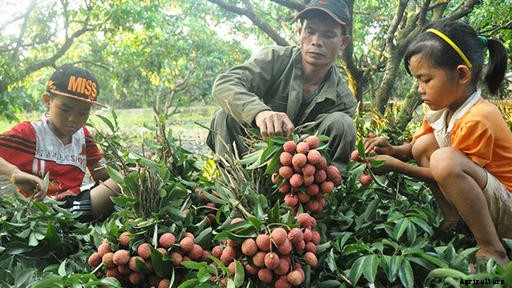
The fruits are harvested in bunches along with a portion of the branch and a few leaves. At the time of harvesting care is taken to harvest the selected bunch, which has attained the desirable maturity as determined by colour development and taste of the pulp. For distant market fruits are harvested when TSS attains 19° Brix and acidity 0.3 to 0.4 percent. The fruits are harvested early in the morning when temperature and humidity are congenial, to have longer shelf-life of the fruit. At the time of harvest fruits are collected in a manner so that they do not fall on the ground. Use of mechanical tools for harvesting is practiced. The harvesting period is generally May-June, depending upon cultivar and location.
The yield of lychee varies according to the age of the tree, agro-climatic condition and maintenance of the orchard. Usually about 80-150 kg fruit/tree is obtained from 14-16 year old trees. However, from a fully grown tree a yield of 160-200 kg/tree has also been recorded. Apart from a management practice, bee keeping in lychee orchards has been found to increase the yield of quality fruits by 15-20 percent, since lychee needs cross-pollination. Apis mellifera is the commonly used bee in lychee orchards, which also provide additional income from honey.
Lychee deteriorates very fast after harvest. Pericarp browning is a major post-harvest problem, which renders the fruit unmarketable. Browning is associated with desiccation. Peroxidase activity coupled with ascorbic acid oxidation enhances anthocyanin degradation. Techniques to reduce browning and maintain the red colour and prolonged storage life include sulphur treatment and packaging in perforated plastic bags and storage under cold conditions. Sulphur dioxide (S02) fumigation is used as a post-harvest treatment to reduce browning. SO2 treated fruits have a bleached pericarp which turns uniformly pink in colour after 2-3 days. Fumigated fruits absorb 30-65 percent of applied SO2. There is increasing concern about the residue of sulphur and the residual limit is only 10 ppm. For sea transportation 600-650g sulphur is recommend for the duration of 50-60 minutes, while for air transport 300-400 g sulphur for 30 minutes are advocated. The Agricultural Produce Export Development Authority (APEDA) has developed a procedure for production of quality lychee. The steps are: production > inspection of farm > harvesting > desolating and sorting > receipt at packhouse > acceptance of produce > sorting and grading > sulphur treatments > packing and cooling > palletization > storage > container loading and transportation.
Aril breakdown or softening of the aril involves a loss of turgidity and translucency where fruits become blunt in taste. The disorder starts near the pericarp and is prevalent at the end of the stem. Post-harvest decay also occurs due to bacteria, yeast and fungi. Lychee browning and fungal contamination is prevented by dipping fruits in hot benomyl. Since this chemical is being restricted from use, alternative methods are desirable. Irradiation of fruit is considered to reduce browning and post-harvest losses. Storage temperature of 2-5°C is considered to extend the shelf-life. Use of perforated polythene bags and storage at 3°C have also been reported to increase shelf-life. Controlled atmosphere storage is considered better for maintenance of the freshness of the fruits. Thus, to have better post-harvest life of fruits, careful harvesting, pre- cooling, transportation in cool van, sulfuring and storing at 2-3°C would be essential.
Processing of lychee is done in different forms. Canning of pulp, aseptic packing and ready to serve lychee juice are common. Dried lychee processing is not in practice. Pulp of lychee is aseptically packed and stored at 2-3°C for preparing lychee juice.
A substantial amount of lychee produced in the country is consumed locally. Lychee, being highly perishable, is available for very short duration. Marketing of fruits is done in different forms. Growers rent their orchards to contractors, who in turn harvest and sell to local markets.
In chains of marketing increased numbers of middlemen reduces the share of growers in the price of produce paid by consumers. Generally, for the domestic market lychee is packed in 10 kg boxes or baskets having a lining of lychee leaves. There has been considerable importance given to the packing of lychee for niche domestic markets. Now lychee is packed in 2-2.5 kg boxes and transported in cool-chain. The exportable lychee is packed in 2 to 2.5 kg or 5 to 6 kg boxes after sulphur treatment.


