Welcome to Modern Agriculture!

Rice is quintessentially Asian crop because 90% of rice production and consumption is concentrated in this region. It is the staple food for 50% of the world and 75% of the world’s poor.
Rice is an important food and cash crop, In Pakistan, it is the second staple food after wheat and it’s the second largest earner of foreign exchange after cotton. Pakistan is the 11th largest producer and 5th largest exporter of rice. Rice accounts 4.9% percent of the value added in agriculture and 1% percent of GDP of Pakistan. During July March 2013-14, rice export earned foreign exchange of US$ 1.667 billion. During 2013-14, rice is cultivated on an area of 2789 thousand hectares, 20.8 percent higher than last year’s area of 2309 thousand hectares. The production stood at 6798 thousand tonnes, against the target of 6200 thousand tonnes shows a growth of 9.6 percent against the target if compared to corresponding period of last year production which was 5536 thousand tonnes, a healthy increase of 22.8 percent witnessed. The rice acreage increased due to lucrative market prices received during the last year which induced the growers to bring more area under cultivation.
21 September – October 2013 Export of rice from Pakistan decreased from US $2.18 billion in 2009-10 to US $1.92 billion in 2012-13, thus showing decline of 19%. Pakistan mainly exports rice to UAE, Iran, Saudi Arabia, Kenya and Afghanistan. In Pakistan rice is an important cash crop of the country and the overall national economy. Rice accounts 4.9% of the value added in agriculture and 1% of GDP. Rice ranks as second among the staple food grain crop in Pakistan and it has been a major source of foreign exchange earnings in recent years. Rice provides 21% of global human per capita energy and 15% of per capita protein. Although rice protein ranks high in nutritional quality among cereals, protein content is modest. Rice also provides minerals, vitamins, and fiber, although all constituents except carbohydrates are reduced by milling. On the other hand rice contains no additives or preservatives, making it an excellent inclusion in a healthy and balanced diet. Rice also contains resistant starch, which is the starch that reaches the bowel undigested. This encourages the growth of beneficial bacteria, keeping the bowel healthy.
It fulfills the food requirements of our country but we also earn a lot of foreign exchange from its export. Besides it is an important raw material for manufacturing starch, paper, sandals, hats,
In Pakistan rice is grown under diverse climatic, hydro-logical and edaphic conditions and is divided into 4 distinct agro-ecological zones. In most of the cases critical problems in rice production and protection are specific to a particular zone. Production technology package is developed keeping in view the distinct agro-ecological conditions in each zones. Brief description of each zone is as follows:
It consists of northern mountainous areas of the country and irrigated rice is grown either in flat valleys or terraced valley-sides. The climate is sub-humid monsoon with 750 to 1000 mm average rainfall, mostly concentrated in summer. Cold damage to rice crop due to cool air temperature and cold irrigation water are major problems. The water temperature seldom exceeds 18oC in water channels. Low temperature stress causes leaf yellowing, stunting in the seedling in early vegetative stages, delayed heading and sterility in the reproduction stage. The modern high yielding rice varieties and the fine Basmati types are not successfully grown in these areas. Berseem, wheat, barley onion are grown in rotation with rice.
It lies in the broad strip of land between rivers Ravi and Chenab where both canal and sub-soil water are used for irrigation. The climate is sub-humid, sub-tropical type with 400 to 700 mm of rainfall mostly in July-August. Rice growing season is fairly long and suitable for cultivating fine aromatic as well as some IRRI varieties. The “Kalar” tract which is abode of the world famous Basmati rice is located in this zone. Wheat, berseem, sunflower, watermelons are grown in rotation with rice.
It consists of the large tract of land on the west bank of river Indus. It has an arid sub-tropical climate with 100 mm of average rainfall and maximum temperature higher than zone 1 and 2. The impeded drainage and excessive water application to rice has resulted in high water table. The long, extremely hot summers are well suited to growing coarse rice varieties. Gram, wheat/barley, oilseed, lathyrus, sarsoon, pulses, coriander and berseem/alfa are grown as rice based cropping system.
It is the Indus delta which consists of vast spill flats and basins; the latter are mostly irrigated. The climate is arid tropical marine with no marked season and is highly suited to coarse varieties. Wheat, berseem and pulses are grown in rotation with rice.
Rice is a tropical plant.it requires high temperature during the growing season of 4 to 6 months. The temperature should be more than 80 degree F and in no way less than 70 degree F even for the quick maturing varieties. In Pakistan rice is cultivated only one a year i.e. early summer. Its cultivation is not possible in areas of severe cold or where the temperature goes below freezing point.
Rice is known as a plant of water. Its cultivation requires large amount of moisture. The annual rainfall should not be in any way less than 40 “.The root of the rice plant should remain submerged in water for a long time. For 75 days the rice fields should have 6” of slow moving water. When the rice crops mature, less water is required and during ripening season, the field should be almost dry so that it can be harvested easily.
The rice growing areas of Pakistan have an average annual rainfall of less than 20 ” .So the deficiency of rainfall has been met by the artificial arrangements of irrigation water through canals and tube wells etc.
With the exemption of sandy soils which are very permeable, rice can be grown successfully on soils ranging from silt loam to clays . Alluvial soil is the most suitable soil for the rich growth of rice. Heavy clayey sub soil with water retaining capacity gives best results.
The flooding of rice fields requires level land and therefore river valleys, deltas and coasted plains are suitable areas, otherwise terracing is required.
There are two methods of rice cultivation:
This involves direct plantation of rice plants in the fields.
In this case sowing is first done in nursery beds. When the plants attain a height of 4 ” to 6 “,they are transplanted into big fields. This method is also called the Japanese method. It is the most scientific and beneficial method. By its practice ,the per acre production increases considerably.
Rice is mostly cultivated in rows and the distance from row to row is kept about 6” and from plant to plant remains 3 “.
Cultivation of rice is mainly confined to the low lying parts of the Punjab plain and the flooded rivers and canal areas of Sindh. To a small extent it is also grown in the sub-mountain districts in the North and the canal irrigated areas. Rice cultivation in N.W.F.P. Baluchistan and Azad Kashmir areas is not more than 1 % to 2 % of their total areas.
In Punjab, the division of Lahore and Gujranwala rank at the top. Best equalities like Basmati, Parmal, Sukhdari, IRRIsix etc are grown in this part of Punjab. Besides somu rice is also cultivated in Shakhupura, Sargodha, Faisalabad, Multan and Bahawalpur divisions.
Pakistan is the world’s largest producer of rice. Each year, it produces an average of 6 million tonnes and together with the rest of the South Asia; the country is responsible for supplying 25% of the world’s paddy rice output. Most of these crops are grown in the fertile Sindh and Punjab region with millions of farmers relying on rice cultivation as their major source of employment. Among the most famous varieties grown in Pakistan include the Basmati, known for its flavor and quality. Rice production comprises 40% of Basmati (Fine) type and 60% of coarse types.
In Pakistan, modern rice varieties were adopted rather rapidly after IRRI rice was introduced in 1968. The rice variety IRRI was reportedly successful in Pakistan because of high solar radiation and abundant irrigation water. When properly managed, IRRI yielded three to four times as much as local varieties and enabled the country to increase its rice production substantially.
Different varieties of rice are grown in Pakistan, for example:
Basmati is the finest variety of rice. Characterized by a unique aroma, extra length and slender grain, Basmati tastes delicious and is a most pure & fresh gift to the world. Cultivated mainly in the fertile plains of Pakistan, the crop matures in monsoons to become fine rice. What is nurtured so tenderly by lush green field & fed by the perennial clear rivers is cradled to perfection in our hands to reach your taste buds as an exquisite delicacy. The grain becomes two-three times longer on being cooked.
Basmati is the finest variety of rice. Characterized by a unique aroma, extra length and slender grain, Basmati tastes delicious. Our Basmati Rice has to be tasted to be believed. The grain becomes two-three times longer on being cooked.
Long Grain 386 Rice a special quality rice, only produced in the province of Punjab and has been gaining international recognition as one of the best qualities of diet rice. Though it is counted as Non-Basmati Rice but its aroma and cooking results match the Basmati Pk-385 variety.
This is the low priced, high volume rice. This variety is grown in the Sindh province of Pakistan and is a major export quality to a number of Middle Eastern and African Ports.
This variety is grown in both the Sindh and Punjab provinces in Pakistan.
Husked rice that first has been heat tempered, soaked in warm water under pressure and dried before milling ; this process allows the inner kernel to retain more of the vitamins and minerals from the bran layer which also clarifies the more yellow kernel after is has been milled. Parboiled rice is healthier than white rice.
Rice sowing area is estimated at 2.31 million hectares, 10.1% less than last year’s area of 2.57 million hectares. Production of rice decreased from 6.95 mil- lion tonnes in 2008-09 to 5.54 million tonnes in 2012-13, thus showing decline of 20%. The production decreased due to decrease in area and effects of monsoon rain and late receding of water period in rice fields prolonged the sowing. Rice is sown in many areas of Pakistan. In Punjab it is cultivated in Sialkot, Wazirabad, Gujranwala, Sheikhupura, district Gujrat, Sargodha, Faisalabad and Kasure. In Sindh, Jacobabad, Larkana, Badin, Thatta, Shikarpur and Dadu district are important in rice cultivation. District Nasirabad and Baluchistan are also a rice producing area. The areas, production and yield of rice for the last five years.
Symptoms: This disease has been recorded all over Pakistan. Initially small dots or circular eye shaped or oval spots appear light in colour on leaves. These spots coalesce and result in linear spots brown in colour. Later on withering and yellowing of leaves occur. Seed setting also affected and causes sterility, shrivelling and show rotting and poor germination.
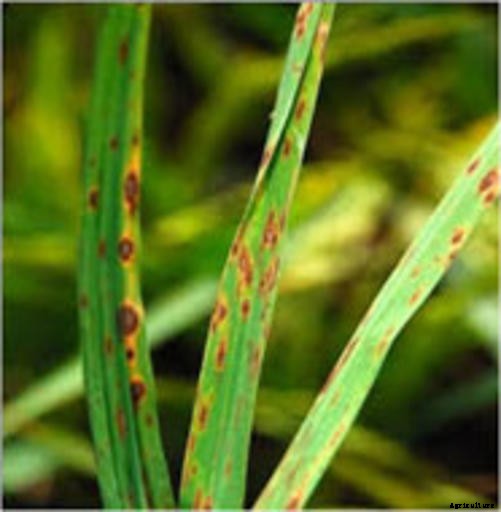
Perpetuation: Diseased seeds, plant debris and soils help the fungus to survive, while air and irrigation water help to the fungus for transmitting from diseased to healthy plants.
Symptoms: This disease also called black or kernel smut is generally distributed wherever rice is grown. Diseased grains are filled with black powder, which can be detected by breaking them. Only a few grains may be affected wholly or partially in an ear. If not severely infected, seeds may germinate but seedlings are stunted.
Perpetuation: The disease causing organism is soil borne.
Symptoms: Some times this disease refers as Pyrricularia blight or rotten neck, generally distributed where ever rice is grown. Small spots appear on leaves, nodes, panicles and grains and sometimes on leaf sheaths. The spots begin as small, water-soaked, whitish, greyish or bluish dots. These spots rapidly increase and become grey in center. Brown to black spots also develops on inflorescence and glumes. In later stages, diseased heads appear blasted and whitish in colour. Grain development is affected and the panicles droop.
Perpetuation: The disease perpetuates through diseased plant debris lying in the field, seed and wild grasses.
Symptoms: This disease is also called white stalk, generally distributed where ever rice is grown. Infected seedlings are thin, chlorotic, may die before or after transplanting. In the field, infected plants have few tillers and leaves die in short time. Live plants have empty panicles. Some infected plants may be stunted instead of elongated, while the abnormal elongation of these (infected) plants in seed bed or field is most common symptom of this disease.
Perpetuation: The disease causing fungus is seed and soil borne, through which it can survive for a long period.
The insect pests that cause serious and economic damage are commonly known as major or important insect pests of rice and these major insect pests are given below with detail of their scientific name, family name and order name,
The scientific or technical name of rice leaf folder is Cnaphalocrocis medinalis (Guenee) and it belongs to family Pyralidae and order Lepidoptera.
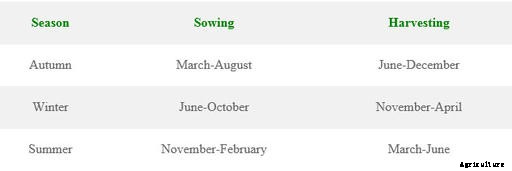
Pakistan is producing a good quantity of rice but the average yield in Pakistan is still behind the yield potential. One of the main reasons behind the lacking in rice yield is Pakistani farmers are still using the traditional practices of rice cultivation because of lack of knowledge about the latest innovations/practices. There is dire need to train the farmers about the latest practices i.e. Zero tillage of rice, direct seedling.