
Welcome to Modern Agriculture!

Are you interested in floriculture in polyhouse? here is the guide for Marigold farming in Polyhouse to get maximum profits. Marigold is the commercially exploited flower crops of the genus Tagetes and family Asteraceae. Marigold is a commonly grown flower of India and it is a very important flower, as it extensively used in religious and social function. Also, Marigold is used as a trap crop. As it is a short duration crop with low investment, it becomes a very popular crop of India. Marigold flowers are very attractive in shape and color. Marigold is widely adopted because of the ease of cultivation. Maharashtra, Karnataka, Gujarat, AP, Tamil Nadu, and MP are major Marigold cultivated states in India. Dashera and Diwali are two festivals when demand for Marigold crop is highest.
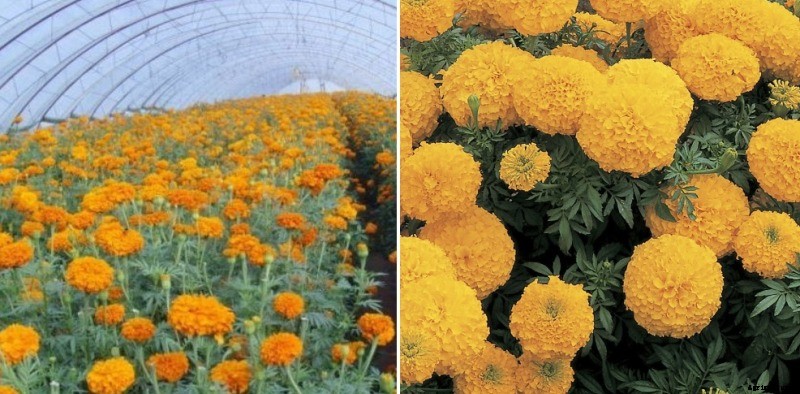
Based on size and color the main varieties of Marigold are African Marigold and French Marigold. Plants of French marigold variety are short while flowers are small in size when compared to African marigold.
The African marigold is hardy, annual and grows about 90 cm tall, erect and branched. These flowers are single to fully double with large globular heads. Flower color changes from lemon yellow to yellow, golden yellow or orange.
The French marigold plant is a hardy annual grows to about 30 cm tall, forming a bushy plant. Foliage is the dark green color with the reddish stem. These flowers are small, either single or double borne on proportionately long peduncles. The flower color changes from yellow to mahogany red.
You may also check the Ladyfinger Farming in Polyhouse.
For the main-field, the land must be plowed well followed by 2-3 harrowing and mixing of FYM @ 20-25 t/ha should be incorporated to the soil. Make the ridges and furrow accurately.
Sowing time of Marigold can be done around the year. In the rainy season, do sowing in mid-June and Transplanting in mid-July month. In the winter season, do sowing in mid of September and mid-October, complete transplantation.
Seed rate for Marigold varies from 2.0 to 2.5 Kg per hectare and takes about 5-7 days for germination. During the preparation of beds, 8 to 10 Kg of well-decomposed farmyard manure per 1 sq.m bed is thoroughly mixed with the soil. The width of the seedbed must not be more than 1.2 m and height should be 15 cm. Before sowing of seeds a little amount of BHC dust is applied to the seedbed to avoidant or termite infestation. During winter beds must be covered with a layer of straw to accelerate the germination process. However, the straw must be removed as soon as the seedlings are visible above the soil. Seeds germinate 5 to 7 days after sowing.
Begin Marigold seeds in a seed-starting flat that’s filled up until 3/4 inch from the top with sterile, moist, seed-starting mix. Sprinkle the seeds on top of the medium and sow them at a depth that equals 2 to 4 times the diameter of the seeds. Spray the soil surface with water carefully to moisten it, and then place the tray in a plastic bag or cover it with plastic wrap and this will promote soil-moisture retention.
You should also consider to read Palak Farming in Polyhouse.
Marigold seeds can germinate in light and darkness as long as they are exposed to a temperature of 70 degrees Fahrenheit. During the Marigold germination period, remove the plastic daily to aerate the tray and check the soil moisture. If needed, moisten the medium with a water-filled spray bottle to avoid washing away the Marigold seeds. You want the soil to remain moist, not wet, during the whole germination period.
After plantation in the field gives water immediately. Bud formation to harvesting is the main important stage for watering. Water stress should not occur at this stage. In April to June month, frequent irrigation at the interval of 4 to 5 days is necessary. Watering is done once in a week or as and when necessary. Water stagnation should be avoided in the field.
You should not miss the Polyhouse Vegetable Farming Advantages.
Watering the crop in 7-8 days interval, but the frequency and quantity of water also depend upon soil and season. In lighter soil, more frequent irrigation is necessary than that in heavy soil. In hot summer it requires irrigation after 405 days interval while at 10 to 12 days interval in winter months. Rainy season crops are irrigated according to climate change. Constant moisture supply is maintained from bud formation to harvesting of flowers.
Generally, Marigold flowers are plucked when they have attained full size. Plucking of flowers must be done in cool hours of the day. The field must be irrigated before plucking so that flowers keep well for a longer period after harvest. Plucked Marigold flowers are collected in polythene bags or bamboo baskets for carrying to markets.
You may be interested in Growing Mint from Cuttings.


