
Welcome to Modern Agriculture!

Today, Let us discuss Bonsai Tree Care, Design, Tips, Ideas, Soil, and Watering.
The name “Bonsai” is derived from two Chinese written characters (kanji), the first of which means “tray,” “basin,” or “pot,” and the second of which means “planting.” Then, it is planting in a container or potted plant. A tree-shaped as a bonsai, but left in the ground is a garden specimen, as is a tree developed in a planter that is too large to be proportionate, and unrelated to the design of the tree. A Bonsai includes the container as a necessary part of the artistic composition.
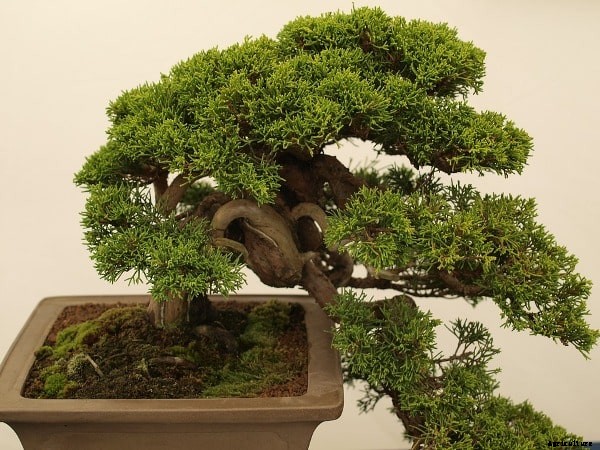
The purposes of bonsai are mainly contemplation for the viewer and the pleasant exercise of effort and ingenuity for the grower. By contrast with other plant cultivation practices, Bonsai plant is not intended for production of food or for medicine. Instead, bonsai practice focuses on the long-term cultivation & shaping of one or more small trees growing in a container.
A Bonsai is produced beginning with a specimen of the source material. This may be a cutting, seedling, or small tree of a species fitting for bonsai development. A bonsai tree can be created from nearly any perennial woody-stemmed tree or shrub species that produce true branches and can be cultivated to remain small through pot confinement with crown and root pruning. Some species are popular as bonsai material because they have characteristics, such as small leaves or needles that make them appropriate for the compact visual scope of a bonsai tree. Bonsai does not want genetically dwarfed trees but rather depends on growing small trees from regular stock and seeds. Bonsai uses cultivation techniques like pruning, root reduction, potting, defoliation, & grafting to produce small trees that mimic the shape and style of mature, full-size trees.
A crucial part of information about how to grow a Bonsai tree is its maintenance & care. The required frequency of watering a Bonsai depends on a wide range of factors, including species of tree, pot-size, soil & climate. Over-watering can effect in root-rot, one of the most common causes of death. However, as Bonsai are planted in such small pots, they also tend to dry up easily. Choosing the right soil mixture & re-potting regularly (on average every 2 years, to make sure the trees don’t become pot-bound, making it hard to soak up and store water) is crucial to keep your tree healthy. The main rule for watering is to check frequently on your tree (instead of, basically, watering it once per day), & when watering to do so thoroughly (to make sure the soil absorbs the water accurately).
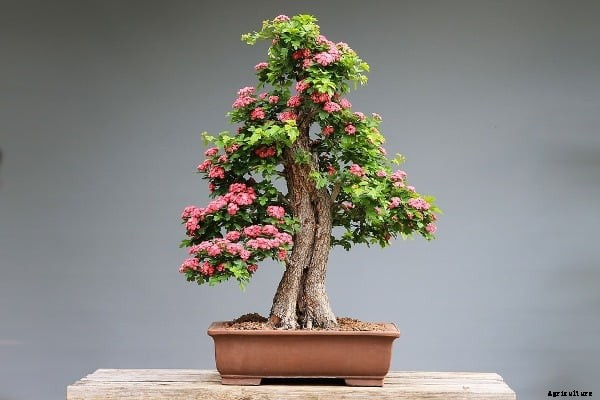
Besides watering & repotting, fertilization is another important thing to keep in mind. Since the trees are put in little pots, with little space and nutrients available, fertilizing regularly in the tree’s growing season is key to keep it healthy. Again, it depends on the tree species when, how much & how often it needs to be fertilized. The brand or type of fertilizer (fluid or solid) doesn’t matter all that much, as long as you make sure to affect smaller quantities than normal plants would require.
The practice of bonsai growth incorporates a number of techniques either unique to bonsai or, if used in other forms of cultivation, applied in unusual ways that are particularly suitable to the bonsai domain. These techniques include:
Read: Kitchen Garden Tips, Ideas, Benefits, Desing.
All Bonsai begin their development in training pots, where they settle until they have a good, fibrous root system and relatively full foliage development which make them look like bonsai rather than now a shrub or tree in a pot. Training pots help trees grown for bonsai tree make the transition between deep nursery containers, a balled and bur lapped root system, or landscape, to the shallow confinement of a bonsai pot. Above all, resist the urge to gather (dig) a tree and put it directly into a bonsai pot, where its chances of survival are slight.
The most excellent sort of training pot is often a large-diameter nursery container with good drainage holes, and with its top cut off to a depth of 8 to 10 inches. During its time in a training pot, the tree should be developed in coarse, fast-draining soil. Traditional bonsai pots, accessible at bonsai nurseries, and some large nurseries and import stores are round, oval, square, rectangular or hexagonal. Some are unglazed on the exterior (traditional for evergreens) and some are glazed & are suitable for most types of trees, as long as the pot complements but does not compete with the tree. Pots for cascade, semi-cascade & flowering bonsai are deeper than others. All bonsai pots have large drainage holes, which are necessary for the rapid drainage that promotes root health, but which must be covered with screening on the inside bottom of the pot to avoid coarse soil from washing away with draining water. Bonsai containers should be unglazed on their inside walls, & on the bottoms, both inside and out.
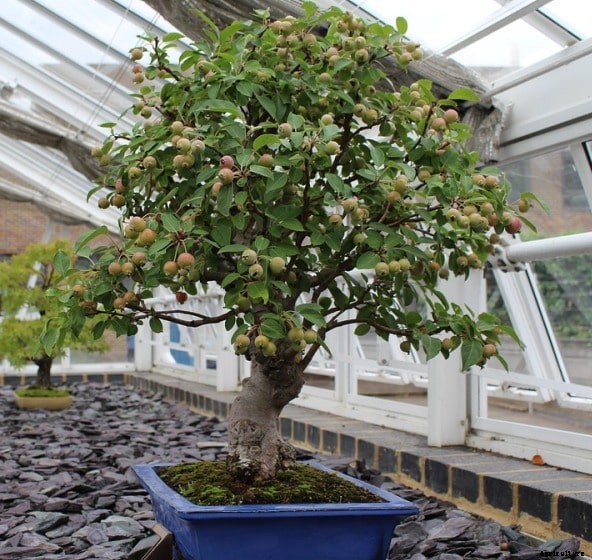
A good Bonsai tree has a triangular shape. It has a front designed for the main viewing but looks good from all angles. It is clear, of branches for the first third of its height and contains the 3 primary branches (included in most bonsai tree designs) within the second third of the height of the tree.
The last third of the height of the tree contains the remaining branch structures. The trunk is clear and visible for the first two-thirds of the height of the tree with the remaining branches beginning to cover the trunk line in the last third. The branch structures are visibly layered, well organized and asymmetrically placed on the outside of trunk line curves whenever possible. The top of the tree “bows” slightly toward the viewer & the apex of the tree (in the case of an informal upright style) is in a direct line over the base of the trunk.
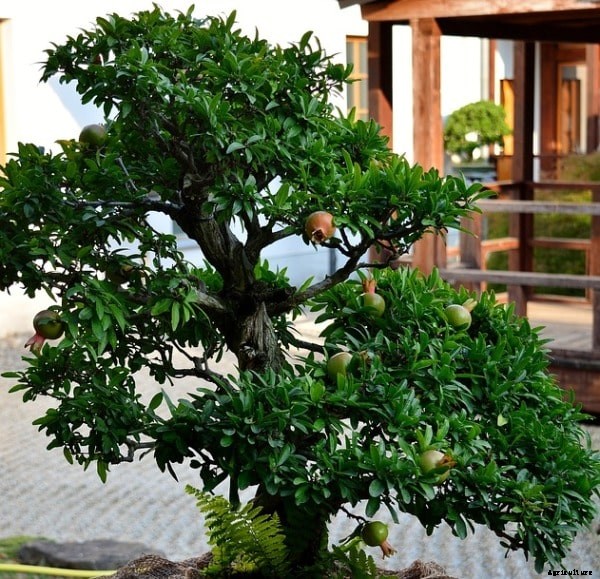
Small trees grown in containers, like Bonsai, need specialized care. Unlike houseplants & other subjects of container gardening, tree species in the wild, in general, grow roots up to several meters long and root structures encompassing several thousand liters of soil. In contrast, a typical bonsai tree container is less than 25 centimeters in its largest dimension and two to 10 liters in volume. Branch and leaf (or needle) expansions in trees are also on a larger scale in nature. Wild trees typically grow five meters or taller when mature, whereas the largest bonsai rarely exceed one meter and most specimens are significantly smaller. These size differences affect maturation, transpiration, nutrition, pest resistance, & many other aspects of tree biology. Maintaining the long-term health of a tree in a container requires various specialized care techniques:
Read: Broiler Farming Project Report For 1000 Birds.
Amaltas, Araucaria, Babul, Bamboo, Banyan, Ber, Bottlebrush, Bougainvillea, Casuarina, Cherry fruit, Chinese orange, Coranda, Cryptomeria, Deodar, Duranta, Excoecaria, Gulmohar, Hibiscus, Ixora, Jacaranda, Java fig tree, Murraya, Malpighia, Oleander, Peach, Pines, Pilkhan, Pipal, Plum, Prosopis, Silver oak and Tamarind, etc.
Araucaria, Aucuba, Azalea, Camellia, Chinese hat, Coral tree, Cryptomeria, Cypress, Flame of the forest, Ginkgo, Juniper, Koelreuteria, Magnolia, Plane tree (Chinar), Peach, Pines, Podocarpus, Sal, Silver fir, Spruce, Taxus, Thuja, Willows, Zanthoxylum, etc.
Choosing a suitable pot for the bonsai plant is not a simple task for beginners. A pot with good reliability, effective drainage, and suitable aeration is the ideal option. Good harmony between pot & tree is a must for giving an aesthetic appeal to your bonsai art.
Pots made out of Bonsai-friendly clay mixture should be used, which exists in the markets. Pots made of ceramic, porcelain, concrete, metallic and plastics are obtainable. Here are some of the basic guidelines given by Bonsai Empire.
Temperature becomes a prominent factor for indoor bonsai. Select a tree suitable for the climate and get rid of the implications due to temperature change. For example, attempting to develop a Japanese maple bonsai tree in a tropical climate will be a disaster. Here you will get a complete species point from Bonsai Empire, so choose a right tree for your location.
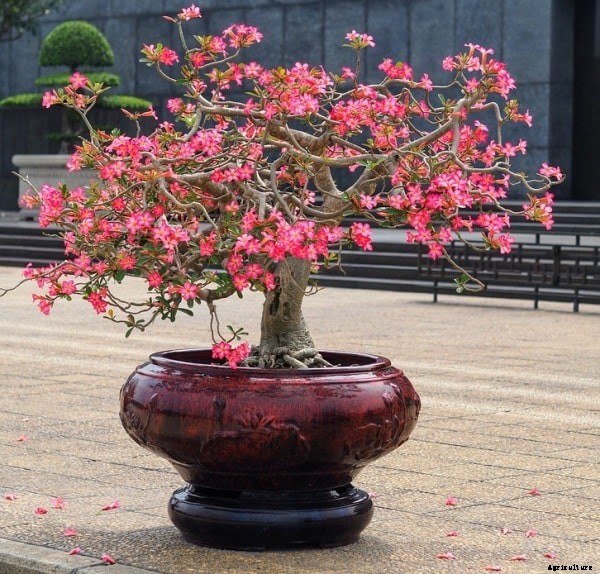
Choosing the right recipe of potting soil for bonsai is a vital step in bonsai tree care and it is a much-debated topic. The components for making the bonsai potting soil mixture depend on different factors. You should believe the availability of soil components locally. Growing conditions that are climatic condition and pH of the soil mixture is another factor. An ideal soil mixture would be one in which all the ingredients will be of uniform size so that it will help in fast drainage of water and proper aeration.
To realize the fact that there is no soil in the bonsai soil mixture. The components used to make a good potting mixture are, in fact, soilless. They are designed to offer an ideal environment for root growth. In fact, the mixture used for bonsai tree potting doesn’t contain any nutrients. It can neither hold moisture for a very long time. This makes regular watering & fertilization unavoidable steps in bonsai tree care. The ideal bonsai mixture is composed of 75% inert aggregate & 25% organic material. The main criterion is that all materials have to be of uniform size. Clay is an excellent choice for organic material; some examples are Akadama, Kanuma & Turface. River rock and the fragmented granite form ideal non-porous aggregates; Haydite, Lava Rock and Permatil form ideal porous aggregates.
Read: Passion Fruit Cultivation.


