
Welcome to Modern Agriculture!

Well, today let us discuss about Betel Leaves Cultivation (Paan), Planting methods.
This betel plant is a vine majorly found in Asia. These leaves have originated in South East Asia. This plant belongs to the genus of Piperacea. The scientific name of the betel leaf is Piper betle. Exclusive betel farming is done in the countries of Bangladesh, India and Sri Lanka. Pakistan is a major importer of the Sri Lankan Betel.
There are many health benefits associated with the consumption of betel leaves. They are consumed with Areca nut or tobacco. These leaves are also used in the preparation of Ayurvedic medicines. Across the world there are many varieties of betel leaves, which are popular all over the world. In many countries betel leaves are used in religious ceremonies. Betel leaves are called as “Paan” in many places of India. Betel leveas cultivation is very profitable under proper management practices.
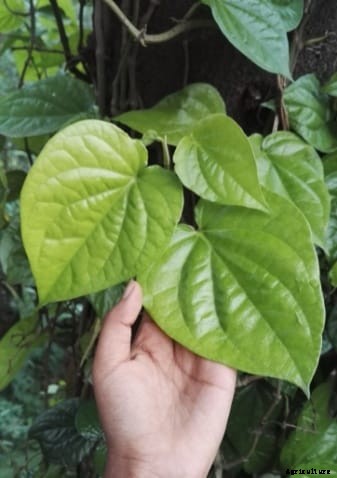
There are many varieties of betel plants which are farmed all over the world. These are mainly cultivated in countries like India, Pakistan, Sri Lanka and Bangladesh. In India commonly cultivated betel varieties are simurali, mahai, ambadi, karpoori, meethi, bangla, bhavana, mahoba, peshwar., tellaki, ramtek bangla, kali bangle, pachakodi and sanchi.
Meetha:
Kapoori:
Bangla:
Sanchi:
Khasi:
Bidan Pan:
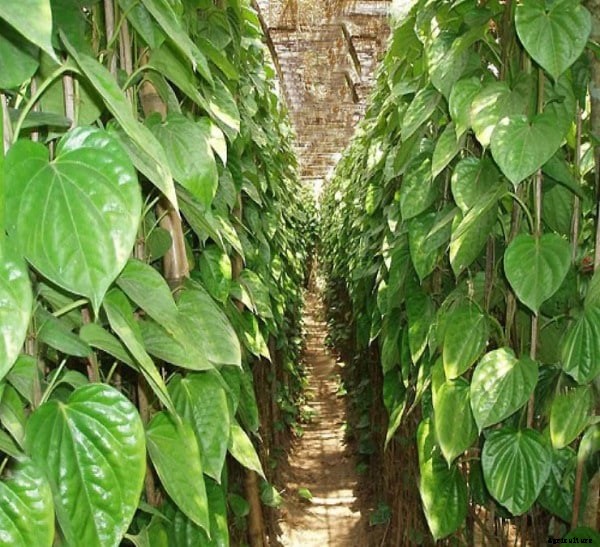
For farming the betel leaf we need fertile soil with better draining properties and also having rich organic matter content. Any soil, which is good can be used for farming the betel leaves. The clay soils are more suitable for farming the betel leaves. The betel leaves need a soil with balanced pH. The betel vines can’t tolerate the extreme climatic conditions. For betel farming, we should avoid saline or alkaline soils and also too light or deep soils should be avoided. Water logging should be avoided in the farm area.
The betel vine has good growth in cool climatic conditions. But it should receive well and plenty of sunshine and humid climate for better growth. The plants can tolerate extreme climates like heat or cold, but do not grow well. For good growth, moderate amount of rainfall is suitable for the plants.
For betel leaf farming, we need to prepare the land. All the weeds, stones and any waste material of the previous crop should be removed. After all this, we need to plough the land thoroughly so that the soil attains fine tilth and becomes smooth. The ploughing can be done by using the bullock carts or tractor. After Ploughing, the land should be tilled and levelled. The soil should be supplied with farmyard manure so as to increase the soil fertility. We must construct good and proper drainage channels in the farm area. There should not be any problem due to water logging in the betel farming area.
The vine of the betel needs a support so five – six months earlier to the planting of the betel plants these stalks are installed. After all this we should plant the stems or cuttings. Immediately water the plants after planting.
The planting should be done in the months of November – December or in January – February.
The plant is propagated through cuttings; the cuttings should have one or two nodes with attached leaves. Furrows should be constructed, before planting the seeds or cuttings. The furrow width should be 50 cm. On the ridges, 2 – 3 rows of the bud vines should be planted along with the mother plant at a distance of 10 -15 cm. The seed rate per hectare of land should range between 1, 20,000 – 1, 60,000.
The nutritional requirement of betel vines depends on the variety, soil and the climatic conditions of the region. Before applying the fertilizers a soil test should be done. So, that we can know the requirement of the fertilizers and nutrients required for the soil. Overdose of fertilizers may be harmful to the soil. Along with the organic manure the chemical fertilizers should also be applied to the soil. After fertilization, light irrigation should be given. Appropriate amounts of nitrogen, potassium and phosphorus should be applied to the crop. To avoid deficiency we can also supply micronutrients like boron, copper, chloride, molybdenum, manganese, zinc, iron and nickel.
At the time of planting, the first irrigation should be given. Based on the moisture content in the soil, we should give the irrigation. Accordingly the irrigation should be given in the rainy season. For growing the betel leaves, water logging should be avoided as it may cause damage to the crop. The water should be drained out from the field in case of heavy rainfall. During the warm and humid climates, the irrigation should be given regularly. By using the sprinklers or drip irrigation system or by other methods we can save the water. The water, which is being used for irrigation should not be saline water.
Weeding: The weeds which grow around the plants should be removed or destroyed because they spread disease and pests in plants. These weeds can be removed manually or by applying weedicides.
Mulching: The mulching can be done in both the ways: organic or inorganic. It helps the soil to conserve the moisture and keeps the land weed free.
Pruning: The criss cross branches and the diseased stems should be removed so that there will be good air flow around the plants.
Training: The betel plant can trellis by itself, but sometimes it can’t so it should be trained for trellising on to the walls and fencing and also the plant needs a support to the trellis.
The common pests and diseases that affect the Betel Vine are:
Aphids: To control these Aphids we need to spray the chlorpyriphos in recommended quantities.
Mites: These mites can be controlled by spraying wettable sulphur spray.
Mealy bugs: For controlling the intensity of mealy bug the plants should be sprayed with Dimethoate solution.
Blight, spot and stem rot: Bordeaux mixture and streptocyclcine should be sprayed on the plants to control the blight, spot and stem rot.
Scale: By spraying the Malathion we can control the scale.
Powdery mildew: The wettable sulphur spray helps us in controlling the intensity of powdery mildew.
Wilt: At the time of sowing the seeds we need to treat the seed with Bordeaux mixture.
Read: Frequently Asked Questions About Plant Diseases.
The harvesting can be done when the leaves get completely mature and attain right size. The harvesting of betel Leaves is done by manual process. While picking them, we should select the fresh and non – defective leaves. Mostly these are harvested during the months of January – June.
Cleaning: The leaves should be cleaned as they might contain fertilizers. They should be washed and cleaned with a dry towel.
Sorting: Betel leaves should be sorted as per their shape and size.
Grading: These should be graded as per their colour and quality.
Yield of Betel Leaves:
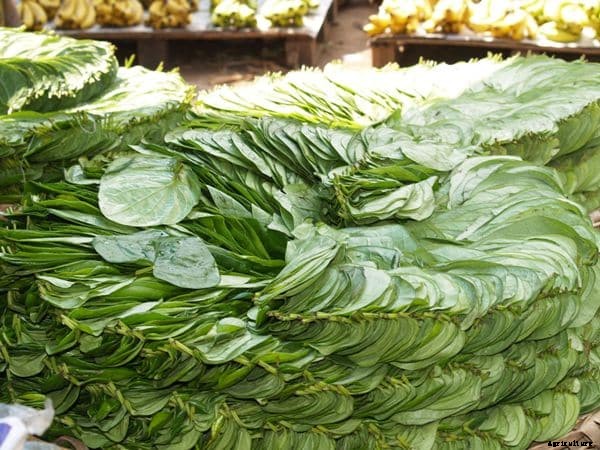
The yield and quality of the leaves completely depend upon the cultural practices and crop management techniques. In a hectare of the land we can get an average yield of 75 – 100 Lakh leaves each year.


