
Welcome to Modern Agriculture!

Introduction to Growing Persimmons:- The persimmons are important deciduous and temperate trees are also known as “Diospyros kaki” is originally from China. Eventually, they spread to Korea, Japan and the rest of the world. Japani phal is local name of this fruit in India. Persimmons can be grown in subtropical and temperate regions of the world. When it comes to Indian scenario, they are grown in Jammu & Kashmir (JK), Himachal Pradesh (HP), Tamil Nadu (TN), and Uttarakhand. The persimmon fruit looks similar to ripened tomatoes with attractive color and shape. The persimmons fruits are very sweet and have an excellent flavour. These fruits should be consumed only after fully ripen stage since it leads to puckering of mouth because of its astringent taste (contains tannic acids). The persimmon fruits have full market demand locally and internationally hence growing persimmons is one of best horticulture businesses. persimmons are being used in puddings, cookies, and bread. The non-astringent variety fruits such as Jirg, Fuyu can be consumed in a raw or fully ripened stage. However, Astringent persimmons variety like Hachiya must be fully ripened before consuming. When it comes to Persimmon tree description, it has a compact spreading habit and requires low maintenance when compared to other fruit trees. The persimmons trees are winter hardy and these are introduced in India by European settlers in the 20th century. Under best orchard management practices, one can obtain decent profits by growing of persimmons.
Scientific Name Persimmons:- Diospyros virginiana.
Family Name of Persimmons:- Ebenaceae.
Genus of Persimmons:- Diospyros.
Persimmons in Indian Languages:- Persimmon fruits are called with different names in India.
Amarphal (Hindi).
Cīmaip paṉiccai (Tamil).
persimmon (Punjabi).
ಪರ್ಸಿಮನ್ (Kannada).
বিলিতি গাব (bengali).
ટીમરુ (Gujarati).
Major Production Countries of Persimmons:- China, Korea, Japan, Brazil, Azerbaijan, Usa, Spain, Egypt, and Australia are major producers of persimmons.
Health Benefits of Persimmons:- Persimmon fruits are a good source of vitamins, minerals, dietary fibre, and anti-oxidants. These fruits are low in calories and fats and good in vitamin ‘C’.
The following are some of the health benefits of Persimmon fruits.
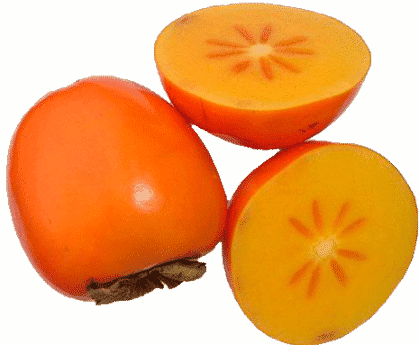
Varieties of Persimmons:- These trees are regular fruit bearers and bear number of fruits. The fruit shape depends on the variety. The shape of the fruit can be from spherical to heart to flattened. When it comes to the colour of the fruit, it varies from light yellow-orange to dark orange-red. There are mainly two categories of varieties are cultivated.
Persimmons Astringent Varieties:
Persimmons Non-Astringent Varieties:
There are other improved varieties grown across the globe, your regional department of horticulture is the best source to find the right variety.
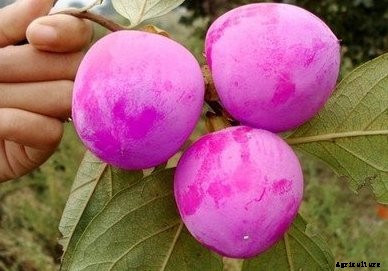
Climate Requirement for Growing Persimmons:- The persimmon trees grow and produce fruits well in both subtropical and temperate regions. The persimmons do not require the winter chilling needed by most deciduous fruits.
Soil Requirement for Growing Persimmons:- Persimmons thrives well on a wide variety of soils. However, they are best grown in heavy clay soils than most other fruit trees, they grow and produce best in deep, fertile, medium textured, well-drained soils. These trees grow very well in soils where pH ranges from 6.5 to 7.5. Persimmons trees do not grow well with excessive salinity and boron in the soils. A well-decomposed farmyard manure (FMY) should be supplemented to enrich the soil during the land preparation. Commercial Persimmon grower should do the soil test for finding suitability. You can use commercial soil test kits in the market to perform this task.
Propagation in Growing Persimmons:- Persimmons are reproduced (propagated) through seed, grafting, cuttings and by micropropagation.
For rootstock, Indian Persimmon known as Amlook is generally favored. The persimmon seeds must be sown with the start of spring because cool temperatures hamper seed germination. If you would like to raise on nursery beds, sandy loam soils rich in humus (organic matter) are desired. Seedlings of all Persimmon rootstocks must be chip-budded either at the beginning of August month or tongue grafted at the beginning of April month. The best results are obtained with chip-budding completed in April.
Land Preparation in Growing Persimmons:- Land should be brought to fine tilth sate by giving deep ploughings. Any clods or weeds should be destroyed. To enrich the soil, add appropriate well-decomposed farmyard manure to the soil during last ploughing. Land should be thoroughly prepared before planting the Persimmons in the field.
Planting and Spacing in Growing Persimmons:- Persimmons should be planted at the spacing of 4 meters x 4 meters to 6 meters x 6 meters. This spacing depends on the variety. A proper layout should be done before planting the persimmons. Generally, contour system is preferred in hills. Persimmon trees begin fruiting after 5 years of planting under good soil and sunny regions. Grafted persimmon plants are transplanted in India with the onset of spring season.
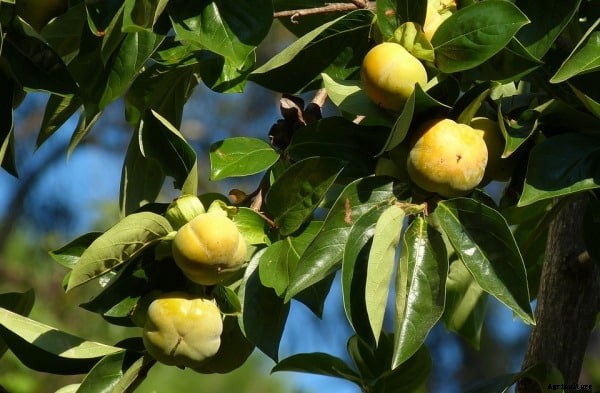
Irrigation in Growing Persimmons:- The persimmon trees require watering every 20 days on light soils and every 30 days on heavy soils. Avoid water stress especially during flowering and fruit set. Avoid water-logging conditions as these trees cannot tolerate and this may cause root rot and finally, trees may die. You can adopt a drip irrigation system to conserve the water. Make sure water drains well from the plant base in the rainy season.
Manures and Fertilizers in Growing Persimmons:- Persimmon trees respond very well to manures and fertilizers. A fertilizer mixture of 4 to 6 percent of nitrogen ‘N’, 8 to 10 percent of ‘P’, and 3 to 6 percent of ‘K’ @ 500 grams/tree/year should be applied. It is advised to apply these fertilizers in spring. You can also apply a half dose of fertilizers in spring and another half in July month. Avoid applying too much of nitrogen as it may cause shedding of fruits from the tree.
Intercultural Operations in Growing Persimmons:- In any garden, giving proper and timely intercultural operations are essential for good plant growth and high yields.
Pests and Diseases in Growing Persimmons:- Controlling pests and diseases is essential in any fruit orchard. Persimmon trees are relatively free from any serious pests and diseases. Occasionally, you may face whiteflies, thrips, and mites. You can observe premature fruit fall due to mite infestation. To control these mites and increase the fruit yield, spraying with Sevin 885 ppm 3 times at 1-month intervals immorality after the petal fall. If you observe any other condition, contact department of horticulture for symptoms and control measures.
Harvesting in Growing Persimmons:- Persimmons will start bearing fruits after 5 years of planting. The Persimmons should be picked when they turn into bright red colour. In India, October is the right month of picking fruits.
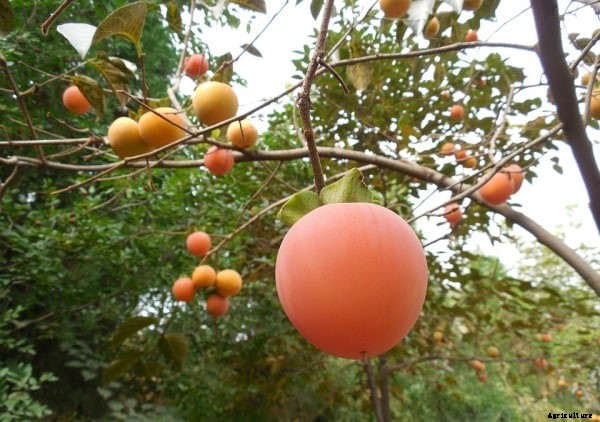
Post-Harvesting in Growing Persimmons:- The shelf life of Persimmons is medium to long period. These freshly harvested Persimmons can be stored for 2 to 3 months at 0 to 2°C. You can grade the fruits based on shape, colour and size and packed in cardboard.
Yield in Growing Persimmons:- Yield of Persimmons depend on the planting method, soil, irrigation, tree age, variety and other garden management practices. One can obtain around 160 to 200 kg of fruits per year from fully grown (matured) tree.
Marketing of Persimmons:- The harvested and graded fruits should be transported to any local fruit market or supply to fruit processing units. You can sell online as well, People are buying many fruits including Persimmons from online stores. You can sell even germinated Persimmon plants online.


