
Welcome to Modern Agriculture!

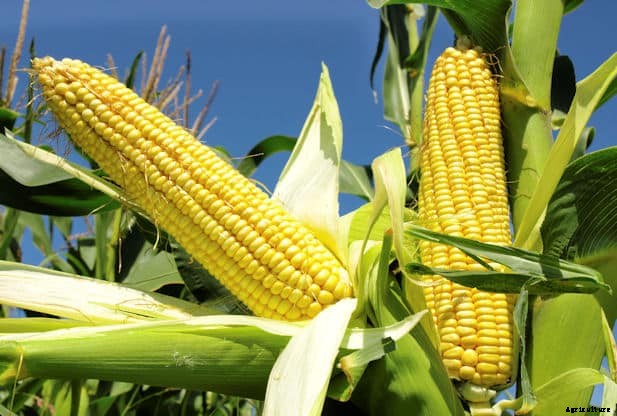
Maize is popularly known as “corn” is one of the most versatile emerging cash crops having wider adaptability under varied climatic conditions. It is called the queen of cereals globally. In India, maize or corn is the third most important food cash crops after wheat & rice.
The maize is grown throughout the year in all states of the country for various purposes including fodder for animals, food grain, sweet corn, baby corn, green cobs, and popcorn. Corn flour is consumed widely in Indian cooking.
Maize or corn serves as a basic raw material to thousands of industrial products that may include oil, starch, alcoholic beverages, alcoholic beverages, pharmaceutical, food sweeteners, food cereals, cosmetic, and film, gum, textile, package, and paper industries.
Below given are some of the health benefits of maize/corn.
Maize/Corn is largely cultivated crop in north India. Major Maize or Corn growing states are Uttar Pradesh, Rajasthan, MP, Bihar, Himachal Pradesh, Jammu and Kashmir, and Punjab which together account for two-thirds of the total area and output of the crop. Karnataka & Andhra Pradesh states are the major producers of maize in south India. MP ranks first in the production of maize in the country.
Read: Sheep Fattening Business Plan, Techniques.
There Number of hybrid commercial Maize varieties available from the seed companies, you have to choose the right high yield hybrid based on the local conditions. Some of the hybrid varieties are Himalayan 123,30V92,30B07, Sona, Kisan,30R77, Hi-Starch,32T25,31T15, Ganga-1, Ganga-101, Ranjit, Deccan, Ganga-5, Ganga-Safed-2, Ganga-4, Ganga-3 and V.L. 54, Vijay, Amber, Jawahar, and Vikram.
Maka (Hindi, Marathi, Oriya), Bhutta (Bengali), Makai (Gujarati), Makaa’y (Kashmiri), Musikinu jola (Kannada), Cholam (Malayalam), Makka Cholam (Tamil), and Mokka jonnalu (Telugu).
In India, Maize is primarily a rainfed Kharif crop which is sown just before monsoon starts. This crop usually grows well under temperatures varying from 22°C to 30°C, although it can tolerate temperatures as high as 35°C. This crop is affected by frost, so it is grown where at least 5 frost-free months available in a year. It requires at least 50 to 90 cm of rainfall. It is not recommended to cultivate this crop in the areas where rainfall is more than 100 mm.
Maize or Corn can be cultivated successfully in a variety of soils ranging from clay loam to sand loamy to black cotton soil. For a better yield of maize, one should consider soils with good organic matter content having high water holding capacity. Well-drained soils with a pH of 5.5 to 7.0 are preferred for maize farming. A soil test is recommended to find out the deficiency of any nutrient values in the soil, any deficiency can be covered by adding good organic matter or compost at the time of land preparation.
Read: Soil Moisture Conservation Methods.
Maize crop is usually cultivated in India, from June to July, Sept to Oct and Jan to Feb seasons. For seed production, sowing during Nov to Dec is suitable since seed maturity will not coincide with the rainy season.
The selected field should be free of volunteer maize plants.
What are volunteer plants?: volunteer plants are basically unwanted plants that are grown from previous maize crop. These maize plants may be a different variety, so there is a chance that genetic contamination may occur.
Plowing should be done to get fine tilth, it may take 6 or 7 plows. At least 13 to 14 tons of Farm Yard Manure per hectare (F.M.Y) should be spread across the field or composted coir pith and apply 10 Azospirillum packets in the field. Prepare furrows and ridges with 45 cm to 50 cm spacing to save the irrigated water.
Read: Goat Fattening Methods, Techniques.
10 to 11 kg of maize seed is required for sowing one-hectare field. To control any seed borne pathogens of downy mildew (fungal disease), should treat the seed with thiram or carbendazim @ 2 grams per kg seeds. One day after seed treatment should treat the seeds with 600 grams of Azospirillum with rice gruel and shade dry for 15 to 20 minutes. Azosprillum help in fixing the atmospheric nitrogen in the soil.
In Maize, farming propagation is done by seeds. One should adopt a plant-to-plant spacing of 10 cm and sow 2 seeds per hill. Should sow the seeds @ 1/3 rd of the ridge from the bottom.
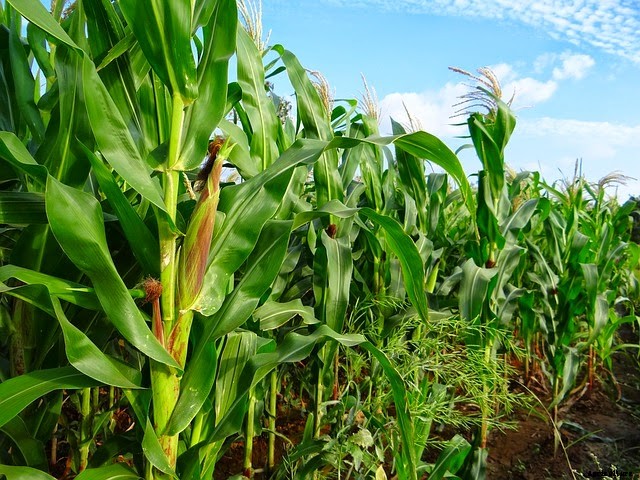
Other than Farm Yard Manure applied at the time of land preparation, should apply inorganic fertilizers like 470 kg of superphosphate, 200 kg of urea, and 180 kg of potash per ha as a basal dose. 20 days after sowing, should apply 50 to 60 kg of urea and at 40 days after sowing 120 kg of urea and 50 kg of potash as a topdressing.
Nutrient deficiency in maize affects the growth of the plant so the yield. Zinc and Magnesium deficiency is common and largely occurs in leaves. To deal with these deficiencies, apply ZnSO4 @ 20 kg per hectare as basal fertilizer. Magnesium deficiency will cause yellowish symptoms between edges and veins of basal leaves. Due to “Fe” or “Iron” deficiency, the whole plant will turn into yellowish color, to deal with this deficiencies supplement the micronutrient mixture at 63 per hectare mixed with 45 kg of sand, after sowing the maize seeds.
As soon as sowing is done, immediate irrigation is required in the field. Subsequently, give life irrigation on the third or fourth day and based on the soil type and season. (It may not be required in rainy season). Usually for maize crop, up to 25 to 30 days, less number of irrigation is recommended, afterward, it is required to irrigate once in a week. During the early stage of this crop, water stagnation should be avoided and should have good drainage.
It requires at least 2 hands weeding in maize crop, one is on 20 to 25 days and another is on 40 to 45 days after sowing. Should apply fertilizer as top dressing & do the earthling up operation after weeding is completed. Spray Atrazin 500 grams mixed in 1000 liters of water and life irrigation on 3rd or 4th day controls the weeds in the maize field.
Read: Pig Fattening Methods, Techniques.
Main diseases in maize farming are downy mildew and leaf spot.
Downy mildew: To control this, remove the affected plants. Spray Metalaxyl 72 WP @ 1 kg per hectare, or Mancozeb 1 kg per hectare, 20 days after sowing.
Leaf spot: To control this, spray Captain or Mancozeb kg per hectare when the disease intensity is high.
Usually, insect attack is very low in maize crop. In young plants, only shoot fly effects and stem borer affects the shoot after 20 to 30 days after sowing, to control this, apply carbofuran granules @ 8 kg/acre @ 2 granules per each plant.
Harvesting should be done when the crop outer cover of the cob turns from green to white color. Harvesting can be done by hand. Machines are available to separate the seeds.
Again yield depends on the field management and seed variety, the quality seed can yield up to 2500 kg per hectare.
Read: How to Prepare a Seedbed for Your Garden.


