Growing fresh, healthy produce inside a controlled environment is a rewarding pursuit, but it also presents unique challenges. For aquaponics growers, light is the invisible engine that turns your fish‑generated nutrients into robust plant biomass. Without adequate illumination, even the most nutrient‑rich water and healthy fish will struggle to deliver the yields you expect.
Enter grow lights – specially engineered fixtures that supply the precise spectrum and intensity plants need to photosynthesize, even when natural sunlight is scarce. With options ranging from LEDs and fluorescents to high‑intensity discharge (HID) units, selecting the right light can feel daunting. This guide distills the essential information so you can confidently choose a grow light that matches your system’s size, crop type, and budget.
Whether you’re just starting out or scaling a commercial‑grade setup, you’ll find practical advice, industry‑tested recommendations, and insider tips for maximizing plant health and productivity.
Why Grow Lights Are Essential for Indoor Aquaponics
Short answer: If your system isn’t located directly under a sun‑filled window or greenhouse, you’ll need grow lights.
1. Natural Sunlight vs. Indoor Reality
Outdoor sunlight delivers a full spectrum for free, but indoor windows filter out critical wavelengths and daylight hours are limited, especially in winter. Consistent, full‑spectrum light is therefore indispensable for steady growth.
2. Plants Need the Right Light, Not Just Any Light
A standard household bulb can brighten a room, but it lacks the blue and red wavelengths essential for photosynthesis. Inadequate spectral quality forces plants to stretch, weakens stems, and severely limits harvest.
3. Impact on Beginner Aquaponics Systems
Fish continually release nutrients into the water. If plants cannot efficiently use that energy due to poor lighting, you’ll see nutrient build‑up, stunted growth, and overall system frustration.
How Light Drives Growth in Aquaponics
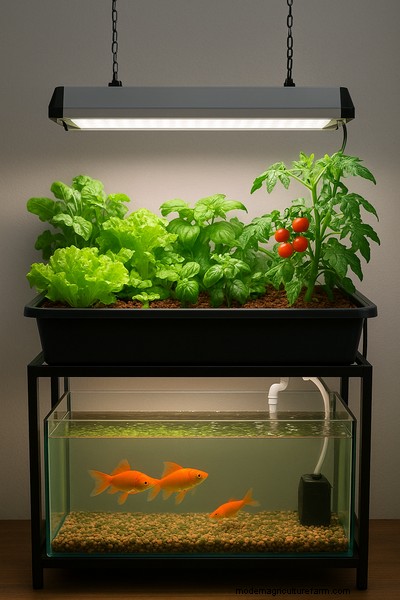
Light fuels photosynthesis—the process by which plants convert light into food. In an aquaponic system, this energy allows plants to extract the nutrients supplied by fish. Without adequate light, plant growth stalls regardless of water quality.
Key Light Factors in Aquaponics
1. Spectrum
- Blue light – promotes leafy growth (ideal for lettuces, herbs, and other greens).
- Red light – supports flowering and fruiting (perfect for tomatoes, peppers, strawberries).
- Full‑spectrum – balances blue and red, mimicking natural sunlight.
2. Intensity
Insufficient intensity causes plants to stretch toward light; excessive intensity can scorch leaves or bleach foliage.
3. Duration (Photoperiod)
Leafy greens typically need 14–16 hours of light per day, while fruiting varieties require 12–14 hours.
Quick Reference Table: Light & Plant Growth
| Light Condition | What Plants Do | Signs You’ll See |
|---|
| Too little light | Slow or no growth | Pale, yellow leaves; leggy stems |
| Too much light | Stress or burn | Brown leaf tips, dry patches |
| Wrong spectrum | Imbalanced growth | Lots of leaves but no fruit, or vice versa |
| Balanced light | Thriving plants | Vibrant leaves, steady growth, strong yields |
Grow lights vary in cost, intensity, and spectrum. Below is a concise overview of the most common types for indoor aquaponics.
1. Fluorescent Lights
Pros:
- Affordable and widely available.
- Low heat output – safe for tight spaces.
- Great for beginners and small leafy‑green setups.
Cons:
- Limited intensity – not ideal for fruiting plants like tomatoes.
- Shorter lifespan compared to LEDs.
Best For: Small tanks, starter systems, or supplemental lighting.
2. LED Grow Lights
Pros:
- Energy‑efficient, with lifespans exceeding 50,000 hours.
- Customizable spectrum (blue, red, or full‑spectrum).
- Low heat output, reducing burn risk.
- Available in compact panels or bars for any system size.
Cons:
- Higher upfront cost versus fluorescents.
- Performance varies; budget models may underdeliver.
Best For: Systems of any size where energy efficiency and plant performance matter.
3. HID (High‑Intensity Discharge) Lights
Pros:
- Very powerful light output.
- Excellent for large‑scale fruiting or flowering crops.
- Proven track record in hydroponics and indoor growing.
Cons:
- High heat output; requires ventilation or cooling.
- Higher energy consumption.
- Bulky relative to LEDs or fluorescents.
Best For: Medium to large aquaponics systems demanding high light levels.
4. Full‑Spectrum Lights
Pros:
- Mimics natural sunlight across blue and red wavelengths.
- Simplifies setup; no need to swap lights between growth stages.
- Excellent for mixed‑crop systems.
Cons:
- Generally more expensive than basic options.
- Quality matters—some “full‑spectrum” labels are misleading.
What to Look for in a Grow Light
Use this checklist to narrow choices and identify the light that best fits your aquaponics needs.
Beginner‑Friendly Grow Light Checklist
1. Light Spectrum
- Prefer full‑spectrum or “plant growth” labeled lights.
- Blue‑heavy for leafy growth; red‑heavy for flowering and fruiting.
2. Wattage & Intensity
- Match intensity to crop type (e.g., lettuce thrives under lower intensity; tomatoes need stronger light).
3. Coverage Area
- Check specifications for square‑foot coverage; larger systems require multiple units.
4. Energy Efficiency
- LEDs offer long‑term savings on electricity bills.
5. Heat Output
- Low‑heat options (LEDs, fluorescents) are easier to manage indoors.
6. Durability & Lifespan
- LEDs often last 5–10 years; fluorescents need more frequent replacement.
7. Budget
- Fluorescents – lowest upfront cost.
- LEDs – higher upfront cost but best long‑term value.
Best Practices for Setting Up Grow Lights in Your Aquaponics System
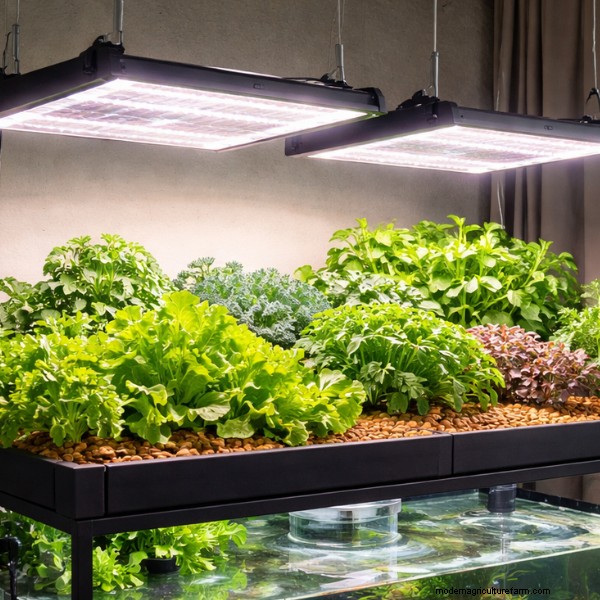
Choosing the right light is just the first step; proper installation determines success.
Step 1: Position Lights at the Correct Height
- Leafy greens: 6–12 inches above the canopy.
- Fruiting crops: 12–24 inches above to avoid leaf scorch.
- Adjust as plants grow to maintain uniform coverage.
Step 2: Angle and Coverage
- Mount lights directly overhead for even light distribution.
- For larger beds, use multiple panels side by side.
- Avoid shadows – uneven light leads to uneven growth.
Step 3: Set the Right Photoperiod
- Leafy greens: 14–16 hours per day.
- Fruiting/flowering plants: 12–14 hours per day.
- Use a timer to automate schedules and save energy.
Step 4: Manage Heat and Ventilation
- LEDs generate minimal heat; suitable for close placement.
- HID lights require fans or ventilation due to high heat output.
- Keep cords and fixtures away from splashing water.
Step 5: Safety First
- Use waterproof power strips and surge protectors.
- Secure fixtures with chains or adjustable hangers.
- Place all electrical components above the water line.
Our Top Picks for Indoor Aquaponics Grow Lights
1. Best Overall Grow Light – GE Lighting BR30 LED Flood Light
Check Price
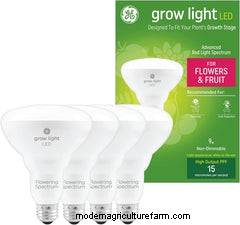
This GE BR30 LED flood light excels for flowering and fruiting crops in aquaponics. Its balanced red‑blue spectrum delivers strong yields with minimal heat, and its 50,000‑hour lifespan surpasses many competitors. Rated 4.7 on Amazon, it’s a reliable choice for growers seeking efficiency and performance.
Pros
- Excellent cost‑to‑performance ratio.
- Fits standard lamp bases.
- Simple installation.
- Natural light temperature.
Cons
2. Best for Larger Systems – Spider Farmer SF4000 LED Grow Light
Check Price
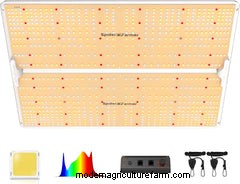
The Spider Farmer SF4000 offers a full‑spectrum LED array with dimming control, ideal for the complete growth cycle of larger aquaponic setups. With a 5‑year warranty and 4.7/5 Amazon rating, it delivers high efficiency and durability.
Pros
- High‑efficiency LED technology.
- Easy to set up and operate.
- Five‑year warranty.
- Durable construction.
Cons
3. Budget Friendly – Aceple LED Small Grow Light
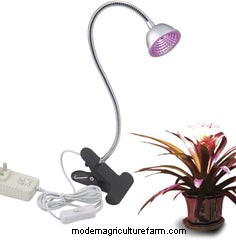
Check Price
Ideal for beginners, the Aceple Desk Plant Grow Light accelerates growth at an affordable price. Its adjustable gooseneck and clamp make it versatile for tables, desks, or countertops.
Pros
- Very affordable.
- Easy to install.
- Adjustable gooseneck arm.
- Energy‑saving.
Cons
- No built‑in timer.
- Bulbs require frequent replacement.
4. Winter‑Optimized – SANSI Full‑Spectrum Grow Light Bulb
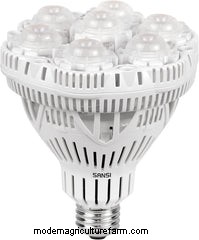
Check Price
The SANSI bulb delivers a superior CRI and minimal heat, making it ideal for winter indoor aquaponics. Its long‑lasting LED core provides consistent performance without frequent maintenance.
Pros
- Full‑spectrum output.
- Low heat emission.
- Long‑lasting lifespan.
- Fully insulated, safe construction.
Cons
Runner‑Ups
1. VIPARSPECTRA 2023 Upgraded P2000 LED Grow Light
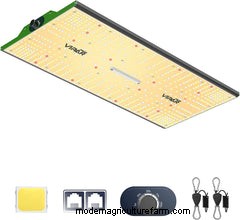
Check Price
Featuring an upgraded diode layout and daisy‑chain capability, the VIPARSPECTRA P2000 ensures uniform light distribution and easy scalability. Rated 4.7/5, it offers full‑spectrum output, dimming, and high PAR levels.
Pros
- Full‑spectrum with excellent heat dissipation.
- Low energy consumption.
- Dimmable control.
Cons
- Still generates some heat; ventilation recommended in warmer climates.
2. BESTVA 2023 Upgraded BP2000 LED Grow Light
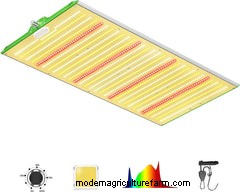
Check Price
The BESTVA BP2000 is compact yet powerful, delivering full‑spectrum light ideal for flowering and fruiting crops. Dimmable and cool‑to‑touch, it’s suitable for both novice and experienced growers, though it’s not waterproof.
Pros
- Very affordable.
- Excellent cooling system.
- Full visible‑spectrum coverage.
- Covers up to 8×8 inches efficiently.
Cons
- Not waterproof.
- No daisy‑chain support.
Common Mistakes and How to Avoid Them
1. Too Little Light
- Problem: Spindly growth, pale leaves.
- Solution: Increase photoperiod (14–16 hrs for greens, 12–14 hrs for fruiting) and verify intensity.
2. Too Much Light
- Problem: Browning leaf tips, dry patches.
- Solution: Raise lights slightly or shorten daily light duration.
3. Wrong Spectrum
- Problem: Abundant foliage but no fruiting.
- Solution: Use full‑spectrum or combine blue and red coverage.
4. Poor Placement
- Problem: Uneven growth.
- Solution: Ensure even coverage, correct height, and eliminate shadows.
5. Ignoring Electricity Costs
- Problem: Unexpectedly high bills.
- Solution: Choose energy‑efficient LEDs and run lights on timers.
FAQs About Grow Lights for Aquaponics
1. How many hours per day should I run grow lights?
Leafy greens require 14–16 hours; fruiting plants need 12–14 hours. Timers keep the schedule consistent.
2. Can I use regular LED bulbs?
Standard household LEDs lack the specific blue/red wavelengths needed for photosynthesis. Dedicated grow lights are essential for healthy growth.
3. Do different plants need different lights?
Yes. Leafy greens thrive under cooler, blue‑heavy light; fruiting crops benefit from more red light. Full‑spectrum lights cover both needs.
4. What’s the best budget grow light for beginners?
Fluorescent T5s or entry‑level LED panels offer affordable performance for small systems or leafy greens. Full‑spectrum LEDs deliver long‑term value.
5. How far should lights be from plants?
- Leafy greens: 6–12 inches.
- Fruiting crops: 12–24 inches.
Conclusion
In indoor aquaponics, light is the cornerstone that translates fish‑derived nutrients into robust plant biomass. Selecting the right grow light—considering spectrum, intensity, photoperiod, and system scale—ensures lush greens, flavorful herbs, and productive fruiting crops. By following the best practices outlined above and avoiding common pitfalls, you’ll elevate your aquaponic operation from a hobby to a reliable, high‑yield system.
Ready to skip the trial‑and‑error? Our 5‑hour Aquaponics Video Course provides step‑by‑step lessons from real systems, practical lighting demos, and proven strategies for balancing fish, plants, and water chemistry.


