
Welcome to Modern Agriculture!

Quail is a small game bird mostly found in the European and North African regions of the world. This bird is considered to nest on the ground and is noticed for its stocky structure and short legs. The bird has a varied plumage and is often raised for its eggs and meat. It is believed that Japanese people started farming the birds and revealed the domestic raising methods to the entire world. Now, many countries do commercial Quail farming business for meat and egg production. The meat and eggs of Quail are tasty and nutritious when compared to poultry eggs that is the reason for its great demand. This business is considered easy and flexible and profitable. It requires less capital investment and labour. Almost any type of weather condition is suitable for Quail farming and the most important fact is it can be raised along with other birds successfully, but with a little risk factor. This Quail farming project report describes the farming methods and requirements, at the end of the report one can find the cost of starting a Quail business farm and the profit associated with it.
Some benefits associated with Quail farming are:
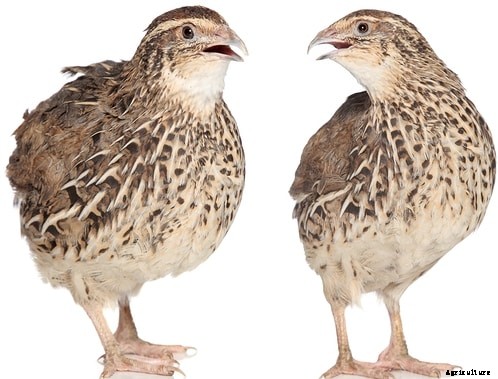
Some general characteristic features of the Quail bird are given here. The appearance may differ for different species.
Read: Broiler Chicken Farming Project Report.
For commercial and profitable business, there are 18 different species of Quail available and like the poultry breeds, they are also divided into egg type and meat type. Among so many species three most important species are:
The common Quail
The Japanese Quail
The king Quail
Some popular layer Quail breeds are:
Broiler breeds of Quail are:
From the egg to a grown up Quail there are many stages of growth which have to be taken care of during the rearing process. The different stages of Quail are described here:
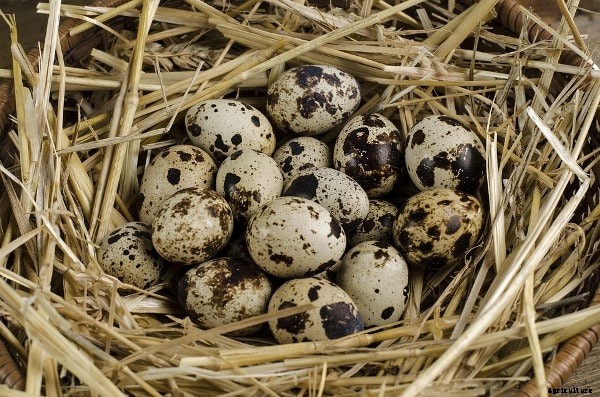
Quail lay eggs all year round and the count is higher during February and September. The female bird starts reproducing from week 6, but preferably 8 week old Quail birds are considered to produce fertile eggs. Once eggs are found in the farm, the breeding groups are created. The Quail doesn’t sit on the eggs to incubate them. Therefore the eggs are incubated artificially and it takes around 16-19 days for the eggs to hatch.
Housing for the Quail birds is an important component of Quail farming business and they can be either housed in cages or in houses built exclusively for these birds. These birds prefer dry climate, but can survive low temperatures as well. A Quail pen can be created with chicken wire and should have smaller mesh size with a top cover. Cage rearing is the most preferable housing system for these birds. Care should be taken to have only one male bird with five female birds in the cage house. Quail birds have a characteristic feature of jumping to a height of 20-30 cm and scratching the earth to find insects. Except during migration or while escaping predators, these birds don’t fly. Farm house should have a special arrangement if these birds were to fly and take big leaps otherwise they would hurt their heads or get injured. Therefore the height of the cage should be properly designed and should range in between 25 cm to 2 m.
Sometimes Quail birds show aggressive behavior and peck other birds in the cage on their head, which results in bleeding from the head. Under such circumstances the birds should be isolated for a day or two until their behavior becomes normal. The most important housing systems for Quail are:
In any kind of livestock farming, feed represents almost 70% of the cost of rearing and Quail also needs good and nutritious food for growth and development. The main food for the Quails is maize, millets and sorghum. The food and water for the Quails should be clean and fresh. The feed should always be stored in a dry, cool place so that it is protected from mites, pests and rodents. Feed older than 2 months should be avoided because there could be a risk of health problems in Quails. Food like lettuce, apple, cabbage, banana, papaya, carrots, rice, cooked pasta, etc. can be provided to the Quails and the feeders should be cleaned thoroughly thereafter. Some other feed ingredients that can be given to the birds are broken wheat, sesame cake, kipper fish, rice bran, broken oyster shell, salt and mineral mix. Each stage of the Quail needs a different quantity of high-protein feed such as:
Insufficient food for the Quails can bring violence in their behavior and such behavior is controlled by providing more feed. Care for the food should be taken if the birds are being raised for using them in remedies. Chemical or antibiotics should not be given to such birds.
Trough for the baby Quails should be half filled with pebbles and marbles so that these birds do not drown in them. Each water trough should be 0.6 cm away from the Quail. If nipple waterers are used then one nipple waterer should serve five Quails. There should be clean and fresh water available for the birds and the waterers should be cleaned regularly. The water should not be too warm otherwise it can cause pathogenic agents to multiply. Water should not contain any particle of the feed in it and it is advised to add a drop of methylene blue to the water once in a week to purify it. Maintaining the feeders and waterers clean is highly essential for good health of the Quails and these should be bleached using sodium hydrochloride in warm water. Disinfectants should be used to clean the feed equipment once in every month to keep the Quails disease free.
Generally the risk behind farming Quail with other poultry birds is that they contract disease from the poultry birds like the avian cholera, variola, new castle’s disease, flu, etc. So, the birds should be treated every 2-3 months with anti-parasitic drug for preventing the occurrence of these diseases. Within 3 weeks of birth the Quail has a risk of aspergillosis caused by fungi in the grains. The symptoms of the disease are shortness of breath due to yellow or green deposits in the trachea. Before administering any medicine the advice of the vet is important. During the growing stages the Quail may suffer from coccidiosis and enteritis and both these diseases can cause death, there increasing the mortality rate of the birds. The symptoms of the diseases are bloody diarrhoea and less appetite. They can be cured by Terramycin. Disinfecting the cages is highly important and all the other Quails should be administered with streptomycin and calcium. Salmonella bacteria can cause diarrhoea, respiratory disorder etc. and can be fatal. The best way to protect the Quails from this disease is vaccinating them properly. Hygiene on the farm can prevent most of the diseases and can lead to better production and profit.
For good management and productivity of the Quail farm, maintaining a record of farm activities is highly important and necessary. Events such as the birth, death or loss, removals, total egg count, eggs sold and no. of Quails purchased along with their dates should be recorded for reference. There should be a record of treatments, vaccinations and other medical activities with their exact dates. Similarly, the expenditure and income of the farm should also be recorded. If the farm has an incubator then the details associated with it such as eggs hatched, temperature, date etc. should all be noted down separately.
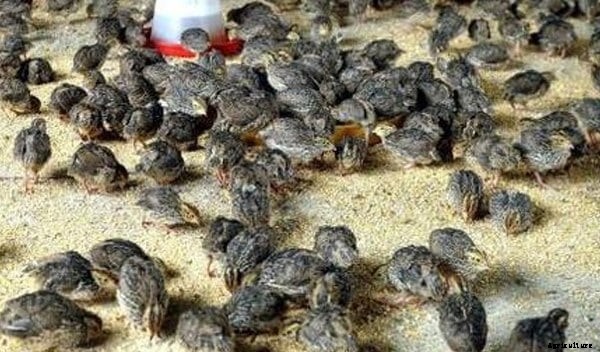
The estimation of a small farm with 2000 Quail birds as input every week is considered and the investment is calculated. The output of the farm is considered to be 1800 Quails every week. Therefore, yearly input of Quail chicks is 1, 04,000 and the output marketable Quails are 93,600 after a 10 % mortality rate. The values shown here are just assumptions and should be taken as reference only.
Cost of construction per sq ft: Rs 200.
The space required by each bird: 0.15 sq ft.
Cost of day old Quail chick: Rs 10 (may vary depending on the species)
Cost of feed per kg: Rs 20.
Mortality rate: 10%
Feed consumption per bird: 600 g
Land, transport, equipment required (fixed costs) Investment in Rs 300 sq ft area with 10 partitions @ Rs 200/sq ft 6,00,000.00 Equipment for 8000 birds @ Rs 10/bird 80,000.00 Other infrastructure like store room etc. 1,00,000.00 Transport cost 50,000.00 Water for the birds 50,000.00 Total cost 8,80,000.00Stock requirements for one cycle (variable) Investment in Rs 16,000 Quail chicks @ Rs 10/bird 1,60,000.00 Feed for 16,000 chicks @ 600 g/bird and Rs 20 per kg 1,92,000.00 Electricity and other charges 50,000.00 Total expenses 4,02,000.00
Expenses for one batch in a week:
Cost of materials and stock investment in Rs 2000 Quail chicks @ Rs 10/bird 20,000.00 Feed cost for 2000 chicks 24,000.00 Other miscellaneous charges including labour and medical facility 10,000.00 Total operational cost per batch 54,000.00Therefore the cost for 52 batches of chicks around the year: 28, 08,000.00.
Sale price of Quails: Rs 40/ bird.
Income from the sale of 1800 Quails in a week: Rs 72,000.00.
Income generated per annum from 52 batches: Rs 37, 44,000.00.
The annual profit from the farm is around: 9, 36,000.00.
It is important to note that the project has not discussed anything about the sale of eggs or gunny bags or manure from the farm. These things can be a source of additional income
Like any other livestock farming business it is important to consult the nearest agriculture or animal husbandry office for details regarding a particular business for the exact amount of subsidy values. But it is believed that NABARD doesn’t give loans or subsidies for Quail farming (check with the firm for exact details).
In India it is considered that Quail farming and sale require a license from the government. There are some conditions laid down for Quail farming business in India so it is advisable to check with the responsible department before investing into this sector. All these conditions have been implemented because Quail belongs to the category of protected species. Some of the conditions laid down for Quail farming are:
Read:Raising Emu Birds for Profit.


