
Welcome to Modern Agriculture!

Today, let us discuss the Pomegranate Farming Project Report/Cultivation Practices of Pomegranate.
Pomegranate is a deciduous shrub, which bears fruits of high nutritive value. It is believed to be found in the northern hemisphere from September to February and in the southern hemisphere in the month of March till May. The fruit is considered to have originated from the present-day Iran region and was distributed to nearby countries. It is found that the pomegranate was domesticated in the 5th millennium BC. Though this fruit is not native to Korea and Japan, it is still widely grown in those countries. Kandahar, a place in Afghanistan is known for producing very high-quality pomegranates. The pomegranate is considered to be the best health-giving plant. This plant is also grown for ornamental purposes as bonsai for its flowers. The red color of the pomegranate is sometimes referred to as ‘balaustine’. The early Egyptians looked upon pomegranate as a symbol of prosperity and ambition. The Greek philosophy describes pomegranate as ‘the fruit of the dead’. The Greeks consider this fruit to be auspicious and use it in a variety of activities.
This pomegranate farming project report gives detailed information about the fruit, its cultivation techniques, the cost of the project, and the profit on the investment.
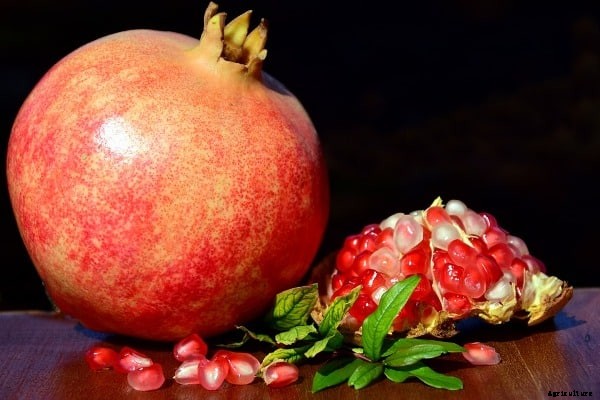
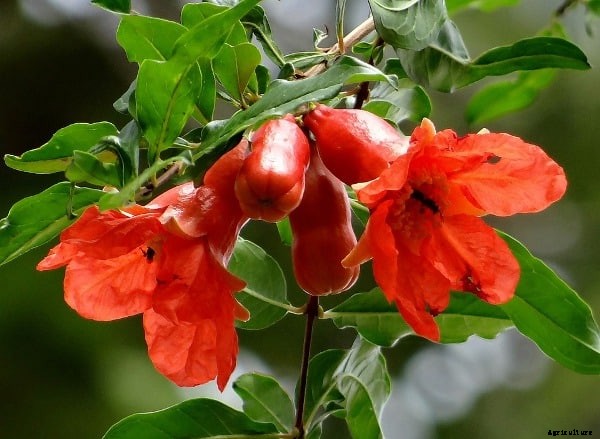
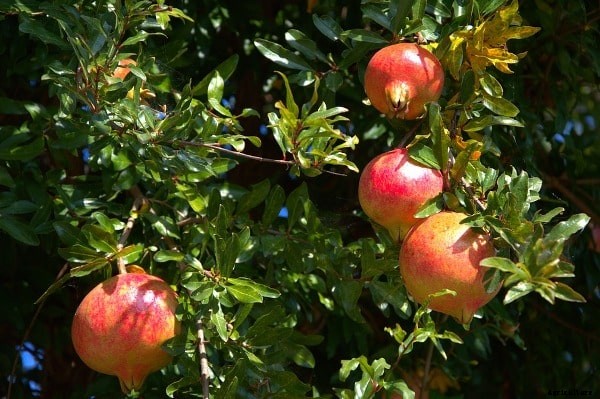
The pomegranate plant is a small shrub with a maximum height of 10 m. It has numerous spiny branches and is considered to live long. The fruit of the plant is red-purple in color with an outer pericarp and inner mesocarp. The edible parts are the seeds that develop from the ovary of a single flower.
The fruit of pomegranate is expected to be highly nutritive and has amazing benefits on human health.
The pomegranate is used in:
The best known Indian cultivars are Ganesh, Mridula, and Bhagwa and they almost share similar characteristics. These fruit varieties have a low acid content and sweet flavor. The fruit is medium with a thin rind.
Some other Indian cultivars are Alandi, Muskat, Jalore, Jodhpur red, Dholka, Malta, Kandhari, Guleshah, Molus, Sharin, Srinagar special, Chawla, Nabha, and Achikdana.
The names of the cultivars are different in other regions of the world, but the basic genotype is the same.
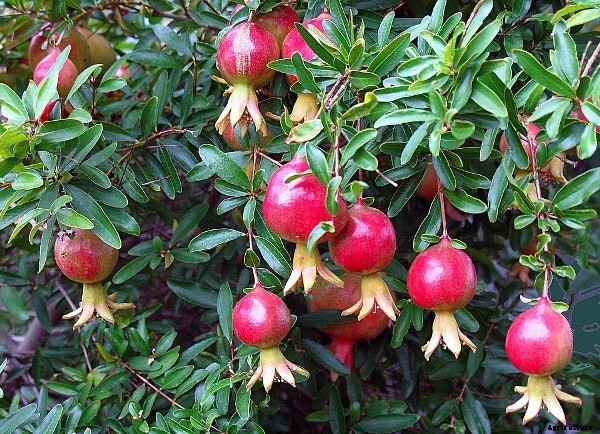
The plant grows in dry climate zones. The optimum temperature for the fruit development stage is 38˚C, but high humidity can destroy the fruits and render them tasteless. The plants are tolerant of drought and severe winter. In the initial years of growth temperatures below 8˚C are harmful. The plant can also resist hot, dry weather with sufficient irrigation. Pomegranate plants can grow in semi-arid regions and also at altitudes of 500 m above sea level.
Plants can survive in both alkaline and acidic soils, but extremely good produce is expected when grown in well-drained heavy loamy soils. Well-drained sandy or alluvial soils are also sometimes suitable for farming pomegranate. Too much soil moisture or too little moisture can cause fruit breaking. The pH of the soil should be between 6.5 to 7.5 and the active lime percentage recommended is 12-15.
Pomegranates propagate through stem cuttings, air layering, or in vitro (tissue culture). Most of the farming is done by plants that are propagated by air layering.
Branches of diameter 1.5 cm are cut in a circular shape with a length of 3 cm and are treated with 3000 ppm of IBA on the cut area. The small ringed bark is wrapped with peat moss and covered with polythene strip and tied on both ends. When roots are observed after 90 days, they are detached from the mother plant and planted in the nursery.
For propagation through stem cuttings, a shoot of age 18 months is selected and 25 cm of the length is taken for propagation. The cut from the plant is sanitized by dipping it in 500 mg/l of 2-Bromo-2-nitro-1, 3-diol, and 1 g/l of carbendazim diluted in hot water at 53˚C. The lower half of the stem is dipped in 5 g/l of butyric acid for 30 sec to induce rooting. These cuttings are planted in a mixture of coco peat and sand for faster rooting. The roots develop after 60 days and then they are transferred to the nursery bags.
The selection of land for pomegranate is important because the plants require at least six hours of direct sunlight to grow and produce properly. The soil pH is adjusted to 6.5 by adding dolomite limestone and phosphorus to the soil. Ripping the soil to a depth of 1 m helps remove unwanted substances and provides good drainage. The plants grow and survive for 30 years, so it is important to add a sufficient amount of nutrients and manure to the soil prior to planting. Proper ploughing and establishing the nutrients will help in better root system and water management. The land has to be prepared 4 to 5 months before planting.
In the northern plains and Deccan plateau regions, the spacing between plants is 5 m x 5 m. In a square plot pits of dimensions, 60 x 60 x 60 cm is dug one month before planting. The pits are dusted with 5% BHC to protect the plants from termites. 20 kg of FYM and 1 kg of superphosphate are mixed in the soil and fill in the pits. The planting material is planted and light irrigation is given. The cutting or air layers are planted during early spring or late winter in the nurseries and the transplantation to the main area is done in the early summer season around March.
High-density planting is done in temperate zones, but the closer spacing is observed to increase the risk of pests and diseases.
When surface irrigation with fertilizers and Fertigation are compared, then it is observed that the latter gives better produce. The recommended quantity of fertilizer is 700 g of nitrogen, 250 g of superphosphate, and 250 g of Muriate of potash per plant in a year. Also, 10 kg of Farm Yard Manure and 75 g of ammonium phosphate is suggested to a five-year-old plant annually. A mixture of the 50 kg FYM and 1 kg of ammonium sulfate applied to the plants before the flowering period to enhance growth and fruit production.
The NPK fertilizer for nonbearing plants is applied in three split doses in the months of January, June, and September. Nitrogen is applied in two split doses, but phosphorous and potassium are applied at a time. FYM is generally applied as a basal dose to the plants in a circular manner with 10 cm depth. Potassium in the soil helps the plant to produce fruits with good weight and high yield.
Though the plant resists dry weather conditions, a regular supply of water is needed for good quality yield. Drip irrigation is found to be an effective way of providing the water requirements and also results in better height, stem diameter, and spread. Irrigating the plants with sufficient time intervals is found positive on the yield. Having a schedule for irrigation also helps in understanding the ripening period. During summer plants are irrigated on a weekly basis whereas in winter they are irrigated at a 15-day interval. In general pomegranate, farm requires 15 m³/ha/day of water in spring and 50 m³/ha /day in summer.
It is highly important to note that pomegranate plants respond to saltwater irrigation. The plants grown in saline water conditions have normal yield and no damage is observed in the trees. Vegetative growth is high in saline water, which should be controlled. Some regions of the world also use recycled water for irrigating pomegranate plants.
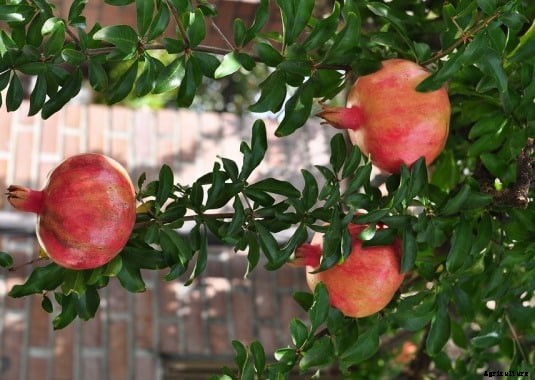
The fruit of pomegranate is picked when fully ripe because ripening is very slow after harvest. The plants bear fruit after 4 to 5 years of planting. Harvesting should be done at the exact time because preharvested fruits or overripe fruits have lower quality. Once the plant starts fruiting, it takes nearly 120 to 130 days for the first harvest. The distal end of the fruit has calyx which gets closed upon maturity of the fruit. The yellowish-red color of the fruit also indicates the maturity of the fruit and harvest time. The fruits are clipped with shears such that no damage is done to them in the basket. The crates or baskets are lined with 2 mm of foam at the base to harvest the fruit.
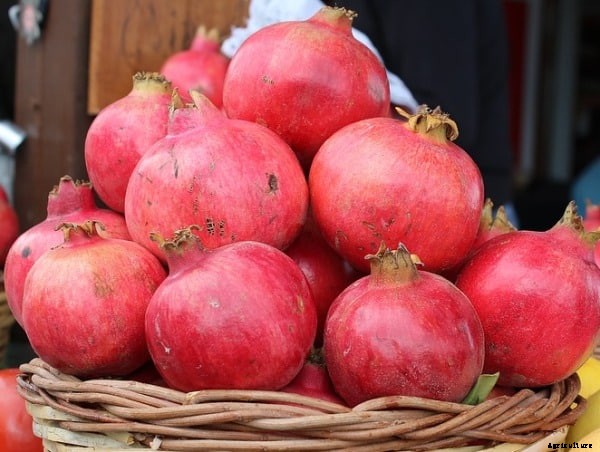
The pomegranate when harvested can respire at a slow rate, thereby causing problems like weight loss, size reduction, skin damage, etc. maturity in the fruit is hampered after harvesting, therefore it is recommended that the fruit is harvested only when it is ripe. The shelf life of a pomegranate is increased by waxing it with antifungal compounds. Treating the fruit with heat after long storage is believed to retain functional and nutritional properties. Fruits can be stored in temperatures between 0-4.5˚C with a relative humidity of 85% for several months after harvesting. Chilling injury can be prevented by pre-treating the fruits with hot water at 45˚C. Late harvest, low temperatures, and low oxygen levels (2-3%) could prevent chilling injury by not altering the taste qualities. Each cultivating variety has its own storage conditions depending on the geographical location of farming. So, care should be taken to understand and process the fruits accordingly.
Read this: Tounge Grafting Methods.
Fruits are graded according to their size, color, and weight and then packed. White boxes with 5 plies are used for exporting and the red boxes with 3 plies are for domestic use. Waste paper pieces are used in the boxes for cushioning the fruits.
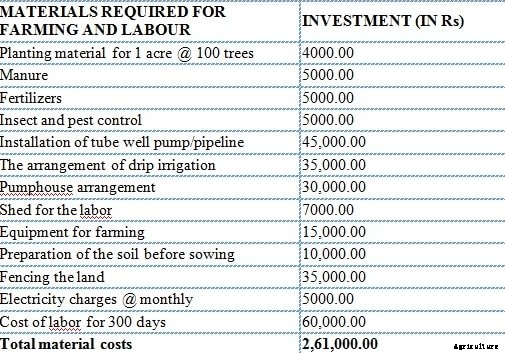
The model describes the minimum requirements to start a pomegranate farm in 1 acre of land. The rent of the land is not included because it may vary in different places and also on the factor of whether it is owned or rented. It is worth mentioning that the cost of other materials depends on the supplier and its availability in the local market. The charges of electricity vary in different places and the cost of labor depends on the number of working days of ‘n’ no of laborers. The number of labor ‘n’ can vary depending on the farm size.
1 acre of land can accommodate 200 plants.
Cost of 1 plant: Rs 15-30 (depending on the variety).
Cost of 1 kg of FYM: Rs 2.50.
Cost of 1 kg of urea: Rs 6.00.
Cost of 1 kg of superphosphate: Rs 9.00.
Cost of 1 kg of Muriate of potash: Rs 25-35.
Cost of 1 kg of micronutrients: Rs 150-260.
The land yields 4 tonnes of fruit after 3 years, which is sold @ Rs 70 -100/kg: Rs 2, 90,240.00.1 ton = 907.185 kg
The profit of Pomegranate farming is: Rs (2, 90,000 – 2, 61,000): Rs 29,240
Apart from this there could be some income each year from the intercropped plants, say around 30 to 50 thousand.
Farmers having cultivable land are eligible for a loan from the State Bank of India up to Rs 1, 00,000 (100% cost of the project) and if the amount is above Rs 1,00,000 then 75-85% of the project cost is given as a loan.
The horticulture department in Telangana has extended a 35% subsidy of Rs 66,000 of the input cost of farming pomegranate in 1 hectare of land. Other incentives are also being given. The subsidy of Rs 7500 per hectare of land is given to old farms.
The pomegranate planting material can be obtained at a wholesale rate from Tirupati greenhouse nursery, Barwaha, Khargone in Madhya Pradesh.
Also, an online order can be made at the ‘Theagrihub’ website after a careful inquiry about the variety and type of planting material.
In case if you are interested in this: Organic Vegetable Farming Plan.


