
Welcome to Modern Agriculture!

INTRODUCTION TO HYDROPONIC FARMING COST AND PROFIT:
The soilless farming technique which is gaining popularity these days is called hydroponic farming. This technique makes use of a water-soluble nutrient mixture for growing fruit, vegetable, or flowering plants. Generally in conventional farming technology, the soil soaks and stores the nutrients that are supplied and the plants in turn take the nutrients from the soil. But in the hydroponic method of farming plant roots get in direct contact with the water-soluble nutrient content and this helps in faster absorption and growth. The idea of hydroponic farming is believed to serve two purposes, one is it can be practiced by people to grow fresh fruits and vegetables where the soil condition is not suitable for conventional farming, second it is a solution for satisfying sustainable food requirements in urban areas where the land for conventional farming is not easily available due to other commercial business ventures. Hydroponic farming is being considered a revolution in the farming or agriculture industry because of its capability to produce surplus food. This farming technique is environment friendly as there is no much use of chemicals in the form of pesticides and insecticides. Growing plants hydroponically need an environment that can be controlled as per the requirement. This kind of controlled setup for the cultivation of crops eliminates the danger of critical warm climatic conditions in agriculture. Experts believe that greenhouse hydroponic farming is a perfect one-stop solution to all farming and food-related problems. Most of the people are showing interest to set up hydroponic systems at their homes. Even one can have commercial hydroponic farming systems for good profits. The following information describes the Hydroponic Farming Cost and Profit.
HYDROPONIC FARMING COST AND PROFIT – ADVANTAGES OF HYDROPONIC FARMING SYSTEMS
There are several advantages of hydroponic farming over other traditional methods:
HYDROPONIC FARMING COST AND PROFIT- PROS AND CONS OF HYDROPONIC FARMING:
Pros:
Cons:
To overcome the high setup and maintenance costs of the hydroponic system there has been a system developed called the ‘simplified hydroponics’. This system was launched by Ms. Peggy Bradley in the United States and was brought to India under the name of the ‘Pet Bharo’ program. The main aim of the Institute of Simplified Hydroponics was to relieve people from poverty and hunger. As it was launched in India the core purpose of the project was to empower the disadvantaged class of people by training, educating, motivating, and micro-financing them to have a sustainable means of livelihood. This method of simplified hydroponics can be initiated in a small area and gets adapted to the conditions of urban areas. This method favors the people in the following ways.
HYDROPONIC FARMING COST AND PROFIT – EQUIPMENT REQUIRED FOR HYDROPONIC FARMING:
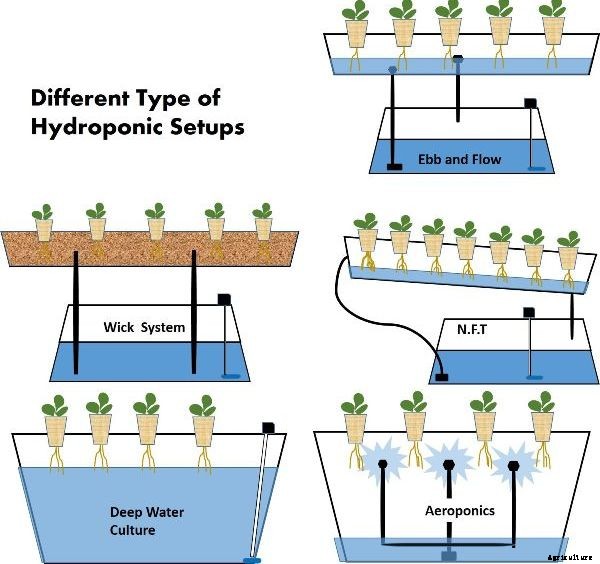
There are various techniques or types of deploying a hydroponic farm: the wick system, water culture, ebb, and flow system, drip system, nutrient film technique, and the aeroponic technique. A basic system of hydroponics may require the following equipment which may change depending on the size of the farm and the technique being used.
HYDROPONIC FARMING COST AND PROFIT – MATERIALS REQUIRED FOR HYDROPONIC FARMING:
The most important requirement of this system of farming is the nutrient solution and it is easily available at gardening centers. The nutrient solution should be a blend of important elements such as nitrogen, potassium, calcium, magnesium, etc. the nutrient solution to be used changes with the type of crop being cultivated.
Hydroponic farming can be done either with a medium or without the medium. Rock wool is the widely used medium because it is affordable and drains easily. Other mediums that can be used for farming are the clay, vermiculite, sand, gravel, and Perlite. Water circulation is not easy with sand gravel and clay as they are heavy but easily available. Perlite and vermiculite are effective.
Light is also an important factor for photosynthesis and the growth of plants. High-density discharge lights can sometimes be used during farming when adequate sunlight is not available. The use of light from various sources has different effects and is therefore used according to the plant type. Light from metal halides is used for young and green leafy plants. For fruit and flowering plants light from high-pressure sodium, lights are used.
The monitoring of the pH levels in the nutrient solution is also equally important because it specifies the acidity or alkalinity of the environment. A pH test meter is used to check the levels of the solution.
HYDROPONIC FARMING COST AND PROFIT – LIST OF PLANTS CULTIVATED USING HYDROPONIC FARMING:
The list of plants mentioned here is the ones that can be easily grown in a hydroponic system. The root plants are difficult to be cultivated in a hydroponic system. The list is not limited to these vegetables.
Greens: Spinach, chard, cabbage, lettuce, celery, mint, etc.
Vining plants: Tomatoes, Cucumbers, peas, etc.
Root plants: Potatoes, carrots, radish, etc
Fruits: raspberries, strawberries, small papaya, peppers, blueberries etc
Herbs: basil, parsley, rosemary, chives, sweet marjoram, watercress, dill, etc
HYDROPONIC FARMING COST AND PROFIT – ESTIMATION OF COST IN HYDROPONIC FARMING:
An example estimate for farming tomatoes in a hydroponic greenhouse (3072 square feet) set up is given here. The cost of the equipment and facilities may vary depending on the location and dimensions of the site. The fixed costs include the investment for the greenhouse structure and the setting up of the environmental control equipment.
20% maintenance of the total costs annually
12,821.76
2564.35
Generator for a single bay 4,000 Cooling equipment for a single setup
1,850 Horizontal air fans 1,000 Electrical panel setup 1,500 Environmental control equipment and other miscellaneous building needs 4,000 Heaters, Poly inflation kit, low voltage wiring package, and protective equipment 2,525 Total equipment cost annually
20% of the equipment cost amount to the maintenance of the equipment
14,875
2,975
Growing and delivery equipment cost include sprayer @ $ 100/unit, carbon di- oxide generator @ $ 480/ unit, pump @ $ 30/unit, feeding system, cooler and transport 11,810 EC meter @ $ 160/unit, pH meter @ $ 50/unit, thermometer @ $ 25/unit, humidity sensor @ $ 120/unit, CO2 sensor @ $ 500/unit, measurement scales @ $ 100/unit 955 Total costs annually
20% of the total cost is spent on maintenance
12, 765
2,553
TOTAL ANNUAL FIXED COSTS IN $ 8192.35
The variable cost for hydroponic farming is calculated on production supplies, labour, packaging, utilities, and other marketing needs. Per unit value of the item may change depending on the demand and location of the market. A rough estimate of each unit is mentioned here to determine the overall cost of the production.
SUPPLIES FOR PRODUCTION ANNUAL COST in USD ($) Beneficial insects include (lacewing, 6 packs @ $ 36/ pack; Encarsia Formosa, 3 packs @ $ 23/pack; aphidus colemani, 1 pack @ $ 48/pack; bees, 3 hives @ $ 75/hive) 558 Fertilizers ( blended mix 429 pounds @ $ 1 /pound; calcium nitrate 429 pounds @ $ 0.4/pound; additional mix 7 pounds @ $ 1/pound; pesticides 7 gallons @ $ 7/gallon; sanitizer 1 gallon @ $ 35/gallon; Rockwool cubes 1 case @ $ 159/case; Rockwool slabs 29 bags @ $ 62/bag) 2,673 Seeds I pack @ $ 107/pack 107 Seedling support mats, I mat @ $ 114/mat 114 10 trays @ $ 1 /tray , sticky traps 1 pack @ $ 30/pack 40 1 case of clips @ $ 83/case, 1 twine box @ $ 22/box, 800 hooks @ $ 0.15/hook 225 Total cost in $ 3,717.72Labour cost for the production depends upon the working hours and the pay per hour of work which may range between 5 hrs/year to 590 hrs/year.
Average annual working hours 759.5 @ $ 8.4/ hour: $ 6425.82
Utilities such as fuel, electricity, water, etc may be charged according to the location of the hydroponic farm. Different countries and places have different rates for using 1 kilowatt of power per hour. Also, the fuel price may vary from place to place.
UTILITIES COST in USD ($) Natural gas 545/1000 cubic feet @ $ 10/ 1000 cubic ft 5,450 Electricity for fan and lights 12500 kilowatt-hr @ $ 0.08/kwh 1,000 100000 gallons of water 170 Other charges like telephone etc 1,080 Total cost in $ 7,700PACKAGING COST in USD ($) 17 label rolls @ $ 30/roll, 66 cases of foam trays @ $ 31/case and 1970 boxes @ $ 0.65/box 510+2046+1280.50 Total costs in $ 3836.50
Other Miscellaneous costs include advertising, office supplies, laboratory fees, internet service, marketing, training, software, etc and amount to,
Miscellaneous costs: $ 2870.00
Accountant and lawyer charges: $ 750 (approximately).
Land rent charges: $ 100/acre.
Total variable costs: $ 25300.05
From the above data it is derived that:
ANNUAL FIXED COSTS ARE: $ 8192.35
ANNUAL FIXED PLUS VARIABLE COSTS ARE: $ 33,492.40
NO OF PLANTS IN THE SYSTEM: 691
NUMBER OF FRUITS PER PLANT: 30 POUNDS (WITH 5% WASTAGE)
ANNUAL POUNDS FOR SALE PER YEAR: $19,694
PRICE OF EACH POUND OF FRUIT: $ 1.80
TOTAL RETURNS ANNUALLY: $ 35,448.30
Therefore the profit on the investment is estimated by deducting the annual costs from the annual returns.
HYDROPONIC FARMING COST and PROFIT – TOTAL PROFITABLE RETURN ON THE INVESTMENT IN HYDROPONIC SYSTEM IS: $ 1955.90
This system describes the production of tomatoes but farming of different vegetables and fruits may deliver different outputs. The profit margins may also change depending upon the demand for the produce in the market and the hydroponic farming system’s production capability. The above-mentioned figures are just given to understand the structure of the investment and help beginners to draw up their business plans.
In case if you are interested in this: How To Grow Organic Lettuce.


