
Welcome to Modern Agriculture!

INTRODUCTION TO MUSHROOM FARMING PROJECT REPORT:
Mushrooms are a type of fungi, which are consumed as food. Mushroom consumption and cultivation are old practices started some thousands of years ago. 20 different species of mushrooms are commercially cultivated around the world. Mushrooms have gained recognition in the food chain because they contribute nutrient supplements to the food and have high medicinal and pharmaceutical value. Mushrooms are believed to have high protein content and sometimes are known as ‘vegetable meat’. They have very low levels of carbohydrate and fat. Mushrooms also contain polysaccharides, vitamins, and minerals comparable to other fruits and vegetables. The second major importance of mushroom is its wide use in preparing medicines. The acceptance of mushroom medicine in the form of tablets and capsules along with greater customer satisfaction has increased the demand for the mushroom industry further. Overall, there are 2,000 different varieties of macrofungi which are considered as edible out of which 80 varieties are in economical cultivation. The white button mushroom is a commercially cultivated variety throughout the world contributing to 40% of the total mushroom production market. Valley regions are suitable for button mushroom cultivation and the materials required are easily available in the local market. The cultivation of mushroom on a commercial scale requires both indoor and outdoor preparations. Outdoor preparations include wetting of the substrate and compost preparation. Generally, the spawn-run and crop production is done in the valley areas from mid-February to mid-May and from September to November by maintaining a temperature range of 22-25˚C for the first 15 days of the cycle. ‘Bukharies’ are locally made stoves used to maintain the temperature by heating sawdust. The compost preparation for the first crop should begin in the first week of January and the second crop at the end of July. The conditions required for mushroom farming are:
The process of mushroom farming involves compost preparation, spawn-run, casing, and harvesting. Let us discuss Mushroom Project Report, cost and profit analysis at the bottom of this content.
MUSHROOM FARMING PROJECT REPORT – PREPARATION OF THE COMPOST FOR MUSHROOM FARMING:
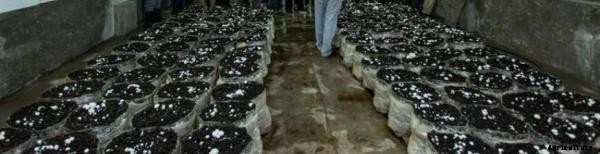
The compost is used as a substrate for growing white button mushrooms. Compost preparation involves decomposition of organic material by microbes, protein synthesis and fibre conditioning for better absorption and moisture retention. Straw is used as a base material for mushroom farming. These days synthetic substrate made from the low -cost agro- wastes such as the maize straw, paddy husk, leaves of mulberry etc. are being used. Carbon to nitrogen ration should be 17:1 in good compost. Organic sources provide all the required supplements and have a better heating capacity, but it is important to provide adequate nitrogen content also. Wheat flour, rice bran, molasses, etc. are good organic sources of nitrogen. Urea, ammonium salts and cyanomide are good inorganic sources of nitrogen. The compost should have water, air and dry matter in a certain proportion to facilitate heating. SKUAST-K is a technology that produces a synthetic substrate for quality mushroom farming practices. Mushrooms, in general, are grown on decaying organic matter and there are three types of systems which are considered for growing mushrooms.
Saprobic: these fungi grow on dead organic matter.
Symbiotic: these fungi grow with other organisms.
Pathogenic or parasitic: these fungi inhibit disease in plants.
Selection of species for mushroom farming is of great importance because not all mushrooms grow on the same substrate and climatic conditions. It is believed that mushroom farming is not suitable in tropical regions due to high temperatures. Therefore, while selecting the species for mushroom farming certain factors have to be considered.
The commonly grown species of mushrooms are:
MUSHROOM FARMING PROJECT REPORT – COMPOST PREPARATION METHODS:
Compost preparation can be done in two ways: the long method (35- 40 days) and the short method (22-26 days).
The long method of compost preparation needs the following steps:
Read: Button Mushroom Cultivation; Compost Formula.
The process of compost preparation by a short method involves:
MUSHROOM FARMING PROJECT REPORT – THE VEGETATIVE GROWTH OR SPAWN-RUN IN MUSHROOM FARMING:
Sterilized wheat grains are used to prepare the spawn. The quality of the mushroom greatly depends on the purity of the spawn used. The addition of spawn to the compost is done at a rate of 0.5% by weight. The growing medium can have different spawning methods such as a double layer, top layer, through shake up and spot spawning. Spawns from the growing areas show faster growth when compared to spawns stored at 2 ˚C.
MUSHROOM FARMING PROJECT REPORT – THE PROCESS OF CASING IN MUSHROOM FARMING:
Adding an inert material to the top layer of the compost is called ‘casing’, which promotes the spore-bearing structure to the mushroom. The casing is done after 2 weeks of spawn-run and the casing layer is 3.8 – 5 cm thick. The casing layer should either be neutral or alkaline nature. Casing helps to retain water within the area. The fruiting in button mushroom is observed due to the release of iron by Pseudomonas putida bacteria which stimulates the process. Varieties of casing soil are:
Sterilizing the casing soil is important to prevent the growth of micro-organisms in the soil. Heat or chemicals can be used to sterilize the soil. Steam is also used sometimes to perform sterilization. The temperature is maintained at 60 ˚C for 5 hours. 2% formaldehyde is used as a chemical sterilizing material. Soil solarisation is another method to sterilize the soil by controlling the growth of parasitic moulds. The casing material is spread on a plastic sheet with 5 cm of thickness and water is sprayed just to dampen it. For 30 days it is kept covered with a polythene sheet. The casing material should be evenly spread over the substrate to prevent the mycelium from coming up and form stoma which may otherwise cause problems during the pin head formation in mushrooms.
MUSHROOM FARMING PROJECT REPORT – THE PROCESS OF HARVESTING IN MUSHROOM FARMING:
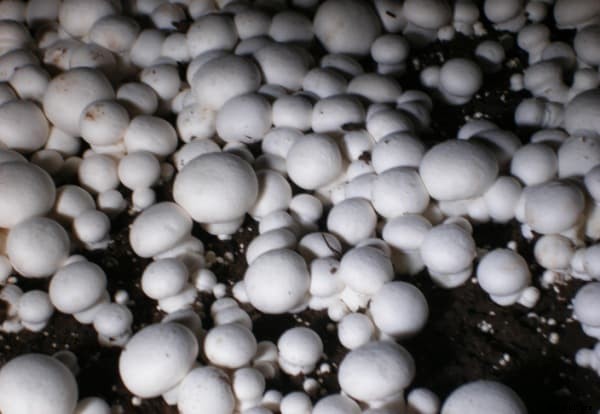
At the fruiting stage, air temperature is maintained at 16 – 18 ˚C with CO₂ concentration at 1000 ppm. Also, humidity is maintained at 70 – 80% by spraying water. There should be sufficient flow of air and excessive humidity should be avoided. The volume of mushroom in the room is directly proportional to the amount of fresh air needed in the room. The first flush of mushroom can be observed after about 3 weeks of casing the substrate and flushes occur at an interval of 7 days. Once the pinheads appear, it takes 7 to 8 days for the button mushrooms to develop. Precautions like excess humidity control, too much watering, etc. should be taken care so as to avoid disturbance in the cropping area.
The harvesting of mushrooms is handled in a gentle way. The mushrooms are turned either clockwise or anti-clockwise and then pulled softly, else they are cut using a sharp knife if the mushrooms are surrounded by pinheads. The area from where the mushrooms are picked should be immediately replaced by sterilized soil. The substrate bed should be levelled and the casing should be done if disturbed. Generally, one large farm can generate 4 to 5 flushes of mushrooms. The mushrooms produced in the first flush are of good weight and quality. Mushrooms have a low shelf life so they are either dried or sold fresh in the market.
MUSHROOM FARMING PROJECT REPORT – DISEASE AND PEST MANAGEMENT IN MUSHROOM FARMING:
The different diseases and their control measures in mushroom farming are:
Insects, mites, and nematodes are the main pests that affect commercial mushroom farming. They can be dealt with the following methods.
MUSHROOM FARMING PROJECT REPORT – ECONOMICS OF MUSHROOM FARMING:
Seasonal cultivation of mushroom is done by creating small sheds over a specified area. The size of the shed discussed here is 60’ x 30’ approximately.
The requirements for making the shed are outlined here; the cost of materials may vary depending on the location of the farm and quality of the material used. The figures in Rs mentioned here are a rough estimate of the investment that is required to start a mushroom farm.
SHED MATERIAL QUANTITY PRICE PER UNIT (IN Rs) TOTAL COST (INR) Bamboo Poles (length 12’, width 3”) 100 120.00 12,000.00 Bamboo Poles (length 10’, width 2.5”) 220 110.00 23,200.00 Bamboo Poles (length 10’, width 1”) 280 100.00 2800.00 Straw from the paddy fields 1 tonne 4500 4500.00 Sutli (twine ) 10 kg 300.00 3000.00 Polythene sheets 35 kg 180.00 6300.00 Total material cost of the shed (fixed assets) 51,800.00The investment model for acquiring the raw materials for substrate preparation, casing and labor are outlined here.
COMPOST MATERIAL QUANTITY IN Kg PRICE PER Kg (IN Rs) TOTAL PRICE (IN Rs) Straw of wheat 6000 8.00 48,000.00 Poultry manure 3600 2.20 7920.00 Urea 140 10.00 1400.00 Sunflower cake 480 15.00 7200.00 Wheat Bran 300 15.00 4500.00 Gypsum 1000 9.00 9000.00 The total cost of compost material 78,020.00Other investments which can be generally used for one crop cycle are given here
Casing soil, 2000 kg @ Rs 2.5/kg: Rs 5000.00
100 spawn @ Rs 70/kg costs: Rs 7000.00
The cost of 6 labour persons @ 300/day: Rs 30,000.00 (for fifteen days)
Other charges like transport, etc.: Rs 10,000.00
Mushroom Farming Project Report – Total charges amount to Rs 52,000.00
Mushroom Farming Project Report – Total investment in mushroom farming is: Rs 1, 81,820.00
There is a 12% and 5% interest and depreciation charged on the fixed assets which amount to Rs 8806.00
So, the total investment is summed up to: (Rs 1, 81,820.00+ Rs 8806.00) Rs 1, 90,626.00
3000 kg of mushrooms are produced per shed and sold @ Rs 100/kg: Rs 3, 00,000.00
Therefore,
The total profit generated in mushroom farming can be estimated as Rs 1, 09,374.00
Farming of mushrooms is believed to impact the livelihood of people positively by contributing to economic, nutritional and medicinal sectors.
MUSHROOM FARMING PROJECT REPORT – SUBSIDIES AND LOANS FOR MUSHROOM FARMING PROJECT:
For spawn units, compost preparation and training – 100% assistance for public sector and 50% of total cost for the private sector in the form of subsidy (maximum subsidy Rs 50 lakhs).
Spawn production units – 100% of total cost for the public sector and 50% for the private sector (maximum subsidy Rs 15 lakhs).
Compost production unit – 100% of the cost to the public sector and 50% of the cost to the private sector (maximum subsidy Rs 20 lakhs).
Pioneer Mushroom Consultancy
No. 100, Neeladri Layout, Electronic, Bangalore,
Karnataka, India – 560100
Contact No’s: Mobile: +91-9611593357
Land Line: 08042785093
Establishing a commercial Mushroom Farming Project is easy and profitable.


