
Welcome to Modern Agriculture!

CASHEW NUT FARMING PROJECT REPORT – INTRODUCTION
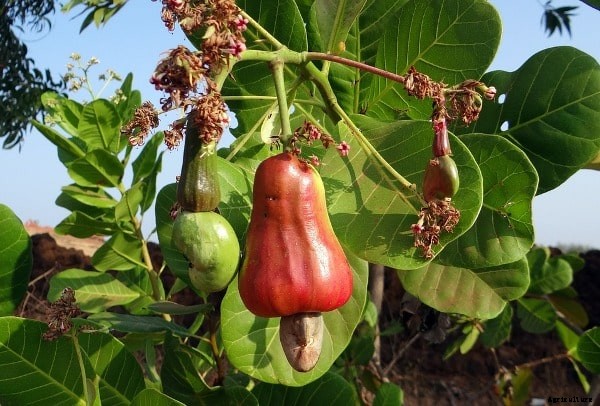
Cashew is produced from a tropical evergreen tree, which is native to north-eastern Brazil. The tree is known to have existed since the 16th century and was brought to India by the Portuguese. It is now cultivated in 28 countries having tropical climate. The fruit and the nut of the tree are both considered edible and have high nutritional value with a delightful taste. The fruit of the tree is called the pseudocarp. The trade of edible nut produced from this tree ranks second in the international market. The nut hangs below the fruit and it is curved in shape. The tree of cashew has a limiting factor such that it cannot tolerate frost and cold climate for a longer period of time. The life of a cashew tree is almost 60 years. The annual production of the raw nut on a global scale is 37.2 lakh tonnes produced in an area of 40.97 lakh hectares. The cashew nut farming was initially practiced to control soil erosion, but later on it emerged to become a major product for international trade. The cashew nut farming project report highlights the plant details, its importance, scope of development, its varieties, farming methods and requirements, cost and profit analysis and finally the support given by organizations to undertake cashew nut farming.
CASHEW NUT FARMING PROJECT REPORT – PROPERTIES OF THE PRODUCT
The cashew tree produces three things, which are traded on the international market: the nuts, the fruit and the nut shell liquid. The cashew nut is considered to contain carbohydrates, fibre, protein, calcium, magnesium, phosphorous, potassium, sodium, zinc, vitamin B & C, small quantity of DFE folate and fat.
The fruit of the cashew tree contains a chemical on the skin called urushiol, which gives it a sweet astringent taste. People, who consume the fruit, initially steam it and wash it in cold water to remove the waxy substance from the skin. The apple/fruit of the cashew is consumed fresh, cooked or is fermented to form vinegar or alcoholic drinks.
The oil produced from the shell is a yellow colored resin and is composed of anacardic acids (70%), cardol (18%) and cardanol (5%). This oil from the cashew nut is used in preparing drugs, antioxidants, fungicides and biomaterials.
CASHEW NUT FARMING PROJECT REPORT – PLANT CHARACTERISTICS
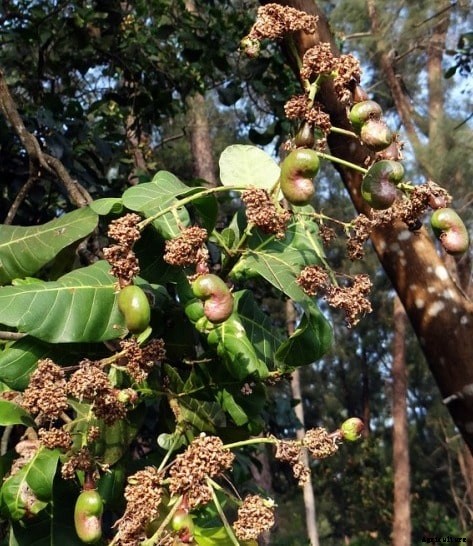
Identifying a cashew tree with these specifications would be easy.
CASHEW NUT FARMING PROJECT REPORT – VARIETIES OF CASHEW NUT
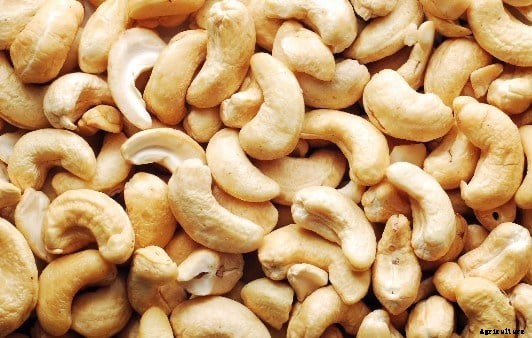
Various research organizations in India have developed more than 30 varieties of cashew nut to be farmed at different regions and achieve practically good yield. The mean yield of all these varieties is 8 to 10 kg of cashew nuts per tree, i.e. one tonne of nuts per hectare of land.
CASHEW NUT FARMING PROJECT REPORT – CULTIVATION DETAILS
CASHEW NUT FARMING PROJECT REPORT – SOIL AND CLIMATIC CONDITIONS
The most suitable temperature for farming cashew is 30 to 38˚C with a relative humidity greater than 50%. Any region with hot, humid tropical weather conditions is congenial for the cultivation of cashew. The minimum altitude requirement is 700 m above the sea level. The plants don’t require heavy rainfall conditions. During the yield season, dry climate for four months is much favorable. The annual rainfall requirement for the cashew crops is 1000 to 2000 mm. Cashew plants can adapt themselves to any type of climate without affecting the productivity. The best soil suitable for this crop is well drained sandy loam soil with a hard pan. Also red sandy loam soil, lateritic soil, sand of coastal areas and soil with acidic pH are all suitable for the cultivation of cashew. Clayey soil, soil with pH more than 8 and soil with poor drainage facilities are not suitable for cashew plants. Flood and water stagnation can have bad impact on the cashew plants.
CASHEW NUT FARMING PROJECT REPORT – LAND PREPARATION AND PLANTING
Even before the pre-monsoon showers the land being used for cashew farming should be cleared thoroughly. Cashew plantations can have three different planting arrangements, such as square, triangular or rectangular.
CASHEW NUT FARMING PROJECT REPORT – PROPAGATION TECHNIQUES
Multiplication of plants can happen either through seeds or by vegetative methods. The selection of the propagation method is highly important for the cultivation of cashew. Commercial cultivation of cashew requires cross pollination and vegetative propagation. The traditional method of farming cashew involved the planting of seeds such that 3 seeds were planted in a single pit. Now, vegetative propagation by different methods is being practiced. Practically soft wood grafting is a commercially best method of cashew cultivation. The other methods are:
CASHEW NUT FARMING PROJECT REPORT – MANURE AND FERTILIZER REQUIREMENTS
Cashew plants respond well to the application of manure and fertilizers. These compounds are applied at various stages of the plant. Manure is applied during the first 15 days of planting. Fertilizer is applied to the plant at the base with a radius of 22.5 m and depth of 15 cm. The fertilizer quantity of the 1st year of planting per plant is 50 g of urea, 175 g of rock phosphate and 85 g of muriate of potash. Similarly the nutrients for the plant during 1st year of planting are 15 kg of FYM, 250 g of nitrogen, 50 g of P₂O₅ and 50 g of K₂O. If cashew is being cultivated as organic plant then nutrients are supplied in the form of oil cakes, green leaf compost, vermicompost, poultry manure etc.
CASHEW NUT FARMING PROJECT REPORT – IRRIGATION REQUIREMENTS
Cashew plants are basically rain fed variety. The plants require water for up to 3 years. Irrigation during the flowering and fruiting increases productivity and quality. When cashew is being cultivated in sandy soils, then irrigation is needed during summer months. Proper drainage should be provided to avoid water stagnation. Drip irrigation with drippers at a distance of 1 m from the crop during the flowering months (second fortnight of December to march) is observed to produce higher yields.
CASHEW NUT FARMING PROJECT REPORT – INTERCROPPING OF PLANTS
In the beginning for about 3 or 4 years other crops can be cultivated in the space between the cashew plants. Commonly cultivated intercrops are turmeric, groundnut, chillies, papaya, bhendi etc. This intercropping facilitates extra income to the farmers.
CASHEW NUT FARMING PROJECT REPORT – OTHER INTERCULTURAL ACTIVITIES
CASHEW NUT FARMING PROJECT REPORT – PEST AND DISEASE MANAGEMENT
The common pests which destroy the cashew crops are:
The plants of cashew are not affected by any serious disease except the powdery mildew, which can be controlled by spraying 2% sulphur.
CASHEW NUT FARMING PROJECT REPORT – HARVESTING THE CROP
The best harvest is obtained from the 4th year of planting. Harvesting should be done from February till May. The harvest of the crop depends on the varieties used for planting and it is observed that the trees give complete yield almost in the 10th year and it keeps increasing until the tree reaches 20 years. Fruit of the tree is removed and the nuts are separated. Harvesting is done on a weekly basis and on a clean land.
CASHEW NUT FARMING PROJECT REPORT – POST HARVEST REQUIREMENTS
Once the harvest is done the cashew is processed through the following methods:
Manual picking is done and the nuts are cleaned. Open pans or hot oil bath is done to clean the nuts. The roasting of nuts using the rotary method is efficient and hygienic. Manual shelling recovers the kernels as a whole and then they are air dried in hot chambers to facilitate peeling. Kernels that are sound are called whole kernels and that which are broken are called splits. Again the grading is done as white, scorched, dessert, etc. The whole nuts are graded differently and the splits are graded differently. The cashews are packed by the Vita Pack Method, which involves removing the air from the packing tin and pumping CO₂ and sealing the pack.
CASHEW NUT FARMING PROJECT REPORT – PRODUCTION TRENDS/YIELD
Analysis of the production based on the variety of cashew plant is helpful for the farmers understand the profit related to the cashew farming. The yield from different varieties is as shown:
The production of the nut also depends on the type of planting such as the normal planting (spacing: 8 m x 8 m) produced 737.88 kg/ha in the Bhaskara variety, whereas the yield was higher in the high density planting (spacing: 5 m x 5 m) i.e. 1882.54 kg/ha for the Bhaskara variety. The high density farming is not being adopted due to lack of awareness.
CASHEW NUT FARMING PROJECT REPORT – ECONOMICS (COST AND PROFIT ANALYSIS)
The model of cost and profit structure discussed here is just for a basic idea of investment. The actual cost may vary for different places using different varieties of cashew for cultivation. Also there could be hidden cost for the processing of the product. The amount mentioned here is a rough data estimated for farming, the practical values may fluctuate based on the market and the location. The data is estimated for 1 hectare of land.
Labour cost per day is: Rs 200 – Rs 300.
The cost of 1 kg of manure is: Rs 2.5.
Cost of 1 kg of fertilizer: Rs 40-50.
Cost of fencing material: Rs 45/meter of wire.
Cost of planting material: Rs 30-35/seedling.
MATERIALS AND LABOUR INVESTMENT (IN Rs) 1st year Investment in the 3rd year (Maintenance) Preparing the land 8,000.00 – Creating the pits 5,000.00 – Planting material 6,000.00 – Planting and staking 3,000.00 – Cost of farm yard manure 5,000.00 5,000.00 Fertilizers cost 1,500.00 3,000.00 Application of manure and fertilizer 3,000.00 3,500.00 Irrigation 2,000.00 4,000.00 Pesticides and insecticides 2,500.00 2,500.00 Application of pesticides and insecticides 3,000.00 2,000.00 Intercultural activities 2,500.00 4,000.00 intercropping 6,000.00 – Fencing cost 10,000.00 – Harvesting – 2,000.00 Total investment into farming 57,500.00 26,000.00Number of plants per hectare of land is: 178 (this may vary depending on the spacing between plants).
The production of raw cashew nuts after 3 years of planting is: 178 kg (the yield subsequently increases every year).
The cost of 1 kg of raw cashew nut: Rs 170.00.
The total cost of 178 kg of raw cashew nuts is: Rs 30,260.00.
The profit earned in the 3rd year of planting is: (maintenance charges – income generated) = (Rs 30,260 – Rs 26,000) = Rs 4,260.
The profit from the cashew cultivation may change depending on the yield of the tree and the quality of the product. The local market demand should also be considered for the above estimation.
Please note that processed product has a different rate in the market and the raw cashew nut has to be processed accordingly to obtain the nut.
The profit from the cashew cultivation may change depending on the yield of the tree and the quality of the product. The local market demand should also be considered for the above estimation.
CASHEW NUT FARMING PROJECT REPORT- LOANS AND SUBSIDIES
CASHEW NUT FARMING PROJECT REPORT – HIGH DENSITY METHOD FOR CASHEW NUT
High density planting technology is for using the available land intensively and obtaining higher productivity. This method is good for areas where the soil is not very fertile and the plants take more time to grow and form the canopy. As the name indicates this method of farming involves planting of more saplings per unit area. The normal planting type accommodates 200 plants per unit area, whereas in high density planting the density of plants in a unit area varies from 312 to 625 depending on the spacing. The high density planting can be practiced for a period of 7 to 10 years. In this method the requirement of nutrient supply to the plants should be intensive; there should be proper pruning and irrigation availability. With this method, it has been observed that the cashew plants yield four times more than the normal method for at least 7 years. Beyond that the yield decreases gradually. This method is useful for conserving the soil, retention of moisture in the soil, controlling the weeds etc.


