
Welcome to Modern Agriculture!

The following is all about Mosambi Cultivation (Sweet Lime), Cost, and Profits.
Mosambi is one of the sweet oranges grown for its pulp and juices. Commercial cultivation of Mosambi fetching excellent yields under ideal cultivation practices. Mosambi belongs to the family of “Rutaceae” and is the 3rd largest fruit produced in India. Mosambi is a small tree that can reach a height of up to 20 to 25 feet. This tree has irregular branches and relatively smooth, brownish-grey bark. Mosambi has lots of and leaves of Mosambi are compound, with acuminate leaflets 6 to 17 cm long and 3 to 8 cm wide. Mosambi flowers are white with excellent fragrance. Usually, Mosambi fruits are green and become light yellowish on ripening.
For commercial Mosambi cultivation, a dry climatic condition with about 60 to 75 cm of rainfall from June to September is required. It also needs well-defined summer and winter seasons.
Mosambi plants thrive well in well-drained red soils or loamy soils. The soil pH should be between 6.5 to 7.5 for optimal growth and higher yields. If you are planning to cultivate Mosambi on large scale, a soil test should be carried out. Mosambi plants are sensitive to waterlogging hence well-drainage should be provided otherwise root rot will kill these plants.
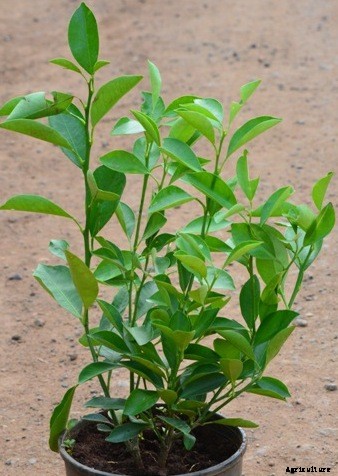
Propagation of Mosambi is done by budding (budded plants). Nursery-raised rootstock is transplanted in the main field.
The time of planting Mosambi depends on the region and climate. Usually, in south India, Mosambi is planted from October end to January.
The field should be prepared well by giving a couple of ploughings. Land should be levelled and brought to fine tilth stage. Any weeds and rocks should be removed as part of land preparation. Pits should be prepared with a dimension of 3 feet x 3 feet x 3 feet (Width x Length x Depth). The pit-to-pit or plant-to-plant distance should 20 to 22 feet. A row-to-row distance of 20 to 22 feet should be maintained. It is recommended to expose these pots for sun couple of weeks before actual planting starts. This can comfortably accommodate a plant density of 85 to 90 plants. High-density planting of Mosambi is possible in hilly areas. It is better to plant good distances as these trees go very big and occupy a good radius.
You should purchase high-quality, disease-free Mosambi plants from certified nurseries to transplant in your prepared field. These seedlings/saplings should be at least 2 years of age (grown in nursery beds, usually Rootstock is raised in nurseries).
Place the saplings at the center of the pits and cover them with topsoil. Irrigate the plant base immediately.
Immediately after planting the saplings of Mosambi, watering should be done for proper root establishments. The frequency of irrigation depends on climate and variety and soil type. The Rangpur Mosambi variety is little tolerant to drought conditions can survive even if you provide irrigation than recommended intervals. Usually, you should ensure soil moisture at the plant base. Mosambi garden does not require any water in monsoon season, however, in winter, irrigation should be carried out every 3 to 4 days and in summer every alternate day. Avoid too much watering as these pants cannot tolerate waterlogging. Most commercial Mosambi farmers adopt a drip irrigation system for best yields and plant growth. You can get a subsidy for a drip system from the local horticulture department.
Pruning is a process of removing unwanted leaves/branches/stems. Pruning of Mosambi has to be done for straight growth and to form a strong framework of the plant. Pruning is done to encourage new growth. For proper growth of the trunk, Remove the shoots in 50 cm to 60 cm near ground level. The Centre of the Mosambi plant should remain open. Make sure to remove water suckers at the early stages of plant growth.
Nitrogen should be applied in 2 doses during March and October. However, Farmyard manure like cow dung, Phosphorous, and Potash should be applied in the month of October.
Manures and Fertilizers I year (kg)/plant Annual increase (kg)/plant From 6th year (kg)/plant Well decomposed farmyard manure (FYM) 10 5 30 N (Nitrogen) 0.2 0.1 0.6 P2O5 (phosphorus) 0.1 0.025 0.2 K2O (Potash) 0.1 0 0.040 0.3Manures should be applied in the basin 75 cm away from the trunk and incorporated in the soil. Solution containing Sulphate of Zinc (0.5%), Iron (0.25%), Magnesium (0.5%), Manganese (0.05%), Boron (0.1%) and Molybdenum (0.003%) should be sprayed once in 90 days at the time of new flush production. In addition to that apply 50 grams in each of Sulphate of Zinc, Manganese, and Iron/tree/ year.
Mosambi plants are prone to pests and diseases.
Mosambi plants start flowering after 3 years of plantation. You should remove this flowering for better and string fruiting for next year. You can start getting yield from the 4th year of planting. You can manually harvest by using any sharp sickle. You can get two harvests in a year one from April to May and the other is in August to September. Usually, Mosambi fruit turns green to light yellowish color on maturity. Don’t allow fruits to ripen fully on the tree.
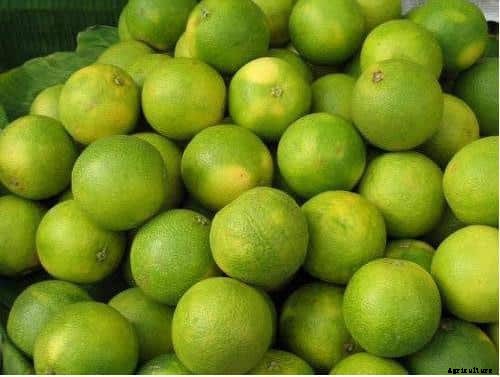
The yield of Mosambi crop depends on soil type, variety, irrigation, plant age, season, and other crop management practices. You can get crop 2 times a year (April- May, and August-September). You can expect commercial yield only after the 4th year of plantation. during the initial years, you can get 60 kg/plant or 5 tonnes/acre. After the 5th year, yield increases to 100 kg/plant or 9 tonnes /acre. You can expect peak (maximum) yields in 10-year-old plantations. The economical lifespan of Mosambi is about 20 years. During last year’s, you can observe reduced yields.
Harvested Mosambi fruits should be cleaned, graded (on size and color), and packed to transport to local fruit markets. Sometimes, you can find fruit selling agents who can buy in bulk at the farm gate.
When it comes to the economics of Mosambi cultivation, profits always depend on market demand and yielding time. Especially those who get the early crop can get good profits.
Now let us calculate 5 acres Mosambi cultivation cost and profits.
Assumptions:
Land: 5 acres (Own) with drip system.
Plant age: 5 years (after planting in the field). (Note the crop yield doubles as the plant grows further).
Note: After the 5th year, you can expect fruits of 9 tonnes/acre or 100kg/plant.
In case if you are interested in this: How To Grow Organic Lettuce.

