
Welcome to Modern Agriculture!

Breeding new varieties is tricky at best, and garlic has been vegetatively propagated for millennia. Each garlic plant is grown from a clove of a parent plant, effectively creating a clone each generation. But is it possible to breed garlic in your own backyard?
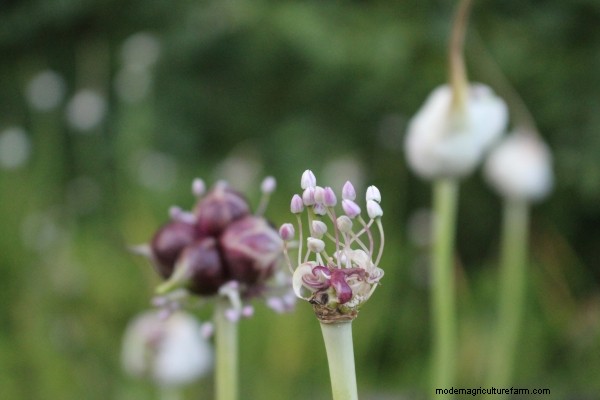
Garlic flowers from inside a garlic scape
Last winter I spent countless hours pouring over Will Bonsall’s Guide to Radical Self Reliant Gardening. It’s packed with a wealth of gardening, homesteading and permaculture knowledge that I just haven’t found anywhere else.
He’s been out there living the life for decades, and with minimal external inputs. He even grows his own oilseed, and what he can’t grow, he just does without.
It quickly became my all-time favorite homesteading book, and I read it cover to cover at least 3 times over the course of three months.
I marked many pages, but one, in particular, had me irrationally excited. While garlic generally reproduces asexually through division of bulbs, or through topsetting bulbils within the scapes at the top of the main stalk, they do apparently have an additional option for cross-pollination.
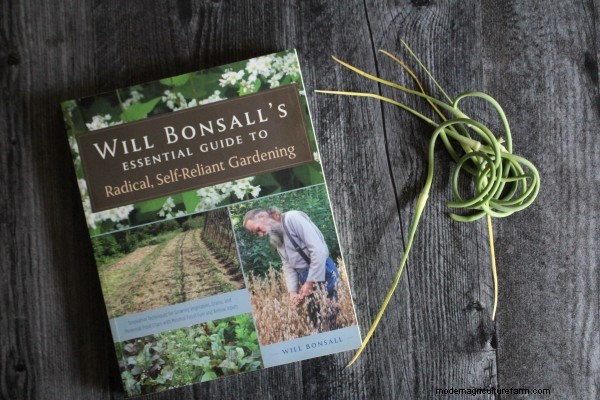
Will Bonsall makes mention of sexually reproducing garlic flowers hiding inside garlic scapes:
“It’s not wholly true that garlic rarely engages in sex. When you look at a cluster of bulbils, especially very early in their formation, you’ll often notice a tiny floret or two scattered among them. These are actually sexual flowers, and might ripen and produce viable seed (of a new variety even), except that they are soon overwhelmed and aborted by developing bulbils around them. If you can spot these sexual and asexual organs when they are first developing and gently excise the nascent bulbils (with a tweezer perhaps, or a very sharp carpet knife) before they can compete, there’s a chance, albeit slight, that some of the sexual flowers may get pollinated and grow to mature seed. Alliums are generally self-sterile, which is probably why the rate of takes is so discouragingly low.”
He goes on to say that he hasn’t actually tried breeding his own garlic seed because as he says, “I have no time for this sort of nonsense; I’m far too occupied as it is. I only urge you to dabble in this, in the hope that you will develop something new to share with me and everyone else.”
I’m not going to pretend that I have a lot of free time, I have two toddlers at home and 30 acres to tend…but the day I can’t dabble in a bit of foolishness to satisfy my curiosity I might as well already be dead. Garlic flowers!?!?! I just had to see them.
We grow a lot of garlic, and harvest scapes by the bucketload in the spring, so leaving a few behind for science is no big deal.
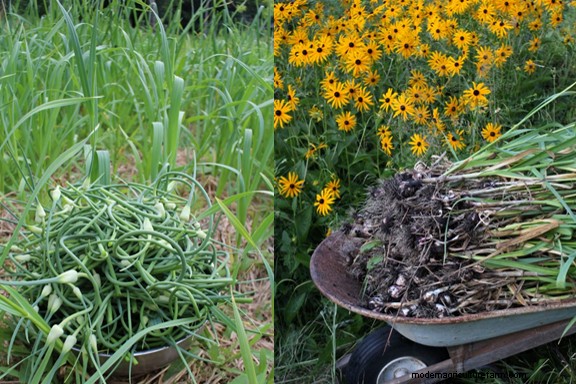
Garlic scape (left) and garlic harvest (right) from just one of our garlic beds.
Generally, garlic scapes are removed to encourage the plants to form large bulbs. I often leave the scapes so I can harvest the top setting garlic or garlic bulbils. Until now, I’ve called those “garlic seed” because they can be planted as well.
We plant the bulbils and harvest full-sized garlic 2-3 years later in large perennial garlic patches, and it’s an excellent lazy gardener’s solution to growing garlic. (It also allows you to leave in permanent garlic patches, which helps reduce pests for other plants, especially around fruit trees.)
The one thing I’d never done though, was torn open an actual garlic scape early on in its developement. There are tiny flowers in there? Really?!?!?
Breeding your own garlic isn’t exactly all that practical, but I’m a huge nerd, and I desperately wanted to see garlic flowers. It’s completely irrational, but I just couldn’t wait. It’s like a secret treasure that’s been hiding in there all along.
I’ve been planting garlic for a decade, and I’ve seen thousands of scapes…but never once have I laid my eyes on a garlic flower.
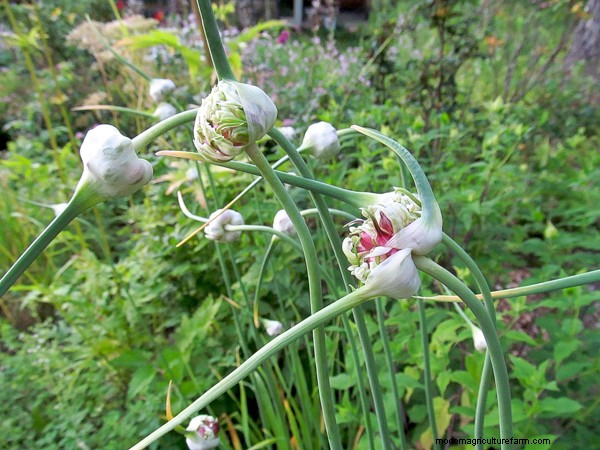
Garlic Scapes forming Bulbils
The following spring I waited eagerly for garlic scapes, and I began tearing them open as soon as the first ones formed.
In the very early immature stages, I could see tiny flower buds forming within the scapes, but they were so tiny and delicate that any contact broke them. Beyond that, it seems that the flowers develop before the bulbils, so I didn’t actually see any bulbils to remove at this stage.
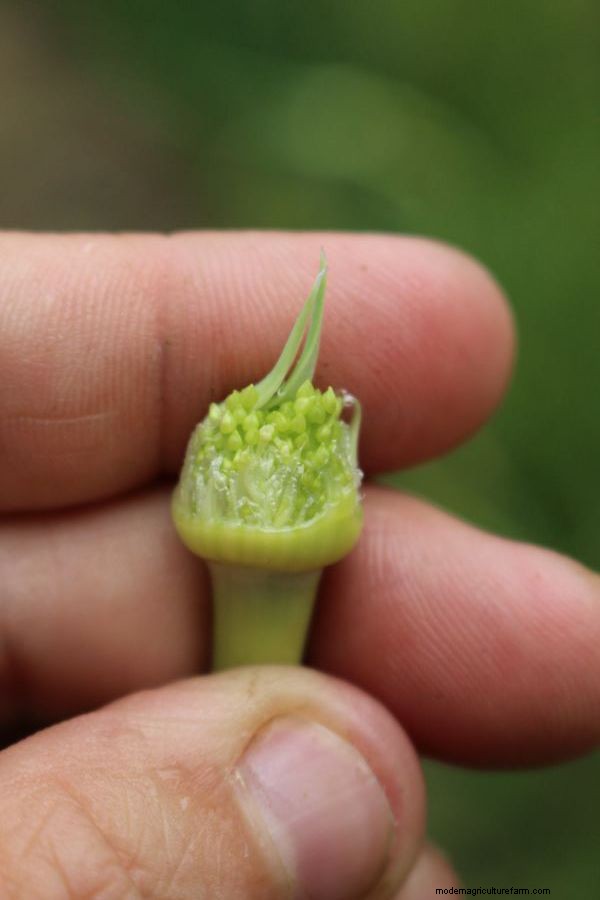
Young immature garlic flowers inside a scape
I waited a few more weeks for the bulbils to begin forming, and then I was able to see both bulbils and garlic flowers together in the same scape.
With careful hands, I gently remove the tiny bulbils, leaving just the small purple garlic flowers.
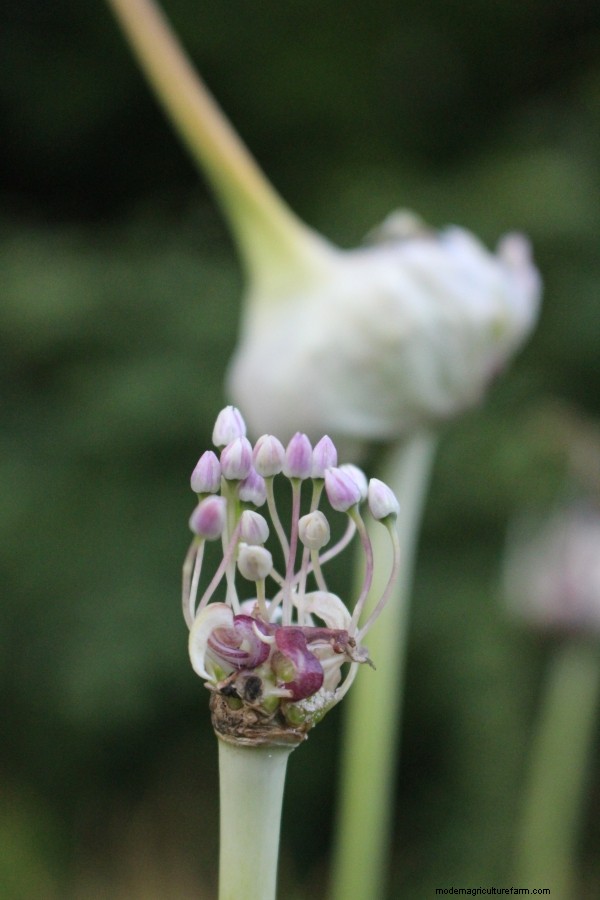
Garlic flowers from inside the scape, after bulbils have been removed
In playing around with all these garlic scapes, I have to say I was most impressed by the sheer variation between the scapes, bulbils, and flowers of different garlic varieties.
Some had just a handful of flowers and bulbils, while others had what looked like a hundred bulbils and dozens of tiny flowers.
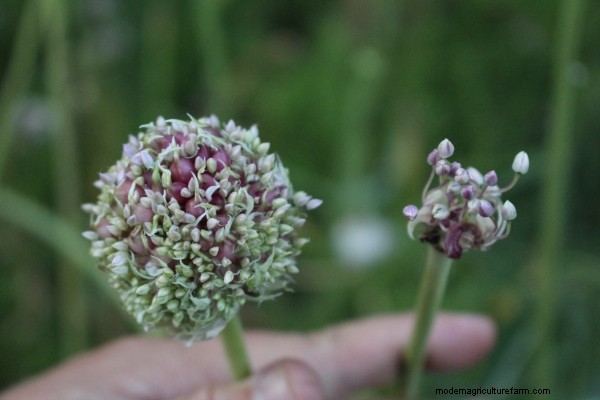
Garlic flower variation ~ some have lots of flowers and bulbils, others just a few
They looked like closed tulips, and I checked back every day waiting for them to open. I expected to have to hand pollinate them with a tiny paintbrush since Will notes that alliums are often self-sterile.
The problem is, those little flowers never opened. They stayed tightly closed well into the fall, and then dried off into nothingness.
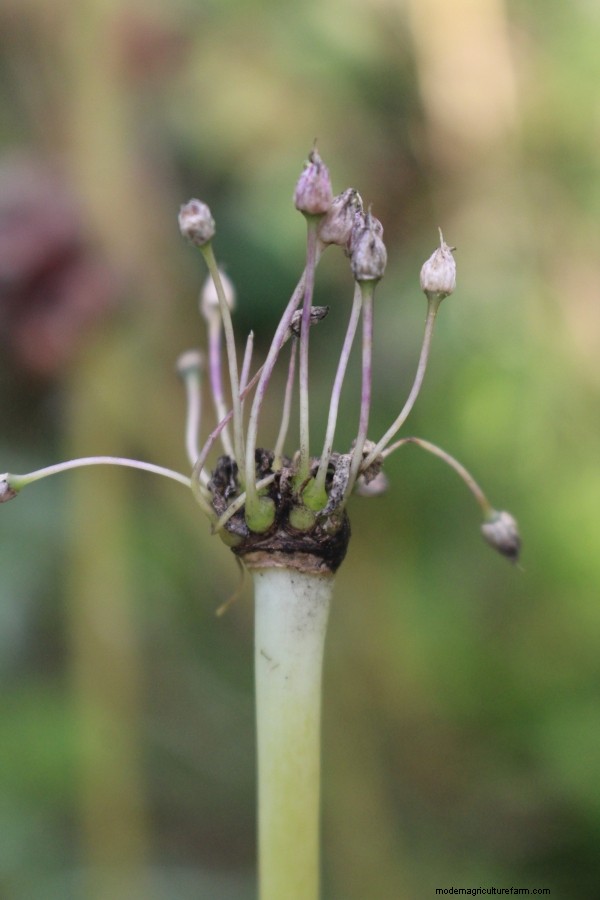
Garlic flowers dying in the fall, un-pollinated unfortunately
After my lack of success last year, I did a bit more research and found someone that has actually produced true garlic seed by sexual reproduction. This article describes the process, and though he did remove the bulbils, he didn’t have to open the flowers or hand pollinate.
Here are his pictures of his garlic flowers and true garlic seed:
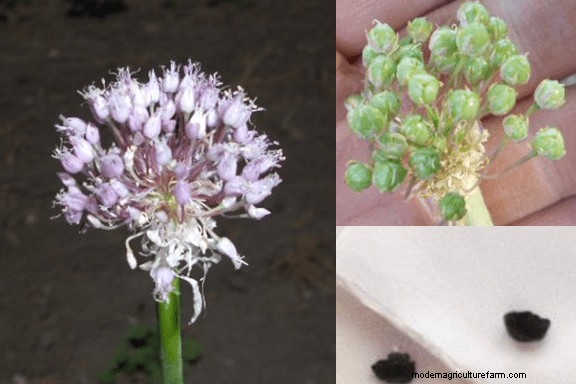
Garlic Flowers (left), Garlic Seed Pods (top right), True Garlic Seed (bottom right) Images Used Via Creative Commons and taken by Joseph Lofthouse
I’m determined to try again this year, and perhaps gently open the flowers by hand if necessary.
If you happen to have time for this type of foolishness, I’d welcome you to follow along with the garlic seed fun. Let me know if you’re successful!


