
Welcome to Modern Agriculture!

Introduction to Sapodilla seed germination process: Sapodilla is one of the major fruit crops in India and belongs to the Sapodillaceae family. Sapodilla is a good source of sugar ranges between 12 and 14 percent. It is popularly known as Chikku, Sapodilla, and Kali Patti. The fruits have and Appreciable amount of protein, fat, fibers, calcium, phosphorus, iron, carotene and also vitamin. Also, several medicinal properties have been ascribed to a different part of the Sapodilla tree. In this article we also discussed below topics;
Importance of Sapodilla – The Sapodilla when fully ripe is delicious and eaten as a dessert fruit. The Sapodilla pulp is sweet and melting. Besides food values, the Sapodilla fruits are used in some Ayurveda preparations. From the time of germination, the Sapodilla fruit will usually take anywhere from 5 to 8 years to bear fruit. The Sapodilla tree will yield fruits twice a year.
Several traditional varieties are grown in India; the important ones are given below;
Cricket Ball – It is also known as ‘Calcutta Large’ bear’s large round fruits. The fruit pulp is gritty and granular and moderately sweet.
Kirthibarti – It is a popular variety in Andhra Pradesh. Fruits are medium-sized and the peel is rough and thick.
Baramasi – It is a popular variety in West Bengal, Bihar, and Uttar Pradesh. The fruits are medium-sized and round.
Pilipatti – This fruit variety has unique small fruits found in Maharashtra and Gujarat. The fruits are oblong, elongated with very soft sweet pulp.
Kalipatti – It is the leading fruit variety in Maharashtra, Gujarat and North Karnataka. The fruit has dark green broad and thick leaves. These are oval-shaped with sweet pulpy pulp.
Pala – This is a popular variety in Andhra Pradesh and Tamil Nadu. These are small to medium with oval or egg shape borne in clusters.
Gutthi – These fruits are small-sized and oval, with apex broadly pointed.
Jonnavalasa – This fruit is from Andhra Pradesh has medium to large ovate fruits with light-colored peel and pulp which is sweet.
Some improved Sapodilla varieties or hybrids are CO 1, CO 2, CO 3, PKM-1, PKM-2, PKM-3, PKM-4, PKM-5, DHS-1, and DHS-2.
The Sapodilla plant is upright in structure and considered to be a slow-growing tree. Sapodilla is an attractive tree and has an extensive root system. The Sapodilla tree develops into a dense, rounded crown-like canopy as it ages. Sapodilla tree is famous for its rich white gummy latex called the chuckle. In tropical areas, the tree can grow to a height of about 100 ft. Different grafted varieties of the Sapodilla are found to have shorter height. The leaves of the Sapodilla tree are 3 to 4 inches long and almost 1-2 inches wide. The plant leaves are glossy, clustered spirally at the top and are arranged alternately. The stomata of the leaves can be found exclusively on the upper part of the tree.
Incase if you miss this: Lemon Seed Germination Process.
The flowers of the Sapodilla tree are small almost around 8 to 12 mm, bell-like in shape. The flowers have three brown outer sepals and three inner sepals. The diameter of the flower is about ⅜ inch. The sepals enclose a pale green to the white corolla and six stamens with stigma extending beyond the corolla. The Sapodilla tree produces several flushes of flowers throughout the year.
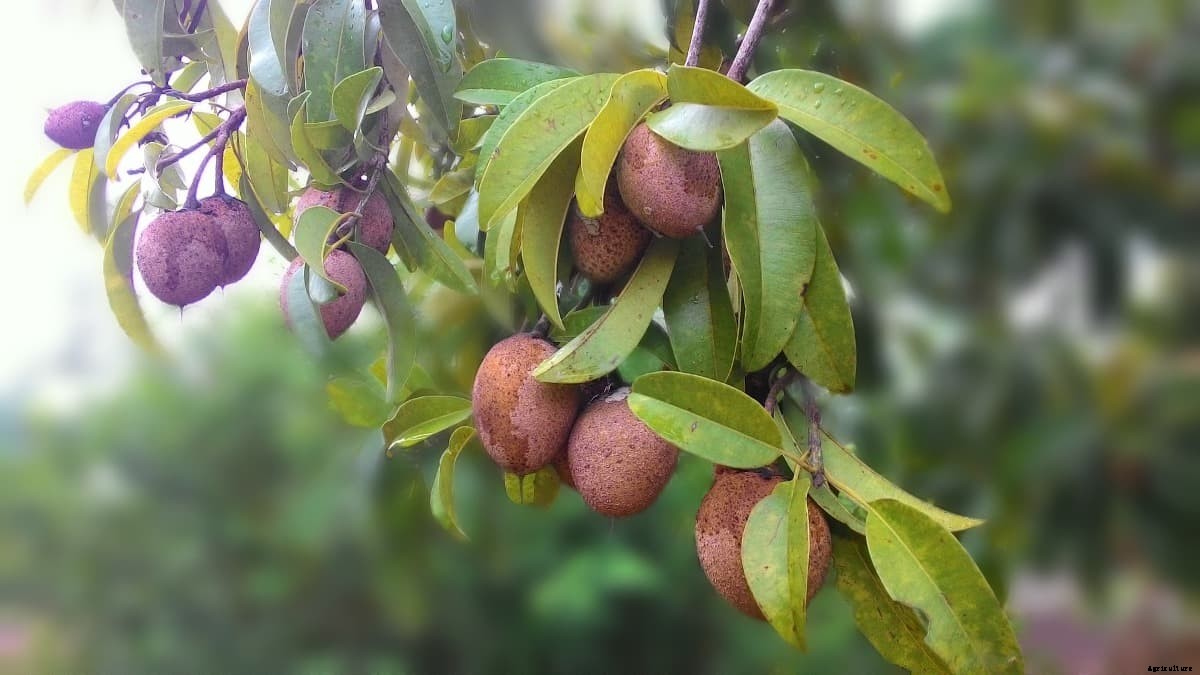
The fruit is round or egg-like in shape. It has an approximate diameter of 2 to 4 inches. The skin of the fruit is brown and scruffy upon ripening. The flesh within the Sapodilla fruit varies in color (shades of yellow to brown) for different varieties. The Sapodilla fruit contains high latex content when raw, but it decreases when the fruit ripens. The flesh of the fruit is smooth and granular in texture and sweet flavor.
The soil requirement for growing Sapodilla should be well-drained, deep and porous type. Typically, any soil variety can be used for Sapodilla growing, but there should not be any hardpan in the subsoil level. The Sapodilla trees can tolerate salt content in the soil. The soil varieties suitable for Sapodilla growing are deep alluvium, sandy loam, and medium black soil. The pH level of the soil should be around 6 to 8. Shallow clay type of soil is not suitable for Sapodilla growing.
To grow a Sapodilla tree, propagation is done by seed, which will be viable for years although commercial growers use grafting. Once germinated, it takes 5 to 8 years to grow a sapodilla tree of bearing age. The fruit tree is tolerant of most conditions but prefers a sunny, warm, and frost-free location in most any kind of soil with good drainage.
Fertilize young Sapodilla trees with -8% nitrogen, 2-4% phosphoric acid, and 6-8% potash every 2 or 3 months with 1/4 pound and increasing gradually to 1 pound. Sapodilla trees are drought resistant, but water once a week if there is no rain. As long as the Sapodilla tree is protected from frost, the tree does not need a lot of care and you should expect fruits to bear.
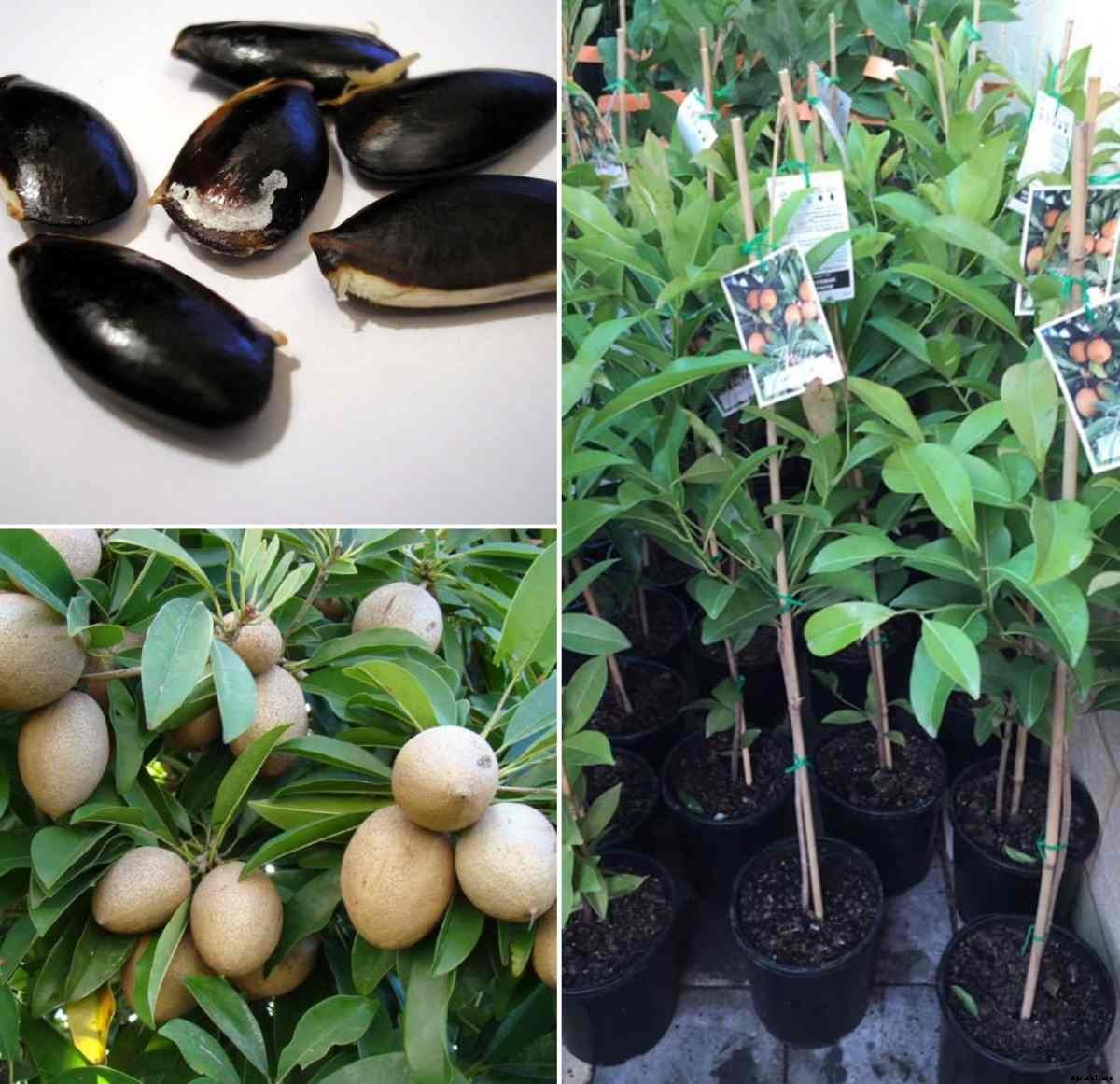
Sapodilla seeds lose viability quickly and should be planted soon after removal from the fruit. They germinate in 2 to 4 weeks. The removal of the hard outer coat will speed germination and seeds must be planted with the more pointed end upward and protruding 1/2 inch above the soil to assure good form in the seedling. Seedlings must be grown in experimental plantings intended for the selection of desirable characters, and use as rootstocks. Seedlings will not bear until they are 8 to 10 years old and they do not essentially come true from seed.
You should not miss the Eggplant Seed Germination Process.
Watering is done every 10 to 15 days in winter and at weekly intervals during summer. A drip irrigation system is recommended.
The physiological maturity of the Sapodilla fruit is indicated by the shedding of brown scaly scurf from the skin. The Sapodilla fruits turn corky brown with a tinge of yellow when they reach the harvest stage. When no green color tissue is observed on the fruit, then it is clearly understood that the Sapodilla fruits are ready for time of harvest. The mature Sapodilla fruits are harvested by handpicking.
Healthy seeds produce hugh quality fruits with better yield. You might be interested in Dryland Farming, Agriculture Technologies.


