Welcome to Modern Agriculture!

Tomato (Lycopersicon esculentum Mill.) is one of the most important vegetables worldwide. As it is a relatively short duration crop and gives a high yield, it is economically attractive and the area under cultivation is increasing. Tomato belongs to the Solanaceae family. Tomatoes contribute to a healthy, well-balanced diet. They are rich in minerals, vitamins, essential amino acids, sugars and dietary fibers. Tomato contains vitamin B and C, iron and phosphorus. Tomato fruits are consumed fresh in salads or cooked in sauces, soup and meat or fish dishes. They can be processed into purées, juices and ketchup. Canned and dried tomatoes are economically important processed products. Yellow tomatoes have higher vitamin A content than red tomatoes, but red tomatoes contain lycopene, an anti-oxidant that may contribute to protection against carcinogenic substances.
On a global scale, the annual production of fresh tomatoes accounts for approximately 159 million tonnes. However, more than a quarter of those 159 million tonnes are grown for the processing industry, which makes tomatoes the world’s leading vegetable for processing. Tomato production in Pakistan was 530 thousand tones during 2011. The nine largest producing countries account for 74.2 % of the world’s yearly production (2011).
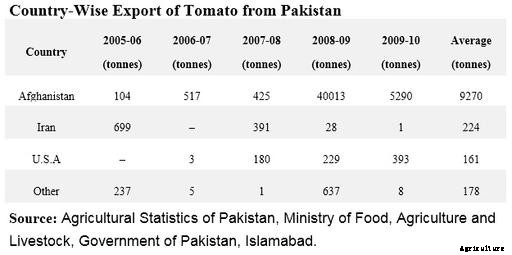
Tomato is a vegetable crop of significant economic value in Pakistan. Generally speaking annual export of tomatoes from the country averaged about 9832 tonnes during the past 5 years. Yearly exports are given below. The lowest export figures in 2006/07 and 2007/08 are attributed to bad crop harvest and rendering exports un-economical. Pakistan exported tomatoes to a quantum of 5692 tonnes, and earned rupees 77 million during 2009-10.
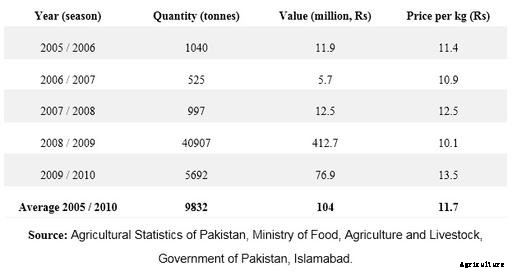
Per unit export prices are also low which apparently are attributed to produce quality. The destination-wise exports of tomatoes are given below:
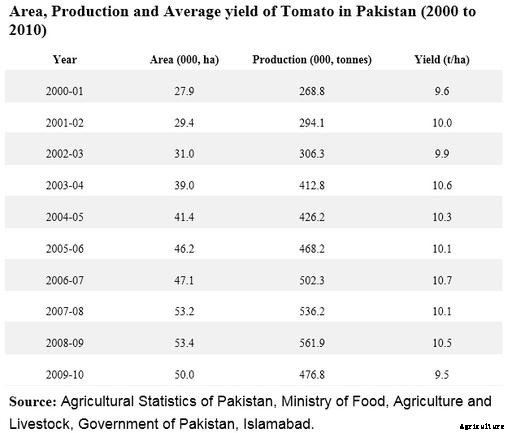
The area, production and average yield of tomatoes in Pakistan is given below. Since 2000-01 to 2009-10, the area under tomato crop has increased from 27.9 to 50 thousand hectares and production has increased from 268.8 to 476.8 thousand tons. The present national yield of tomatoes based on ten years average is 10.1 tonnes/ha which is quite low. To obtain a potential yield, high yielding varieties and improved production technology have to be adopted.
Area, Production and Average yield of Tomato in Pakistan (2000 to 2010)
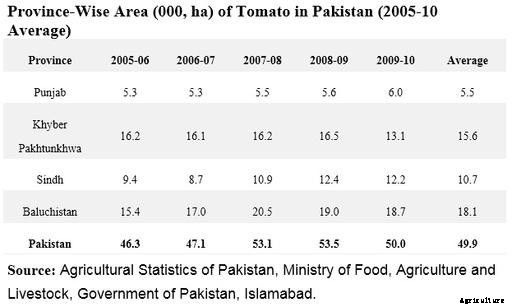
The province-wise area of tomatoes based on the average data of five years (2005-10) is given below. Balochistan is the leading tomato province cultivating annually an average area of 18.1 thousand hectares followed by KPK and Sindh with area of 15.6 and 10.7 thousand hectares, respectively.
Province-Wise Area (000, ha) of Tomato in Pakistan (2005-10 Average)
The province-wise production of tomato based on the average data of five years (2005-10) is below. Baluchistan is the leading tomato province producing annually 205.6 thousand tonnes followed by KPK and Sindh with production of 153.1 and 80.4 thousand tonnes, respectively.
Tomato is grown most of the year in some parts of the county. However, the supplies are substantially reduced during intense heat and rains of summer and monsoon months from June to August. In the hot-wet season, production shifts from lowlands to the relatively cooler and dryer highlands. Because high land production areas are limited, tomato supply dwindles in the wet season resulting in drastic price increases. Another period of stress is the onset of frost during December and January when production is depressed.
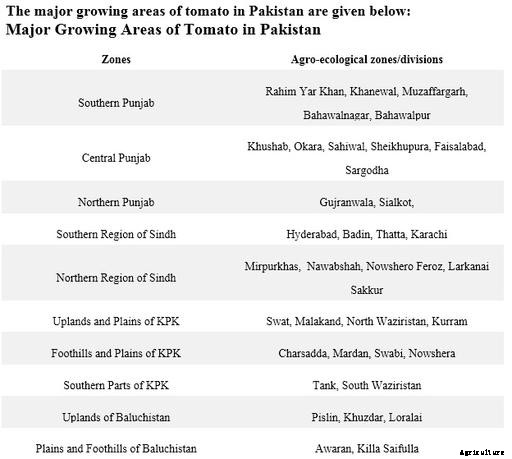
The major growing areas of tomato in Pakistan are given below:
Major Growing Areas of Tomato in Pakistan
All the cultivars which are commercially grown in the country have been introduced from other countries mainly from Europe and America. The principal cultivars grown are; Money Maker, Roma, Riogrande.
Province-wise nursery sowing, transplanting and harvesting times of tomatoes are given below
Tomato is very sensitive to cold. In most cultivars, flowering does not develop normally below 15oC or above 35oC. The optimum range lies between 21oC and 24oC. Seed germination does not occur in soil temperature below 10oC or beyond 35oC. The optimum range for germination occurs between mean soils temperatures of 15.5oC and 29oC. In the plains, most difficult period of tomato production is from mid May to June when the day and night temperatures are very high and during monsoon season (July-August) when there is a rapid development of pests, diseases and weeds.
Tomato thrives best almost on all types of soils. A well fertile sandy loam soil is best suited to produce early crop. The loams and clay loams have greater water-holding capacity and are better suited to longer season of production. Soils rich in organic matter and mineral nutrients are suitable for higher yields. Soils ranging from pH 5.5 to 7.0 are best suited for tomato production.
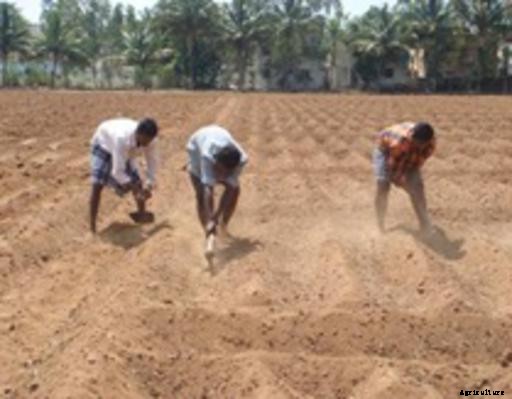
Preparation of land is necessary for growing successful crops. Well rotten farm yard manure should be applied @ 10-12 tons per acre at least one month before planting the crop for maintaining proper physical conditions and fertility status of the soil. Five to six ploughings will be needed to prepare a good seed bed. The ploughed land must be disked well and should be thoroughly leveled for even distribution of water. Raised beds of 1.5 m breadth should be made.
As much as 120 to 150 g of seed is required to prepare nursery for one acre.
Transplants for open field can be raised in the plastic tunnel if they are to be grown in a season when climatic conditions outside would not be favourable for growth. Mixture of well rotten farm yard manure, sand and soil in the proportion of one part each is commonly used as medium for growing transplants.
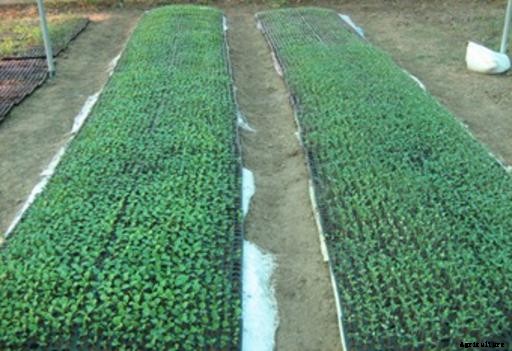
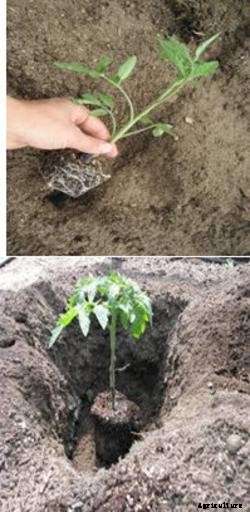
Seedlings of 15-25 cm tall with 3-5 true leaves are most suitable for transplanting. Before transplanting, the seedlings should be hardened by gradually reducing the frequency of irrigation and exposing the seedlings to strong sunlight. The seedlings in the nursery beds should be watered on the day before transplanting. Transplanting of seedlings in the field should be done late in the afternoon to curtail transpiration of the seedlings. The soil around the roots of the shifted plants should be well pressed to ensure a good contact with the roots and the plants are irrigated immediately. The seedlings are transplanted on both sides of 1.5 meter wide raised beds with plant to plant distance of 50 cm.
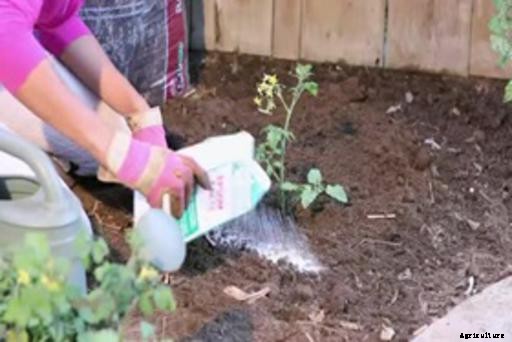
General recommendation for chemical fertilizer to be applied is, 46 kg Nitrogen, 60 kg Phosphorus and 25 kg Potash per acre. For better results, full quantity of Phosphorus and half of Nitrogen and Potash should be applied before transplanting of seedlings. Remaining half of Nitrogen and Potash should be applied 6-8 weeks after transplanting.
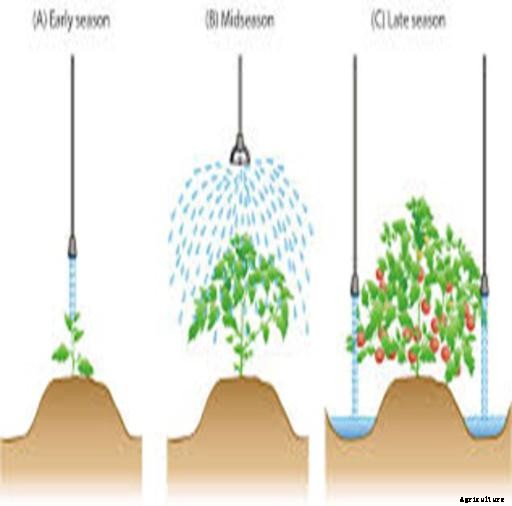
Tomato is not resistant to drought. Yields decrease considerably after short periods of water deficiency. It is important to water the plants regularly, especially during flowering and fruit formation. The amount of water that is needed depends on the type of soil and on the weather (amount of rain, humidity and temperature). About 20 mm of water per week is needed under cool conditions, about 70 mm during hot and dry periods. Watering plays a major role in attaining uniform maturity and reducing the incidence of blossom end rot, a physiological disorder associated with irregular water supply and the resulting calcium deficiency in the fruit during its enlargement. The plants are irrigated just after transplanting. Irrigation with an interval of 7-8 days is recommended. The irrigation interval can be decreased from 5-6 days when weather is too hot. Irrigation water should be given in sufficient quantity but with care so that beds should not be submerged into water.
Weeds compete with the tomato plants for light, water and nutrients. Sometimes they provide shelter for organisms that cause tomato diseases, such as Tomato Yellow Leaf Curl Virus (TYLCV), and reduce the yield. Effective non-chemical weed management begins with deep plugging, diverse crop rotations and competitive cover crops.
The following integrated practices are useful for controlling weeds effectively:
Harvesting will continue for about one month, depending on climate, diseases and the cultivar planted.
Tomato can be classified in four stages of maturity:
Stage 1: Seed are white in color (immature) and can be cut when the tomato is sliced. There is no juice inside the tomato.
Stage 2: Seeds have a tan color (mature) and some juice present.
Stage 3: Seeds are pushed aside when cut. The colour inside is still green.
Stage 4: Juice becomes red in color.
Tomatoes that are harvested at the first stage of maturity will ripen into poor-quality tomatoes. Tomatoes harvested at third and fourth stages of maturity will ripen into good-quality tomatoes. It is also good to look carefully at how ripe the tomatoes are. How ripe a tomato is when it is harvested affects the fruit composition and tomato quality. Tomatoes accumulate acids, sugars and ascorbic acid when they ripen on the plant. Field-ripened tomatoes have a better flavour and overall quality than tomatoes that ripen after picking. Hence it is important to understand ripeness stages.
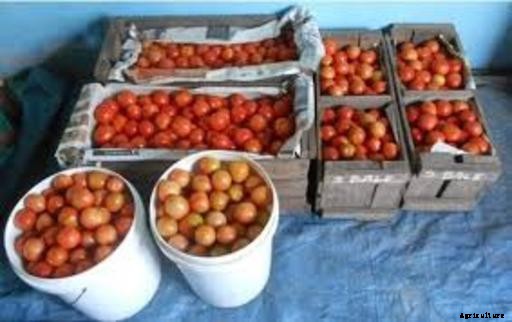
Tomatoes are picked in picking containers (nylon net bags or plastic buckets). These picking containers need to be emptied into larger containers which must not weigh more than 25 kg. The containers need to hold only tomatoes that are mature, ripe and free from damage. When the field containers are full, they should be transported to a sorting area located on the farm. In sorting areas, the fruits are washed and sorted by size, colour and variety. Sorting areas need to be out of direct sunlight, preferably cool and clean. Washing and sorting can be done with long water containers. It is also possible, to add a permissible amount of chlorine solution to the water, to disinfect the tomatoes. Once the tomatoes are taken out of the sorting canal they must be dried and carefully placed in a container, ready for dispatch to their final destination. Uniformity is one of the first attributes that buyers look for. Appearance comes before aroma and taste.
Badly packed tomatoes will not only ruin the tomato crop for sale, but will also mean lower prices. Even if tomatoes are just being sold at the farm gate, they will require some form of packaging, which can be a simple traditional basket. Packaging protects against pathogens, natural predators, loss of moisture, temperatures, crushing, deformation of tomatoes and bruising. It is a good idea to use padding material at the bottom of packages and in between layers of tomatoes.
Storing tomatoes in tropical and subtropical climates can be difficult without cold storage. Tomatoes that are to be sold fresh for table consumption must not be stored for long. Tomatoes are picked when ripe and stored for a few days in a cool room, after which they transported to distant markets. During the journey the tomatoes will ripen to the market stage. Tomatoes will deteriorate if they are kept at temperatures below 10°C for longer than 2 weeks or if kept at 5°C for longer than 6 to 8 days.
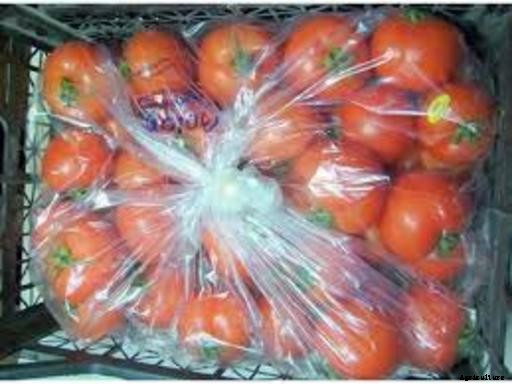
Insects, such as white fly and aphids cause physical damage only when they occur in large numbers. However, they may transmit viruses, which can cause much greater damage. These insects can come from outside your field, and may cause entire crop to become infected. Also, leaves damaged by insects become more susceptible to fungal and bacterial diseases.
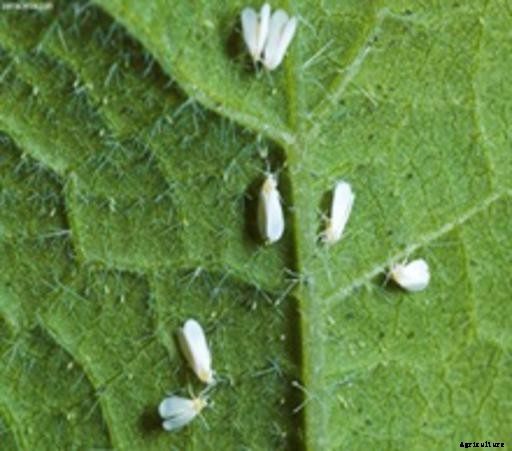
The adult fly is white in color and 1-2 mm long. It feeds, just like the larvae, on the leaf sap. When plant leaves are turned over, a whole swarm of white fly may fly up. They lay eggs on the underside of the leaves. The eggs hatch after about 1 week. After 2 to 4 weeks the larvae form a cocoon and metamorphosis takes about one week. White flies are especially a problem in the dry season. Once the wet season starts they disappear. Some measures to combat white fly:
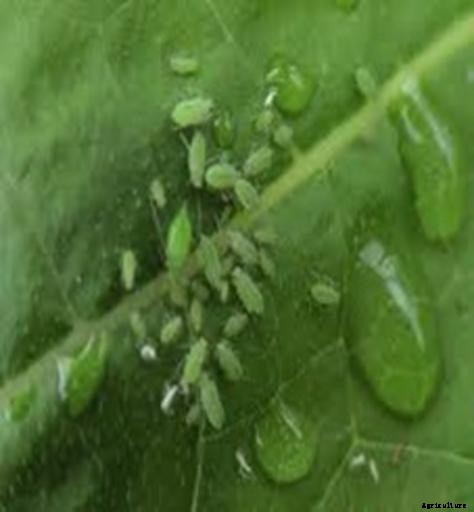
Aphids are soft, oblong insects about 2.5 mm in length. Direct damage occurs when they attack the crop in large numbers, especially the youngest leaves and stems. In addition to causing direct damage, aphids also transmit several viruses. Measures to control aphids:
Tomato plants are susceptible to several fungi, bacteria and viruses. Fungi and bacteria cause foliar (leaf), fruit, stem or root diseases. A virus infection often leads to dwarfed growth and decreased production. Damage caused by diseases can result considerable yield losses for a farmer. Some diseases commonly found in tomatoes are discussed below.
This bacterium is especially common in humid tropical lowlands, where temperatures are relatively high. It causes bacterial wilt, which is a soil-borne disease. The first symptoms in infected plants are wilting of terminal leaves, followed in 2-3 days by a sudden and permanent wilt, but there is no yellowing. Adventitious roots may develop on the main stems. The vascular system in the stem of infected plants appears light brown in transverse or longitudinal section; it becomes a darker brown at a late stage of infection. The pith and the cortex near the soil line also become brown when the plant is completely wilted. A white, milky stream of bacteria will ooze from xylem elements when stem sections of infected plants are suspended in water. The bacteria survive in the soil and enter roots of young plants through wounds made by transplanting, cultivation, insects or certain nematodes. The bacteria are spread through irrigation water, soil movement, or moving infected plants (e.g. when transplanting). The following measures will help to control bacterial wilt:
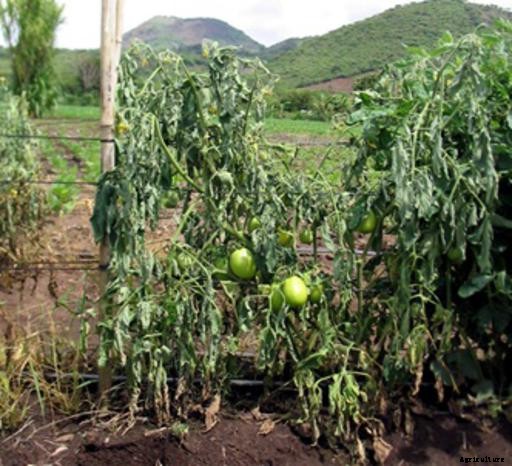
From the bottom up, leaves wilt, turn yellow and curl at the edges. A brown stain can be seen if the stem or roots are cut. The plant may wilt on only one side or on a leaf, while the other half or rest of the plant remains healthy for a long time. Pink fungus fluff is found on dead plant parts. Measures that can help control Fusarium wilt.
This disease is most common in cooler climates (e.g. highlands). Signs of infection are similar to those of Fusarium, but they appear more slowly. The plants wilt, and leaves become yellow. Many side roots may form at the base of the plant. The fungus spreads through crop debris, especially in slightly acidic soils (low pH). This disease also affects other Solanaceous plants. Measures to control this wilting disease:
This fungus can be found everywhere, and its effect is most serious in humid and hot climates. It is spread via seed, wind, rain and infected plant remains. Plants that have been damaged are more susceptible to this fungus. Round, brown spots (with concentric rings) appear on the leaves, reaching a diameter of 1.5 cm. Sometimes small lumps can be found on the stem or on leaves, causing leaves to turn yellow and wilt. Flowers and small fruit fall off. Major control measures:

This fungus can be found in all regions of the world, but is more common in highlands or in cool humid conditions in lowlands. The fungus is usually spread via crop remains. Dark, watery marks with a yellow spot on the inside are visible on the leaves. Sometimes the marks start at the edge of the leaf and spread inward, sometimes the spots spread from the centre of the leaf outward. On the underside of the leaves, the spots are white. The stems and fruit can be affected also. Fruit gets brown spots and the leaves wilt. The signs of late blight become visible early in the growing season. Measures that can prevent late blight:
CMV causes stunting in tomato plants. Leaves may show a mild green mottling or more shoestring symptoms in which the leaf blades are greatly reduced. Fruits are small in size and often misshapen. CMV is transmitted by different aphid species. Aphids usually introduce the virus into a tomato crop from weeds or neighboring crops. Control of the vector is important to prevent CMV epidemics:
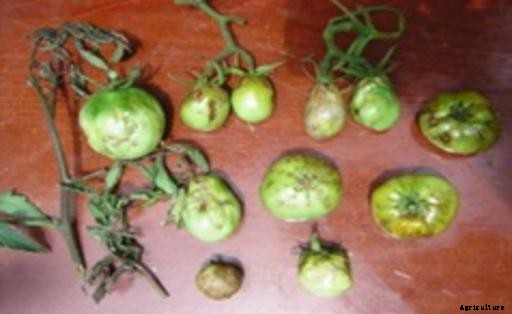
TYLCV occurs worldwide. Infected plants are erect and stunted. Leaves are yellow and curl upward or downward. An entire yield can be destroyed if plants are infected in the nursery. Whitefly transmits TYLCV.