
Welcome to Modern Agriculture!

Aloe vera, a succulent perennial plant that resists drought, is well-known for its therapeutic properties.
Several beneficial effects of Aloe vera have been documented, such as immunomodulation, wound and burn healing, hypoglycemia, anticancer, gastro-protective, antifungal, and anti-inflammatory properties.
Aloe vera has been used for a variety of commercial purposes because of its beneficial therapeutic properties.
Kingdom – Plantae
Order – Asparagales
Division – Spermatophyta
Subdivision – Angiospermae
Class – Monocotyledoneae
Family – Liliaceae
Genus – Aloe
Species – barbadensis Mill
Arabic – Sibr Chinese – Lu Hui
Persian – Sibr Cuban – Sabilla
Urdu – Ailwa Dutch – Aloe
Hindi – Kumari French – Aloes
Sanskrit – Ghritra kumari German – Aloe
Kannada – Karilola Greek – Aloi
Telugu – Kalabanda Haiti – Laloi
Tamil – Kattalai Italian – Aloe
Gujarati – Eliyo Japanese – Rokai
Kashmiri – Musabbar Korean – Nohwa
Marathi – Korphad Russian – Aloe, Aloi, Sabur
Oriya – Musaboro Thai – Wan hang Jo
Punjabi – Musabbar Vietnam – Lohoi
Assamese – Musabhar
Taste : Bitter
Odour : None
Size & Shape : Plant growing to 60-100cm in lance-shaped with elongated.
Strands Colour : Leaves are green to grey- green flower.
Flower : Yellow tubular in 25-35cm in a slender loose staments.
Root : Root fibbers that can reach 30-40 cm in length
Based on the report made by IMARC, the compound annual growth rate – CAGR of global aloe vera market is predicted to rise by the rate of 7.70% for the year of 2021-2026. USA is the global leader in aloe vera production.
As reported by NMPB – National medicinal plant board (statistics from 2015-2016), Uttar Pradesh was the leading state in India with 512 hectares of aloe vera farming. wwhile, Manipur being the 2nd ranking state and Rajasthan being the 3rd ranking state in terms of aloe vera cultivation.
Manipur, Kerala, Mizoram, Himachal Pradesh, Telangana, Rajasthan, Uttar Pradesh, Jammu and Kashmir, Haryana, Maharashtra and Karnataka are the states in India where NMPB has recorded aloe vera cultivation.
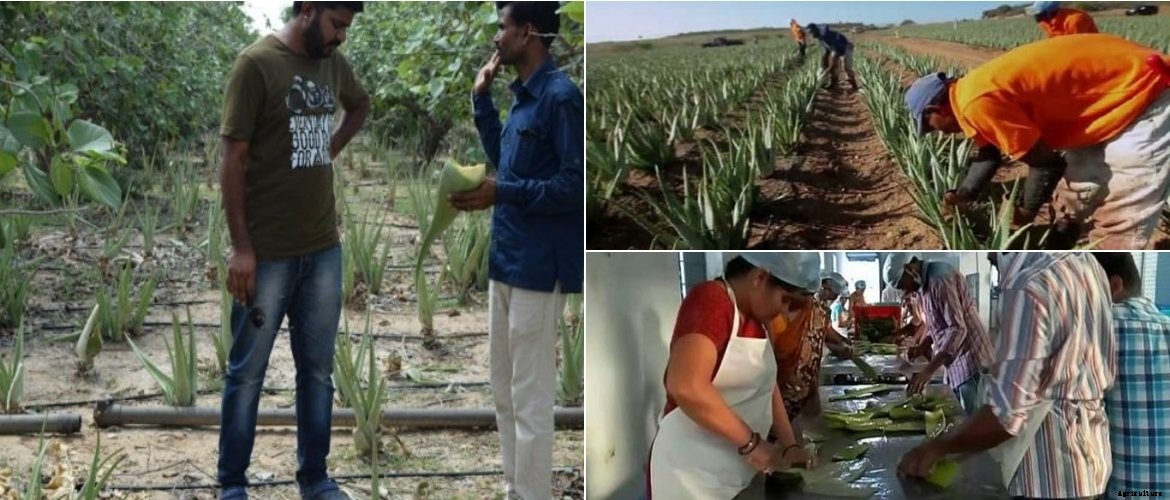
Medicinal and aromatic plants (MAPs) are now not just playing an important part in Indian traditional medicine market but also experiencing a worldwide demand as more and more research and studies are proving their credibility. Hence, aloe vera cultivation proves to be one of the profitable agribusinesses.
NAM program initiated by NMPB focus on shifting the dependence of harvesting the MAPs from forest area to planned cultivation with good agricultural practices. A total of 140 priority medicinal plant species are identified, out of which 95 species have been finalized by NMPB for subsidy schemes . Aloe vera being one of them (with eligibility of 30% subsidy).
Click Here to get the details of the nodal and controlling offices in your respective state.
In the following section, we will present the general good practices for aloe vera farming. Please keep in mind, the some methods and procedures ( such as soil enrichment and spacing ) might vary depending on the terrain and the soil composition. However, in most cases, the methods presented in this section can be applied to any aloe vera farm.
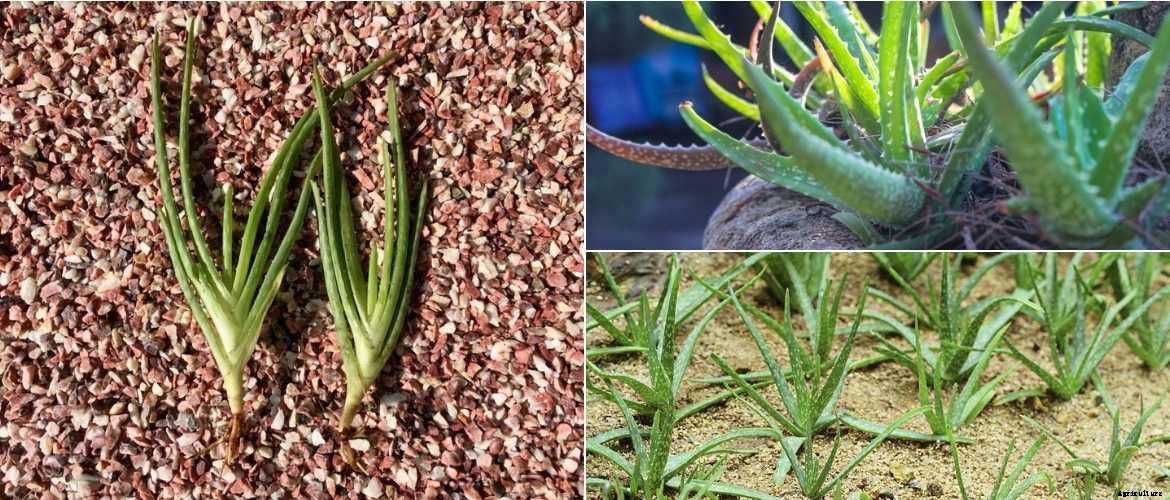
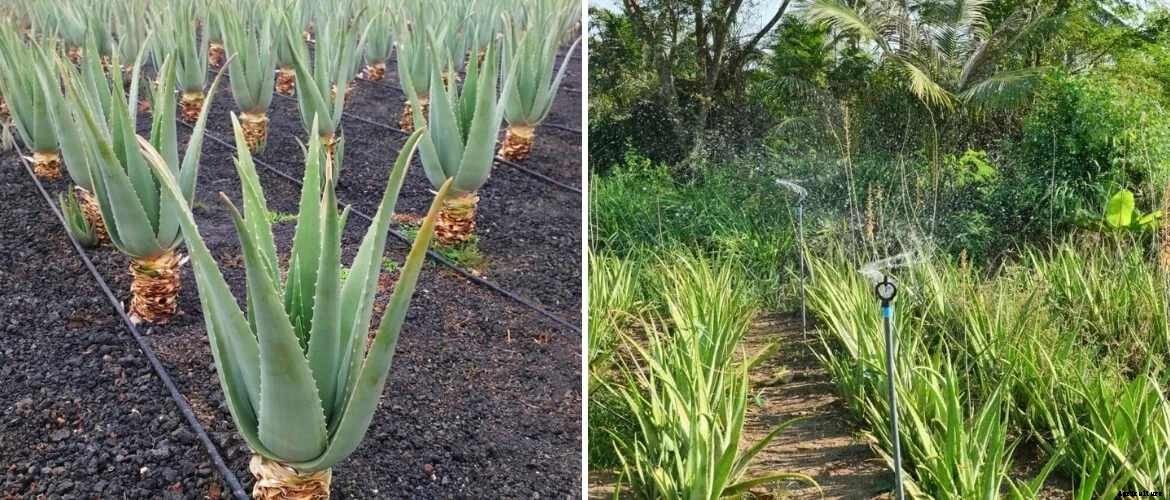
According to Prioritised list of Medicinal Plants for cultivation, aloe vera comes under the medicinal plants which are eligible for 30% subsidy. National Mission on Medicinal Plants or now known as National Medicinal Plants Board – NMPB (merged with National AYUSH Mission – NAM in 2015-16), facilitates with the subsidy application process. (It also has roles like drawing up policies and strategies for conservation, proper harvesting, cost-effective cultivation, research and development, processing, marketing of raw material in order to promote and develop this sector.)
Based on the report released by the national medical plant board in 2016-17, the estimated cost of farming aloe vera per is 24889.70 rupees per hectare or 20570.00 rupees per acre. (The base cost will be increased by 10% every subsequent year).
Apart from the subsidy on aloe vera farming in India, NMPB has also released details of subsidy on other agrobusinesses such as subsidy on nursery setup for aloe vera, subsidy on post-harvest management of aloe vera, subsidy on processing of aloe vera.
| Programme | Estimated Cost | Admissible Assistance / Subsidy |
|---|---|---|
| 1. Nursery | ||
| Production of planting material | ||
| a) Public sector | ||
| i) Model nursery ( 4 ha.) | 25 Lakh INR | Maximum 25 lakh INR |
| ii) Small nursery (1 ha.) | 6.25 Lakh INR | Maximum 6.25 lakh INR |
| b) Private sector | ||
| i) Model nursery ( 4 ha.) | 25 Lakh INR | 50% of cost limited to 12.5 lakh INR |
| ii) Small nursery (1 ha.) | 6.25 Lakh INR | 50% of cost limited to 3.125 lakh INR |
| 2. Cultivation | ||
| Aloe vera cultivation | As per the estimates by the government for current year | 30% of total cost of cultivation |
| Programme | Estimated Cost | Admissible Assistance / Subsidy |
|---|---|---|
| Drying shed | 10 lakh INR | 100% subsidy for government / semi-government / public sector 50% subsidy for SHGs / Cooperatives / Private sector |
| Storage godowns | 10 lakh INR | 100% subsidy for government / semi-government / public sector 50% subsidy for SHGs / Cooperatives / Private sector |
| Programme | Estimated Cost | Admissible Assistance / Subsidy |
|---|---|---|
| Processing unit | 4 crore INR | 100% subsidy for government / semi-government / public sector / SHGs / Cooperatives / Private sector Limited to 4 crore INR / Unit |
| Marketing infrastructure | 10 lakh INR for rural collection center | 100% subsidy for government / semi-government / public sector 50% subsidy for SHGs / Cooperatives / Private sector |
| 2 crore INR for district collection center | 100% subsidy for government / semi-government / public sector 50% subsidy for SHGs / Cooperatives / Private sector |
|
| Organic / GAP certification | 5 lakh INR / 50 Ha. | Assistance / subsidy upto 50% of the cost limited to 10000 INR / ha. Minimum area of 4 ha is required. The subsidy amount will be given spreading over a period of 3 years for GAP farming. For GAP certification, 5 lakh INR for 50 ha. will be provided |
| Demonstration plots | _ | Project based depending upon species cultivated and infrastructure created limited to Rs. 10.00 lakhs / plot of minimum 2 acres |
| Setting up of seed/ germ plasm centres | _ | Rs. 25 lakhs/ centre |