
Welcome to Modern Agriculture!

Maintaining Bee colonies in man-made hives is called Honey Bee Farming or Bee-Keeping. The practice of Honey Bee farming is termed technically as ‘Apiculture’ and the location where these man-made hives are maintained is called an ‘apiary’. Bees are generally farmed for their honey and other products like Bee wax, Propolis, flower pollen, royal jelly, Bee pollen, etc. This practice also produces Bees which are sold by the Beekeepers for income generation. Bee farming was believed to have begun thousands of centuries ago in North Africa. It is estimated that there are more than 20,000 species of wild Bee species around the world. Bee farming is practiced with the social species of Honey Bee variety, which live in colonies. Two widely known varieties of Bees from the Apis genus are Apis Mellifera and Apis cerana. The mellifera species are mostly managed by Bee keepers of Europe and America and hence this species is also known as a Western Honey Bee. The cerana is managed by the Bee keepers of the tropics and is also known as Asiatic Honey Bee. There are two major ways in which these Bees are farmed, they are: the traditional Bee keeping way like the fixed comb hives and the modern Bee keeping techniques like the top-bar hives, horizontal frame hives and the vertical stackable frame hives. This Honey Bee farming project report describes the activities of Bee Keeping and at the end it discusses about the cost involved to maintain a small farm of Bees and the profits linked to it.
Commercial Bee keeping is possible in India because of a vast forest cover facilitating the presence of nectar and pollen on its grasslands. It is known that 160 million hectares of land is under farming in India out of which 55 million hectares of land is under entomophilous crops that need cross-pollination by Bees or other pollinators. The production of honey is about 10 million tonnes and that of Bee wax is about 10,000 tonnes. So if roughly estimated there is a scope of keeping 200 million Bee colonies in the country which can provide self-employment to over 10 million families of the rural population. Currently, there are 1.8 million colonies in the country and there is a need to expand the area under Honey Bee farming such that the required target is met. With increasing demand for honey in the country as well as in the international market, the potential for Honey Bee farming should be tapped so as to create employment opportunities for the people in the rural areas and generate good income. Honey Bee farming has remained a minor unit of cottage industry and there is being little scientific support and infrastructure provided for this sector. It is important to recognize the demand for Indian honey in the local and international markets and start exploring new ways to increase the production so as to meet the growing demand.
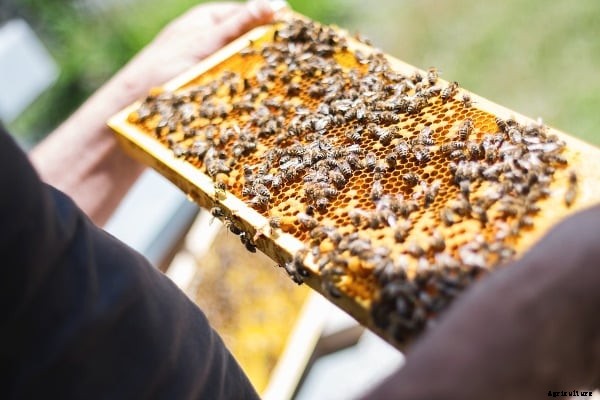
Honey Bee belongs to the category of social insects, which dwell in organized groups. While living in these groups they show some typical behavioural traits such as communication, nest construction, defence, division of labour, environmental control etc. These activities among the group make them excellent creatures on earth. A colony of Honey Bees generally has three types of Bees; the workers, drones and a Queen. Each Bee category has its own working structure, but survival and reproduction can happen only when all the Bees work in coordination with each other. The size of the colony is directly responsible for the efficiency of the colony.
Queen
Drones
Workers
Laying workers
All the Bees pass through different stages of growth before becoming adult Bees. These developmental stages are: egg, larvae and pupae. ‘Brood’ is a term used to define all these three stages. It is to be noted that unfertilized eggs turn drones and fertilized eggs become either Queen or workers. Feed or nutrition is most important for female Bees. Solid pattern of the healthy capped worker brood frame can be easily recognized. The areas which are brown in colour, convex and have no punctures are called cappings.
The factors on which the requirement of equipment depends are the size of the farm, the number of colonies, type of honey, etc. The basic farm needs are hive components, protective wear, smoker, hive tool etc. The components of a hive are:
There are some recommendations for selecting a good apiary site for a profitable commercial Bee Farming business. These are:
Generally Honey Bees of two varieties are farmed depending upon the availability of resources and the floral conditions of the area. The two varieties are Apis Cerana and Apis mellifera. The success of the farm depends majorly on the quality of Bees selected for the farm especially the Queen Bee. The following can be done to select good Bee colonies;
The Honey Bee feeds on pollen, nectar, honey and water. These are a source of energy to the insects. Pollen provides the Bees with proteins, vitamins, minerals and fat content, whereas honey provides them with carbohydrates. Emergency feed should always be available at the farm and consists of 15-20 pounds honey from an established colony of Bees. This emergency feed is of utmost importance during the winter and spring seasons. Excess sugar syrup is not recommended as a substitute for feed because it may result in dysentery due to too much moisture. Emergency feed may be combs of honey, dry sugar or sugar candy.
The apiary has different rules for management during different seasons and these are mentioned here in detail:
The colony of Bees has to be kept in thick shade during the summer and water has to be provided near the apiary at all times. The temperature of the farm can be regulated by using wet gunny bags to cover the top or by sprinkling water around the colonies during the noon. The entrance of the apiary has to be widened, additional gates have to be included into multi chambered colonies, thin and small sticks between adjacent chambers has to be placed for passage of fresh air. All these can improve ventilation in the farm.
Some activities during the monsoon include clearing the debris, removing the unwanted vegetation, supply of artificial feed like the sugar syrup and pollen, check robbing, putting together weak laying worker colonies and finally control the incidence of pests in the Bee farm.
After the monsoon sufficient space has to be created in the apiary and the strength of the colony has to be increased to stimulate drone brood rearing. The control of pests is recommended and honey extraction should be essentially done before the winter.
The colonies farmed in the hilly areas have to be examined carefully and should be provided with winter packings. Artificial feed is provided to weaker colonies, so as to initiate brood rearing. Windbreaks are installed to protect the colonies from chilling winds and weaker colonies are made to unite with the stronger ones.
When the spring arrives, the colonies are unpacked and cleaned by removing the worn out parts and sufficient space is provided. Extra feed is provided to increase brood rearing and extra frames are raised through comb foundation sheets. The old Queen has to be replaced with new Queen in the colony by mass Queen rearing. During spring, Honey has to be extracted regularly and swarming has to be prevented.
There could be innumerable reasons for the cause of disease and abnormalities in Honey Bees. It is advisable to diagnose the exact cause before taking up any control measures. There are some recommended management techniques to follow in order to control or prevent the occurrence of these diseases such as:
Honey Bees are threatened by pests such as tracheal mites, varroa mites, small hive Beetles, wax moths etc. chemical treatment of these pests is not recommended so as to preserve the quality of raw honey. Some ways to protect Bee colonies from pesticides are:
The most suitable time for removing honey is during the summer when the honey is adequate for the Bees. Some rules for honey extraction are:
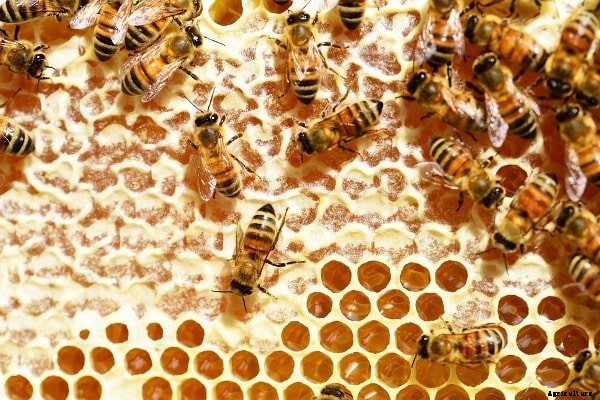
The cost analysis is made on 50 Bee colonies and the approximate values have been presented here for reference. The values may change depending on the location and availability. It is important to understand that there could be some extra costs involved for land and maintenance, which have not Been included into this estimation, but have to be definitely needed for practical implementation of the project.
Assumptions of Honey Bee Farmig Project Report:
No. of Bee hives: 50.
Cost of comb foundation sheet: Rs 700/kg.
Cost of sugar: 45/kg.
Cost of nucleus box: Rs 1200 for Cerana and Rs 2000 for Mellifera.
Cost of hive stand: Rs 300.
Cost of honey extractor: Rs 5000/ piece for cerana and Rs 7000/piece for mellifera.
Labour cost per day: Rs 250.
Cost of cerana Bee colony: Rs 2500.
Cost of mellifera Bee colony: Rs 3500.
Initial capital investment:
Material Investment in Rs (cerana) Investment in Rs (mellifera) Cost of 50 Bee colonies 1,25,000.00 1,75,000.00 Cost of 25 nucleus box 30,000.00 50,000.00 Cost of honey extractor 5000.00 7000.00 Cost of 50 Bee hives 50,000.00 1,00,000.00 Cost of 300 ant wells 6000.00 6000.00 Cost of 75 feeder frames @ Rs 100/ frame for cerana and Rs 120/frame for mellifera 7500.00 9000.00 Cost of farm equipment (hive tool, swarm net, Bee veil, smoker, wire embedder, storage drums and other miscellaneous) 5000.00 8000.00 Cost of 75 hive stands Cost of 100 Queen gates 4000.00 – Cost of 50 Queen Bee excluder sheet – 10,000.00 Total cost 2,32,500.00 3,65,000.00Recurring investment:
Material and labour Investment in Rs (cerana) Investment in Rs (mellifera) Cost of comb foundation sheet 2800.00 21,000.00 Cost of sugar for feeding @ 100 kg for cerana and 200 kg for mellifera 4500.00 9000.00 Charges for survival and pollination 10,000.00 25,000.00 Labour charges for 300 days 75,000.00 75,000.00 Total cost 92,300.00 1,30,000.00Production details:
Honey produced from cerana is: 500 kgs.
Honey produced from mellifera is: 1250 kg.
Cost of raw honey per kg: Rs 200 (average).
Wax produced from cerana is: 4 kg.
Wax produced from mellifera is: 10 kg
Cost of Bee wax per kg: Rs 300 (average).
25 Honey Bee divisions can be sold as:
Cerana: Rs 62,500 (Rs 2500 for per division).
Mellifera: Rs 87,500 (Rs 3500/division).
The total income from cerana Bee farming: Rs (1, 00,000 + 1200 + 62,500) = Rs 1, 63,700.
The total income from Mellifera Bee farming: Rs (2, 50,000 + 3000 + 87,500) = Rs 3. 40,500.
The profit earned on working capital or recurring capital is:
Cerana farming: Rs 71,400.
Mellifera farming: Rs 2, 10,500.
The National Bee Board (NBB) in association with NABARD has schemes for financing the Bee keepers in India and also provides assistance for women‘s employment in these sectors. It is recommended to visit the National Bee Board website or the nearest office to understand the nature and terms or assistance being provided for Bee Farming in India.
Read: Azolla Farming Project Report.
Read: Raising Free Range Chickens.


