
Welcome to Modern Agriculture!

As global food demand rises, agriculture faces challenges such as low yields, fragmented supply chains, and food waste. Addressing these issues requires collaboration across the sector and the adoption of transformative technology. One solution that is gaining traction is traceability in agriculture—a system that records every step of a product’s journey from farm to fork.
Digitizing supply chains creates a clear, real‑time record of every activity—from planting and harvesting to storage and distribution. With this visibility, stakeholders can pinpoint bottlenecks, reduce waste, and streamline operations, ultimately lowering costs and boosting efficiency.
A robust traceability system gives producers the tools to manage risk proactively. By tracking key data points, companies can quickly detect and respond to contamination or disease outbreaks, protecting consumers and preventing costly recalls.
Global conservation groups, such as WWF‑Myanmar, combine traceability with remote sensing to monitor land use. By registering farmers and recording their geospatial coordinates, they can overlay new deforestation events and verify that supply chains are truly deforestation‑free. This data supports compliance with emerging regulations and strengthens environmental stewardship.
Producers who can prove that their products meet certification standards—whether for safety, fair labor practices, or organic quality—gain a competitive edge. Studies show that consumers are willing to pay a premium for products that carry verifiable traceability information.
In an era of heightened consumer awareness, traceability builds trust. Transparent records demonstrate ethical sourcing, prevent fraud, and enable accurate labeling, reinforcing brand loyalty and resilience during crises.
Traceability data is increasingly required by retailers and exporters, especially for products with geographical indications, organic certification, or non‑GMO claims. Producers who can document quality and sustainability meet buyer requirements and unlock new markets.
By ensuring that each product is produced, packaged, and distributed sustainably, traceability supports SDG targets related to responsible consumption, climate action, and life on land.
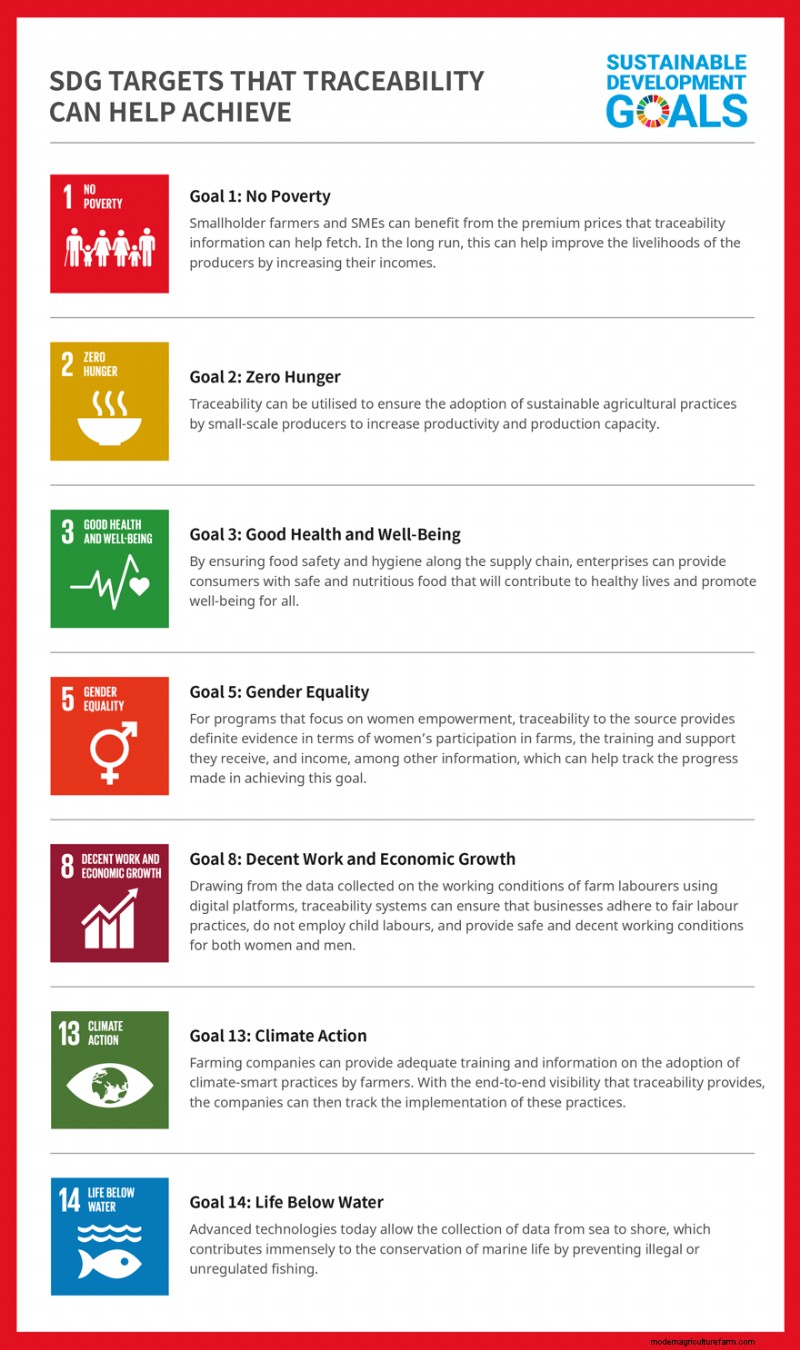
Implementing end‑to‑end traceability offers more than compliance; it reduces operational costs, enhances profitability, curbs fraud, and unlocks new business opportunities. When stakeholders collaborate on a tech‑enabled system, the entire supply chain can realize its full potential.
Watch our webinar to learn how traceability solves real‑world challenges and drives growth in agriculture.
The EU Deforestation Regulation (effective 31 Dec 2026) requires proof that commodities like cocoa, coffee, and palm oil are sourced from non‑deforested land. Failure to comply can result in a 4% annual turnover penalty and market bans. Cropin’s platform combines farm‑level geospatial data with satellite monitoring to provide auditable, deforestation‑free evidence.
US FDA’s Food Safety Modernization Act (FSMA) 204 mandates detailed traceability for high‑risk foods, extending the compliance deadline to 20 July 2028. Companies must track key data elements—product identity, location, date—and critical tracking events like harvest and shipment to accelerate recalls.
GlobalGAP focuses on safety, sustainability, and worker welfare. Accurate farm‑level records are essential for certification and audit readiness. Cropin’s digital Monitoring, Reporting, and Verification (dMRV) delivers time‑stamped, geo‑referenced data, reducing audit preparation time.
Three major regulations—EUDR, FSMA 204, and GlobalGAP—converge, making traceability a business necessity rather than an optional advantage. Companies without systems risk losing market access and facing penalties.
Major retailers such as Walmart, Carrefour, Nestlé, PepsiCo, and Unilever now demand farm‑level traceability to enforce deforestation‑free sourcing. Lack of data can result in delisting or price penalties.
Modern traceability platforms integrate satellite imagery, remote sensing, IoT, and AI to deliver scalable, auditable visibility. The shift from paper to digital has made traceability affordable for producers of all sizes.
In the face of climate shocks, geopolitical tensions, and disease outbreaks, traceability enables rapid supplier identification and compliance verification, turning resilience into a strategic advantage.
Explore Cropin Sage and witness the power of real‑time agri‑intelligence.