
Welcome to Modern Agriculture!

Composting plays a significant role in forestry, agriculture, and gardening. One should have proper knowledge about making organic compost from waste and manure. We give you a step-by-step guide to composting yourself.
This article will explain how to make your own organic manure compost. For plants to grow well, any gardener or farmer would benefit from adding nutrients and organic matter to the soil. Compost is one of the most common and beneficial stuff to add. Compost can be purchased at any garden supply center but making your own compost is very simple and less costly.
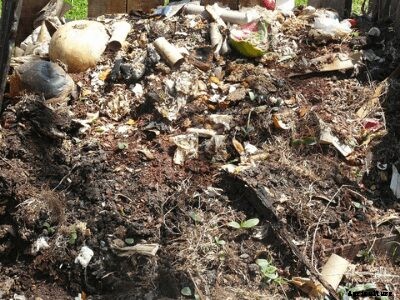 Manure inputs for Organic Compost:
Manures are plant and animal waste which is used as plant nutrient sources. After their decomposition they release nutrients. The practice of gathering and using waste from sources of livestock, people, and vegetables to increase crop production is as old as farming. Manures are the organic materials produced from the remains of animals, humans, and plants containing plant nutrients in complex organic forms. Naturally occurring or synthetic chemicals that contain nutrients from plants are called fertilizers. Manures with low nutrient content per unit quantity have a longer residual effect in addition to enhancing soil physical properties compared with high nutrient content chemical fertilizer. Major sources of manure inputs are:
It is also possible to group manures into bulky organic manures and concentrated organic manures based on nutrient concentration
 Bulky organic garbage contains a small number of nutrients and is used in large quantities. The most significant and commonly used bulky organic manures are farmyard manure (FYM), compost and green manure. The use of voluminous organic manures has several benefits:
Sheep and goat droppings provide higher nutrients than manure and compost at the farmyard. The manure comprises on average 3 percent N, 1 percent P2O5 and 2 percent K2O. It is implemented in two ways for the industry. The sheep or goat shed sweeping is put in pits for decomposition and is applied later on to the field. In this method, the nutrients present in the urine are wasted. The second method is sheep penning, whereby sheep and goats are kept in the field overnight, and urine and fecal matter applied to the soil is introduced to a shallow depth by working blade harrow or cultivator or grower.
Bird excreta ferment very quickly. When left exposed, within 30 days 50 percent of its nitrogen is lost. Poultry manure contains higher amounts of nitrogen and phosphorus than other heavy organic manures. The mean content of nutrients is 3.03 percent N; 2.63 percent P2O5 and 1.4 percent K2O.
There is a higher nutrient content of concentrated organic manures than bulky organic manure. The important concentrated organic manures are cakes made from oil, blood meal, manure from fish, etc. These are also called organic fertilizers with nitrogen. Before the crops use their organic nitrogen it is converted into readily available ammonia nitrogen and nitrate nitrogen by bacterial action. Hence, these organic fertilizers work relatively slowly, but they provide nitrogen that is usable for a longer period.
Upon extracting the oil from oilseeds, the remaining firm portion is dried out as the cake that can be used as manure. There are two types of oil-cakes:
Edible oil cakes that can be fed to livestock safely; for example, groundnut cake, coconut cake, etc.
Non-edible oil cakes that are unsuitable for livestock feeding; e.g.: Castor cake, Neem cake, Mahua cake, etc.
Oil cakes that are both edible and non-edible may be used as manures. Nevertheless, edible oil cakes are fed to cattle, and non-edible oil cakes are used in particular for horticultural crops as manure. Upon mineralization, the nutrients present in oil cakes are made available to crops 7 to 10 days upon application. Oil cakes need to be well powdered for even distribution and faster decomposition before use.
Composting is a method or procedure employed to accelerate the process of natural decay. The process turns agricultural waste into a mulch that is used for soil fertilization and conditioning. Leaf waste naturally decomposes in around two years. Composting can take as long as a year, or as little as 14 days, depending on how much human control is involved.
Also, see: A Step by Step Guide on Composting – Types, Methods, and Process
Most of the yard waste, including leaves, grass clippings, plant stalks, vines, weeds, twigs, and branches, can be composted into compost. Fruit and vegetable scraps, coffee grounds, eggshells, and nutshells are among the compostable food waste. Certain compostable products include hair clippings, feathers, grass, manure for animals, bonemeal, and meal for blood.
Products should not be composted in the composting process if they encourage sickness, cause odors, attract pests or create any nuisance. These include meat, fish, poultry, dairy products, animal-fat foods, human/pet waste, weeds with formed seed heads, and plants contaminated with disease, such as roses and peonies, or highly susceptible to it.
Products that should be composted in limited quantities include wood ashes (source of lime), sawdust (requires extra nitrogen), plants treated with herbicides or pesticides (chemicals need time for thorough decomposition), and black and white newsprints (slowly composted, so it should not exceed 10% by weight of the total pile).
Shredded Organic Wastes: Shredding, cutting or even scraping organic products exacerbate deterioration. Another way to shred leaves is to mow the lawn, storing the shredded leaves in the mower bag, before raking. Forming a compost pile requires at least 34 cubic feet of shredded material.
Nitrogen: Nitrogen speeds up the composting cycle. Good sources include cutting of fresh grass, manure, blood meal, and nitrogen fertilizer. Lime, if at all, should be used sparingly. This increases decomposition, but too much causes loss of nitrogen, and it is not usually necessary unless the pile includes large quantities of pine and spruce needles or fruit waste.
Good Location: The compost stack should be in a warm area and should be shielded from overexposure to wind and too much direct sunlight. Although heat and air make composting easier, the materials are dries by overexposure. Neighbors should not be offended by the venue.
Air: The organic compost pile should be well ventilated, and its enclosure. There will be some decay without oxygen, but the cycle is sluggish and it creates odors.
Water: Products should be kept as moist as a sponge squeezed in the organic compost pile. Too little or too much water retards the breakdown. Overwatering brings about odors and nutrient loss.
The compost pile included saves space and prevents litter. The enclosure should be collapsible or the entry should be large enough to allow turning of the pile. It should be at least 4’X4’X4′′ (generally, a pile under 3 cubic feet does not decompose properly), but no greater than 6′′ (too much weight induces compaction and oxygen loss). Wood, pallets, hay bales, cinder blocks, stakes, and chicken wire or snow fencing can be used to create the enclosure. It also sells prefabricated compost bins.
There is no defined system for constructing a compost pile, apart from the basic requirements for decomposition and prevention of odors and other nuisances. One approach may be quicker than another but it works well with a variety of methods. Piles may be constructed in layers to ensure a proper proportion of carbon (e.g., leaves, woody materials) to nitrogen (grass, fertilizer), but the layers should be thoroughly mixed after the pile is installed.
Turning and mixing the pile with a pitchfork or shovel, or shifting it to another bin, provides the oxygen required for decomposition and compensates for excess humidity. An unmixed pile can take 34 times longer to decompose. Recommendations for stack mixing range from every three days to every six weeks. Faster composting results in more frequent turnings. Odors indicate that the pile is too damp or lacks oxygen, and need to be turned more frequently.
Occasional watering may be important, particularly in dry weather, to keep the Organic compost pile damp. Covering the pile with black plastic eliminates the need for watering; also avoids the leaching of nutrients by rainwater.
A properly decomposing pile should in its center generate temperatures of 140 ° -160 ° F. Most weed seeds, insect larvae, and diseases are destroyed in the rain. When the center starts cooling, the pile should be turned. Turning the pile holds the temperature, ensuring that all material is exposed to the heat in the center. The pile won’t heat up anymore when the compost is finished.
Small quantities of fresh materials may be added but they should be buried inside the pile to prevent pests and composting speed. Better add a new batch of fresh products.
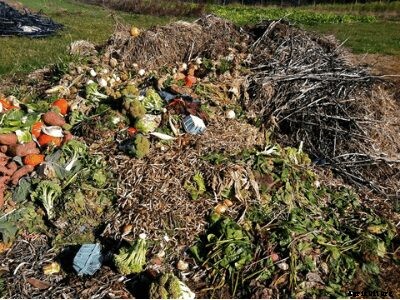 Finished Compost:
Compost finished is dark brown, crumbly and has an earthy smell. A well-built, well-tended pile typically yields finished compost in 2 weeks to 4 months, depending on the seasonal temperatures. An unattended pile made from unshredded material can take a decomposition time of more than a year.
Also, see: Ultimate Guide on Vermicomposting – Process, Techniques, and Worm Farming


